
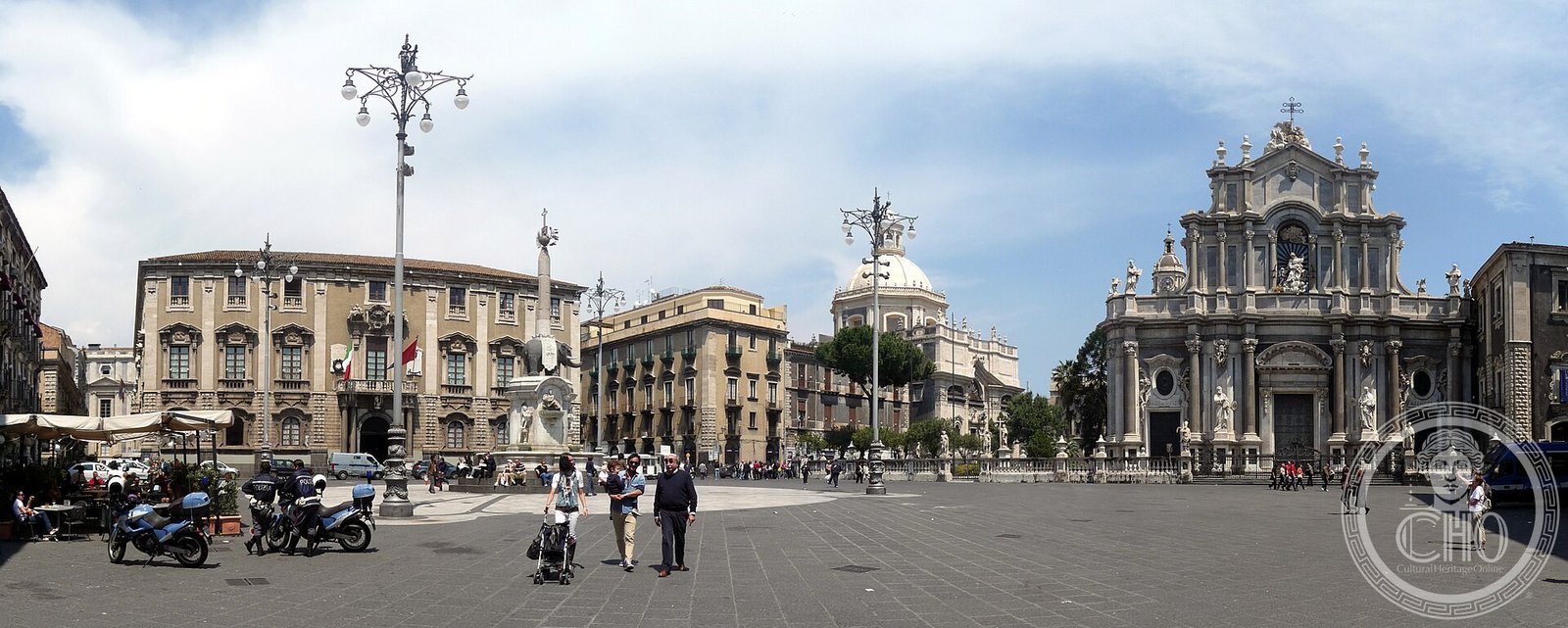
Catania is Sicily’s second-largest city, situated on the Ionian coast at the foot of Mount Etna, the most active volcano in Europe. Rebuilt almost entirely in distinctive black-and-white baroque style after the devastating earthquake of 1693, its historic centre is a UNESCO World Heritage Site (2002) shared with other Val di Noto baroque towns. From the volcanic stone facades of its cathedral and palaces to the vibrant fish market of La Pescheria, Catania presents one of the most coherent and dramatic urban landscapes in southern Italy.
At a glance
- Type
- Historic city centre (UNESCO World Heritage Site)
- Period
- Ancient Greek foundation (729 BCE); current urban fabric principally 1693–1730s (post-earthquake Baroque reconstruction)
- Style
- Sicilian Baroque; volcanic black lava stone (basalt) construction
- Location
- Catania, Metropolitan City of Catania, Sicily, Italy
- Coordinates
- 37.5023° N, 15.0873° E (city centre)
Overview
Catania occupies a position of unique geographic drama among Italian cities, spread across ancient lava flows on the lower slopes of Mount Etna with the Ionian Sea immediately to the east. The city is home to approximately 297,000 residents and is the hub of Sicily’s most densely populated metropolitan area, with strong university, transport, and commercial functions. Its historic centre, laid out by Giovanni Battista Vaccarini and other architects after the 1693 earthquake that destroyed 95 percent of the city, is widely regarded as one of the finest Baroque urban ensembles in Europe, characterised by the theatrical use of local black basalt stone contrasted with white limestone ornament.
History
Catania was founded as a Greek colony named Katane in 729 BCE and was subsequently ruled by Syracusans, Carthaginians, Romans, Byzantines, Arabs, Normans, Hohenstaufen, Aragonese, and Spanish before becoming part of unified Italy in 1861 — a succession that deposited extraordinarily rich cultural strata beneath the present city. The catastrophic earthquake of 11 January 1693, which killed an estimated 60,000 people across eastern Sicily, obliterated the medieval fabric and prompted the most ambitious urban reconstruction project in the history of the island. Under the direction of the Viceroy Juan Francisco Pacheco and architects including Vaccarini, a new city was built on a rational grid with wide streets designed to resist future seismic events and allow processional grandeur, using the basalt of Etna as the primary building material.
What you see
The centrepiece of the historic city is Piazza del Duomo, where Vaccarini’s Fontana dell’Elefante (1736) — a Roman basalt elephant topped by an Egyptian obelisk — stands as the city’s emblem in front of the Cathedral of Sant’Agata, whose facade combines volcanic black stone with white marble in a signature Catanese manner. The Via Etnea axis runs northward from the square straight toward the visible cone of Etna, a deliberate urban design gesture that makes the volcano a constant presence in city life. La Pescheria, the fish market operating in a sunken lava-stone basin off Piazza del Duomo, is one of the most theatrically atmospheric markets in Italy, alive every morning with the fish of the Ionian Sea and the raucous calls of vendors.
Cultural significance
UNESCO inscribed the Late Baroque Towns of the Val di Noto, including Catania, on the World Heritage List in 2002, recognising the post-1693 reconstruction as an outstanding achievement of urban planning and architectural invention. Catania is the birthplace of the composer Vincenzo Bellini (1801–1835), whose operas shaped the bel canto tradition; his tomb is in the cathedral and the Teatro Massimo Bellini remains a leading opera house. The city’s combination of ancient history, volcanic geology, Baroque urbanism, and living popular culture — expressed through its food markets, street food traditions, and festivals — makes it one of the most layered and compelling destinations in southern Italy.
Practical information
- Key sites
- Piazza del Duomo, Cathedral of Sant’Agata, Fontana dell’Elefante, La Pescheria, Teatro Massimo Bellini, Castello Ursino, Via Etnea
- Cathedral hours
- Monday–Saturday 07:30–12:00 and 16:00–19:00; Sunday 07:30–12:30 — verify on official website
- Admission
- Cathedral and most squares free; Castello Ursino admission charged
Getting there
Catania Fontanarossa Airport (CTA) is Sicily’s busiest airport, served by major European airlines and located just 5 km from the historic centre; buses (Alibus) and taxis connect it to the city in 15–20 minutes. By rail, Catania Centrale is the hub of the eastern Sicily network with connections to Messina (1 hr 20 min), Syracuse (1 hr), and Palermo (3 hrs via Messina). By road, the A18 motorway connects Catania to Messina in the north and Syracuse in the south; the A19 leads to Palermo. Within the historic centre, the historic tramway (Metro di Catania) and a network of bus lines serve the main squares and neighbourhoods.
Sources & resources
See the place
Find it on the map
See this place and what’s around it →📷 Become a Cultural Heritage Online photographer
Share your photos of places: they stay published under your name as the author. The more they're seen, the more you get noticed — and soon a contest will reward the most appreciated photos.
Log in or sign up free to add a photo