
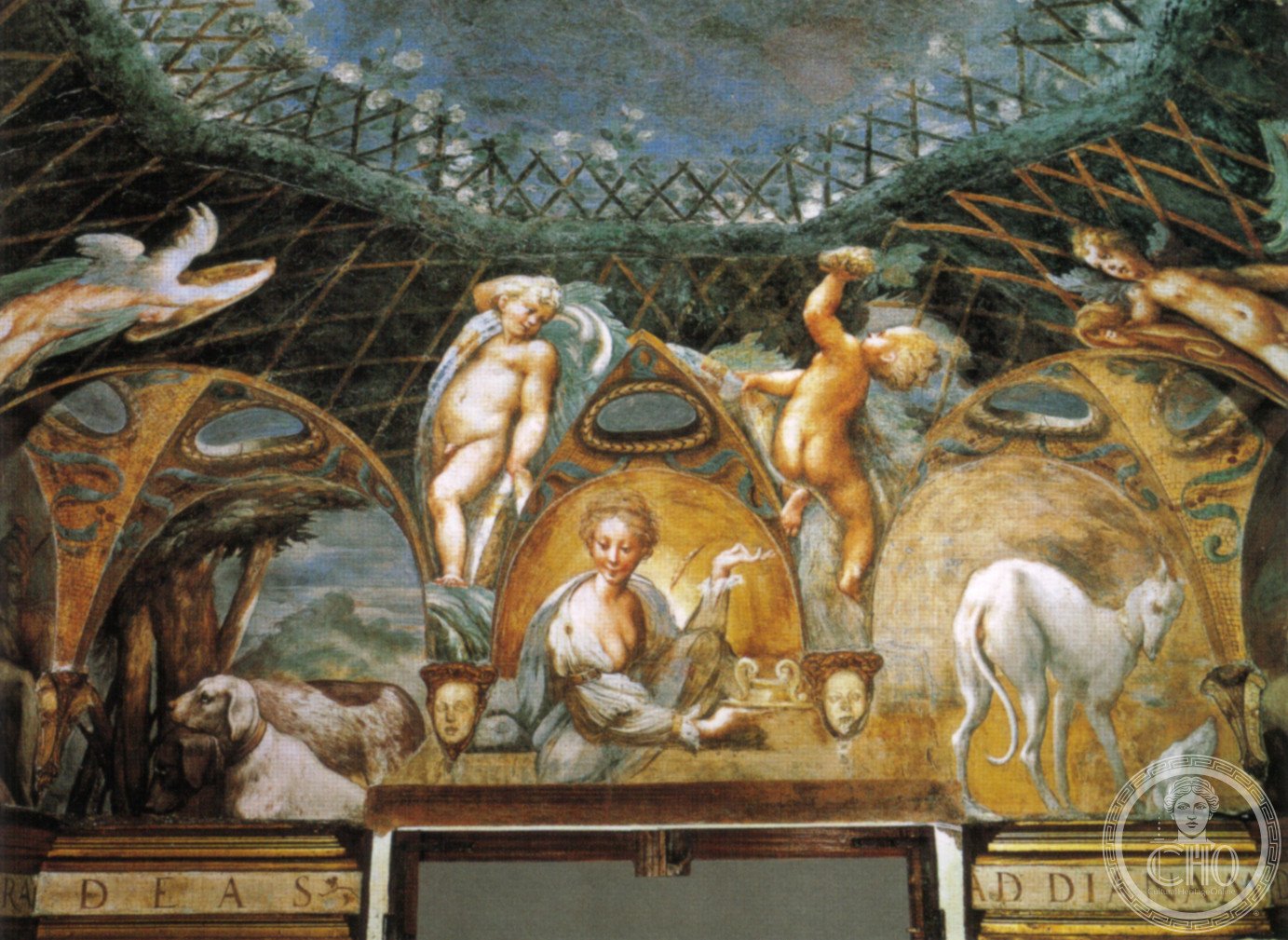
The Rocca Sanvitale is a perfectly preserved moated fortress residence in the centre of Fontanellato, near Parma in the Emilia-Romagna region of northern Italy. Begun in the thirteenth century and substantially completed by the fifteenth, the castle is celebrated above all for the intimate chamber known as the saletta di Diana e Atteone, whose walls and vault were frescoed in 1523 by Parmigianino with one of the masterpieces of early Italian Mannerism, commissioned by Paola Gonzaga and her husband Galeazzo Sanvitale.
At a glance
- Type
- Moated fortress-residence (rocca)
- Period
- 13th century (begun); substantially completed 15th century; embellishments to 18th century
- Style
- Medieval military architecture; Renaissance and Mannerist interior decoration
- Location
- Fontanellato, Province of Parma, Emilia-Romagna, Italy
- Coordinates
- 44.8826° N, 10.1728° E
Overview
The Rocca Sanvitale stands at the heart of Fontanellato’s compact historic centre, its quadrangular tower-block rising above a wide water-filled moat crossed by a drawbridge — one of the best-preserved examples of the urban castle-house that characterised the turbulent medieval communes of the Po Plain. Until the 1930s the castle remained the private home of the Sanvitale counts and their descendants, preserving its original furnishings, portraits, and decorative cycles in an exceptional state of continuity. It is now open to the public as a museum and is among the most visited historic residences in the Province of Parma.
History
Construction of the moated block began in the thirteenth century, and the castle was largely completed in its current form by the fifteenth century, when the Sanvitale family consolidated their lordship over the town and the surrounding territory. The most artistically significant episode in the castle’s history came in 1523, when the young painter Girolamo Francesco Maria Mazzola — known as Parmigianino — was commissioned by Galeazzo Sanvitale and his wife Paola Gonzaga to fresco a small private room with the myth of Diana and Actaeon. Embellishments to the apartments continued through the sixteenth, seventeenth, and eighteenth centuries, adding painted ceilings, tapestries, and period furnishings. The family retained ownership until the twentieth century, a remarkable continuity that ensured the survival of the interiors largely intact.
What you see
Visitors enter across the drawbridge spanning the surrounding moat and pass through the fortified gateway into the courtyard. The principal attraction is the Parmigianino room: an intimate chamber whose lunettes, spandrels, and vaulted ceiling are painted with a dense foliage pergola through which the figures of Diana, Actaeon, and attendant nymphs and hounds emerge in a continuous illusionistic landscape. Adjacent rooms preserve period furniture, dynastic portraits by local and Parma-school painters, a collection of arms and armour, and a ducal kitchen. The external tower provides views over the town and the flat agricultural landscape of the Parma plain.
Cultural significance
The Parmigianino fresco cycle in the Rocca Sanvitale is one of the earliest and most elegant examples of Mannerist decoration in northern Italy, predating the painter’s later and better-known Roman and Bolognese works and offering a rare glimpse of his style at its most intimate and experimental. The castle as a whole is a prototypical example of the signorial residence that shaped the urban landscape of the medieval and Renaissance Po Valley, making it an essential reference for understanding the culture of the Italian city-state.
Practical information
- Address
- Piazza Matteotti 1, 43012 Fontanellato PR
- Opening hours
- Typically open Tuesday–Sunday; check the official Rocca Sanvitale website for current seasonal hours
- Admission
- Paid entry; concessions available; check official website for current prices
Getting there
Fontanellato lies approximately 18 kilometres northwest of Parma city centre. By car, take the A1 motorway exit at Fidenza and follow provincial roads south to Fontanellato, or drive west from Parma on the Via Emilia and branch north. Parma is served by the Milano–Bologna high-speed rail corridor (Frecciarossa and Italo), with Fontanellato reachable by local bus or taxi from Parma station. SETA bus services connect Parma with Fontanellato on weekdays.
Sources & resources
See the place
Find it on the map
See this place and what’s around it →📷 Become a Cultural Heritage Online photographer
Share your photos of places: they stay published under your name as the author. The more they're seen, the more you get noticed — and soon a contest will reward the most appreciated photos.
Log in or sign up free to add a photoIs this page about you?
This page is read by travellers and heritage enthusiasts who find it on Google. Tell us how you are connected to this place and we will take it from there.