
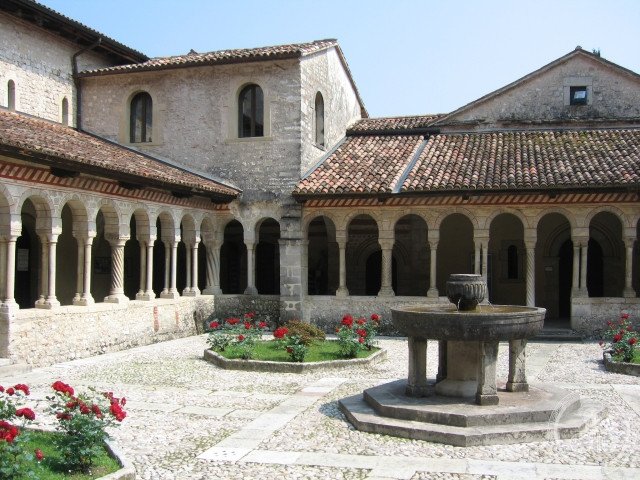
Follina is a historic village in the Treviso province of the Veneto, set among the vine-covered hills of the Conegliano Valdobbiadene Prosecco wine district, now a UNESCO World Heritage Site. Best known for the Cistercian Abbey of Santa Maria, the village also preserves a medieval street plan, traditional stone architecture, and a centuries-old connection to the wool trade and viticulture that shaped this corner of the Veneto foothills.
At a glance
- Type
- Historic hill village
- Period
- Medieval origins; documented from the 12th century
- Style
- Vernacular Veneto stone architecture
- Location
- Follina, Treviso province, Veneto, Italy
- Coordinates
- 45.9547° N, 12.1010° E
- Current designation
- Within UNESCO World Heritage Site — Conegliano Valdobbiadene Prosecco Hills (2019)
Overview
Follina occupies a narrow valley at the foot of the Dolomite foothills, watered by the Lierza stream whose mills once powered a flourishing wool industry. The village grew up around the Cistercian abbey founded here in the 12th century and retains a compact historic centre of stone houses, arcaded streets, and small piazzas typical of medieval Veneto settlements. Today Follina is also a gateway to the Prosecco wine route, with local producers offering tastings of the DOCG sparkling wine produced from the surrounding hillside vineyards.
History
The earliest documentary evidence for Follina dates to the 12th century, when a monastic community was established in the valley. The village developed as a service and market centre for the abbey and for the wool-working mills along the Lierza, which remained the economic backbone of the community through the Renaissance. Under Venetian rule from the 15th century, Follina participated in the broader agricultural and commercial network of the Treviso hill country. The 19th century brought significant change with the suppression of monastic communities under Napoleon and the subsequent decline of the wool industry, but viticulture expanded to fill the economic gap, a transformation that laid the foundations for the Prosecco heritage recognised today.
What you see
The historic centre of Follina is compact and easily explored on foot. The principal monument is the Cistercian abbey with its celebrated Romanesque cloister and Gothic church, which dominates the village square. Around the piazza, arcaded buildings in local stone recall the medieval market character of the settlement. The Lierza stream runs through the village, and traces of the old mill infrastructure survive in some properties. Beyond the built fabric, the surrounding landscape of terraced vineyards on steep hillsides — designated UNESCO heritage — provides a dramatic backdrop and excellent walking routes through the Prosecco country.
Cultural significance
Follina represents the layered heritage of the Veneto foothills, where medieval religious architecture, craft industry, and centuries of viticulture have combined to create a distinctive cultural landscape. Its inclusion within the UNESCO-recognised Conegliano Valdobbiadene Prosecco Hills acknowledges the inseparability of human settlement and agricultural practice in shaping this scenery. The village serves as an exemplar of the small-scale, community-centred heritage that UNESCO increasingly protects alongside individual monuments.
Practical information
- Address
- Follina, Treviso, Veneto, Italy
- Opening hours
- Village accessible at all times; abbey visiting hours vary — see Cistercian Abbey of Santa Maria listing
Getting there
Follina is located approximately 30 km north of Treviso and 70 km north of Venice, in the Valdobbiadene valley. By car, take the A27 motorway and exit at Vittorio Veneto Sud, then follow the SS635 through the Prosecco hills. Local bus routes connect Follina with Treviso and Vittorio Veneto. The closest rail station is Vittorio Veneto on the Treviso–Calalzo line, from which local buses run to Follina.
Sources & resources
See the place
Find it on the map
See this place and what’s around it →Historical events at this place (1)
- 2019 Ars in tempore
📷 Become a Cultural Heritage Online photographer
Share your photos of places: they stay published under your name as the author. The more they're seen, the more you get noticed — and soon a contest will reward the most appreciated photos.
Log in or sign up free to add a photo