
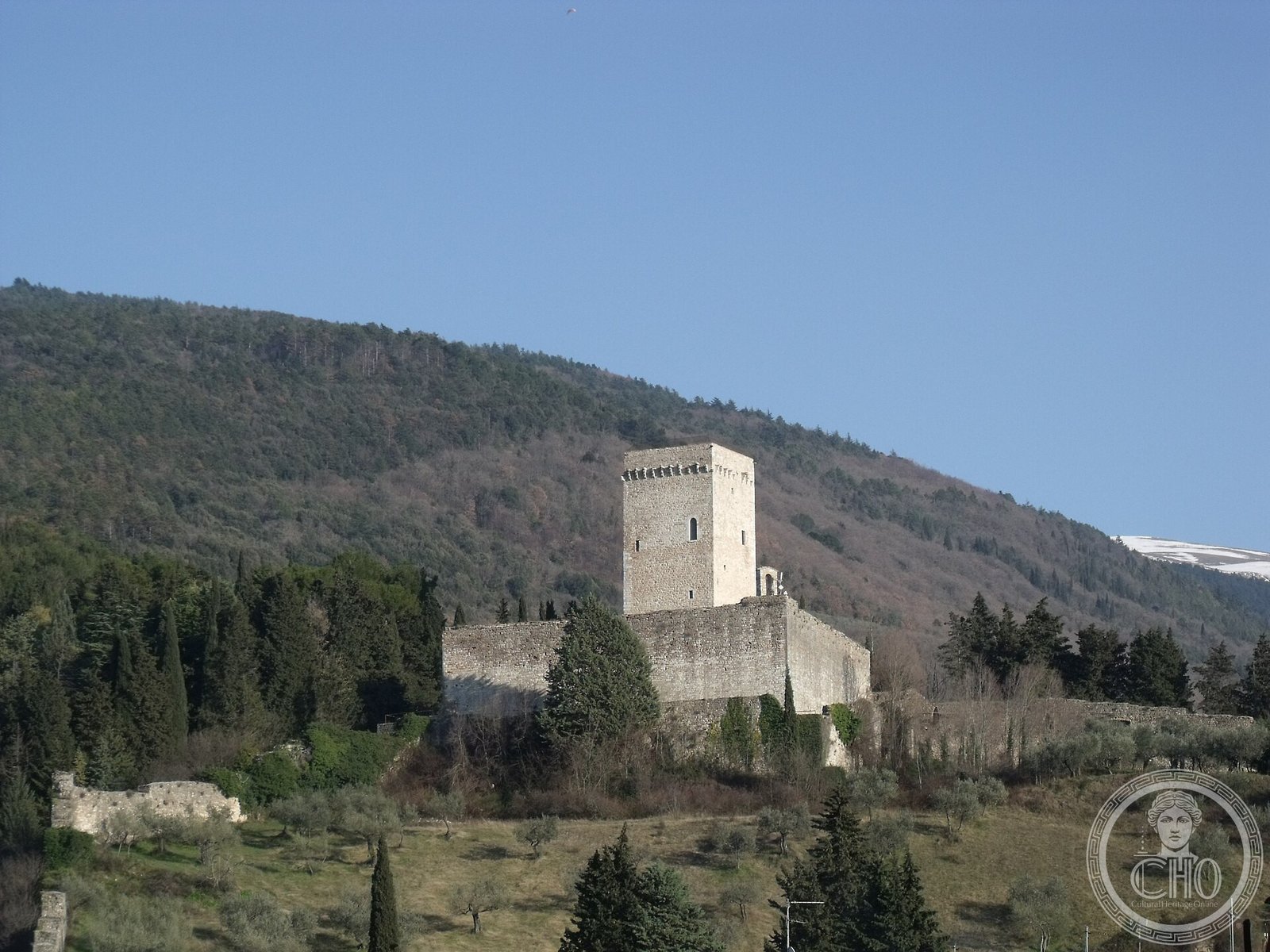
Rocca Minor is a medieval fortress perched on the hillside of Assisi in Umbria, central Italy, positioned below the larger and better-known Rocca Maggiore. Built as part of Assisi’s system of defensive works in the 13th and 14th centuries, the smaller rocca served as a complementary fortification guarding the approaches to the city from the east. Today it stands as a tangible remnant of the fortified landscape that defined Assisi during the communal and signorial periods of Italian medieval history.
At a glance
- Type
- Medieval fortification (rocca)
- Period
- 13th–14th century; modified in subsequent centuries
- Style
- Medieval military architecture, Umbrian stone construction
- Location
- Assisi, Province of Perugia, Umbria, Italy · 43.0713° N, 12.6215° E
Overview
Assisi’s defensive system comprised two distinct fortresses: the dominant Rocca Maggiore on the summit and the smaller Rocca Minor lower on the slope, together providing layered control over the town and the surrounding Umbrian valley. The minor rocca, while less imposing than its counterpart, played an important role in the military strategy of medieval Assisi and bears witness to the complex political history of the region during the struggles between the papacy, the Holy Roman Empire, and the local commune. The site offers views over the olive-covered slopes below Assisi and forms part of the historic townscape inscribed on the UNESCO World Heritage List.
History
Assisi’s fortifications were developed and modified across several centuries of turbulent medieval politics, beginning with the original construction of defensive works in the 13th century when the city was contested between imperial and papal factions. The Rocca Maggiore was rebuilt by Cardinal Albornoz in 1367 on behalf of the papacy to reassert control over the region; the Rocca Minor, positioned as a secondary defensive element, was part of the same strategic system. Over the following centuries the fortresses gradually lost their military function as Umbria came under stable papal administration, and both rocche became landmarks of Assisi’s historic silhouette.
What you see
The Rocca Minor presents the characteristic masonry of Umbrian medieval military architecture, built from the same warm local limestone that gives Assisi its distinctive rosy-golden appearance. The remaining walls and tower stubs rise above terraced slopes thick with olive trees, creating a picturesque ensemble that has been part of Assisi’s celebrated historic landscape for centuries. From the site, visitors can appreciate the strategic logic of the two-fortress system, with the Rocca Maggiore visible on the ridge above and the Umbrian valley spread below.
Cultural significance
Rocca Minor forms part of the historic fortified landscape of Assisi, a UNESCO World Heritage Site inscribed in 2000 primarily for its Franciscan monuments but encompassing the full medieval townscape. The fortress is a material witness to the political and military history of Umbria during the medieval period and complements the Franciscan spiritual heritage for which Assisi is internationally famous.
Practical information
- Location
- Assisi, Province of Perugia, Umbria, Italy
- Access
- The fortress ruins are visible from the surrounding paths; check local tourism offices for current access
- Nearby
- Basilica di San Francesco (0.5 km), Rocca Maggiore (0.3 km), Piazza del Comune (0.4 km)
Getting there
Assisi is served by the Santa Maria degli Angeli train station, approximately 5 km from the historic centre, with frequent bus connections to the town. By car, Assisi is accessible via the SS75 motorway from Perugia (about 25 km). Within Assisi, the Rocca Minor is reachable on foot via the medieval lanes climbing the hillside; the walk from Piazza del Comune takes approximately 10–15 minutes. Electric minibuses serve the town’s historic core.
Sources & resources
See the place
Find it on the map
See this place and what’s around it →📷 Become a Cultural Heritage Online photographer
Share your photos of places: they stay published under your name as the author. The more they're seen, the more you get noticed — and soon a contest will reward the most appreciated photos.
Log in or sign up free to add a photo