
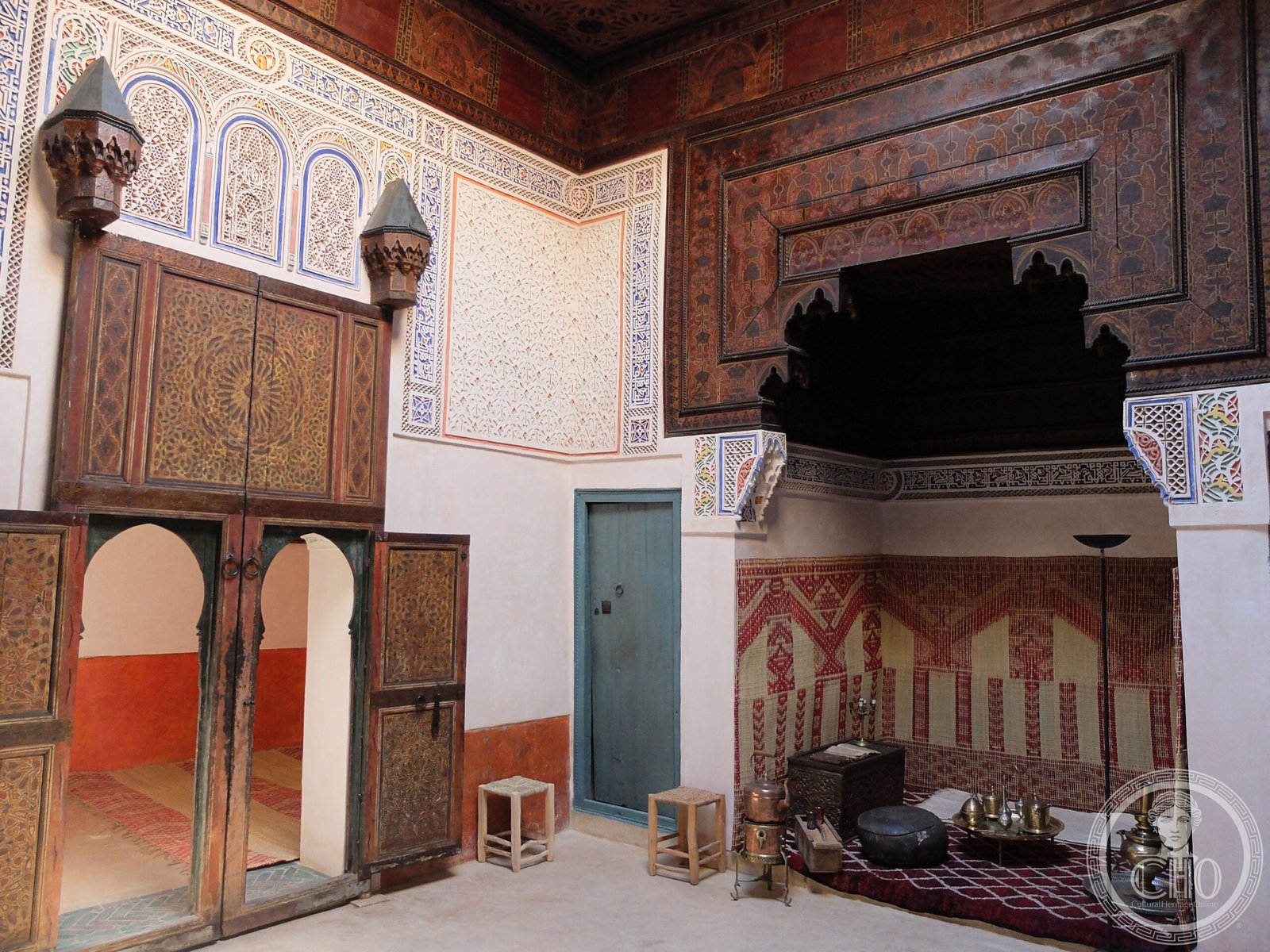
The Museum of Mouassine, housed in the Douiria Derb el Hammam, is a private ethnographic museum occupying a restored 16th-century Saadian-era upper floor dwelling (douiria) in the Mouassine quarter of Marrakesh’s medina. The collection focuses on traditional Moroccan domestic life, craftsmanship, and decorative arts, with particular attention to the Saadian and early Alaouite periods. Its intimate scale and location within an authentic historic neighbourhood make it one of the most atmospheric museums in Marrakesh.
At a glance
- Type
- Ethnographic and decorative arts museum
- Period
- Building: 16th century (Saadian era); museum established 21st century
- Style
- Traditional Moroccan courtyard architecture (riad/douiria form)
- Location
- Mouassine quarter, Marrakesh medina, Morocco
- Coordinates
- 31.6295° N, 7.9915° W
Overview
The Mouassine quarter is one of the oldest and best-preserved neighbourhoods of the Marrakesh medina, developed during the Saadian dynasty in the 16th century around the Mouassine Mosque and its monumental fountain — one of the finest public monuments of the era. The Museum of Mouassine occupies a douiria, a term denoting an upper-floor residential annex of a larger private compound, and its rooms retain original stucco, zellij tilework, and carved cedar ceilings that communicate the luxury of Saadian domestic architecture to an extraordinary degree.
History
The Mouassine district was laid out in the 1550s–1560s under Sultan Abdallah al-Ghalib, who funded the mosque, fountain, and surrounding charitable infrastructure. The douiria at Derb el Hammam belonged to a prosperous urban household and passed through various uses over the centuries, falling into disrepair during the 20th century. Its restoration and conversion into a museum was undertaken to safeguard one of the most intact examples of 16th-century domestic architecture in Marrakesh, enabling public access to spaces normally sealed within private ownership.
What you see
Visitors enter through a discreet door in a narrow alley and ascend to rooms arranged around a small interior courtyard. The galleries present objects of Moroccan material culture: embroidered textiles, silver jewellery, painted wooden chests, hammered copper vessels, ceramics, and traditional garments. The architectural fabric itself is an exhibit — original stucco panels carved with geometric and floral programmes, painted timber ceilings, and zellij dados all dating to the Saadian period. The terrace affords views over the medina rooftops toward the Koutoubia minaret.
Cultural significance
The Museum of Mouassine provides a rare interior experience of Saadian-era domestic architecture at a time when many comparable structures remain inaccessible within private ownership or have been converted into tourism riads that obscure the original spatial logic. Its location in the Mouassine quarter — among the best-preserved 16th-century urban fabric in Morocco — makes it an important resource for understanding pre-colonial Moroccan urban culture and craftsmanship.
Practical information
- Address
- Derb el Hammam, Mouassine quarter, Marrakesh medina, Morocco
- Admission
- Ticketed entry; check current prices on arrival or official sources
Getting there
The museum is located in the Mouassine quarter of the medina, approximately 10–12 minutes on foot from Jemaa el-Fna square via the main souks. From the Mouassine fountain (a notable landmark), the entrance is a short walk through the Derb el Hammam alley. Petits taxis can drop visitors at the nearest medina gate; the final stretch is on foot through pedestrian alleyways.
Sources & resources
See the place
Find it on the map
See this place and what’s around it →📷 Become a Cultural Heritage Online photographer
Share your photos of places: they stay published under your name as the author. The more they're seen, the more you get noticed — and soon a contest will reward the most appreciated photos.
Log in or sign up free to add a photo