
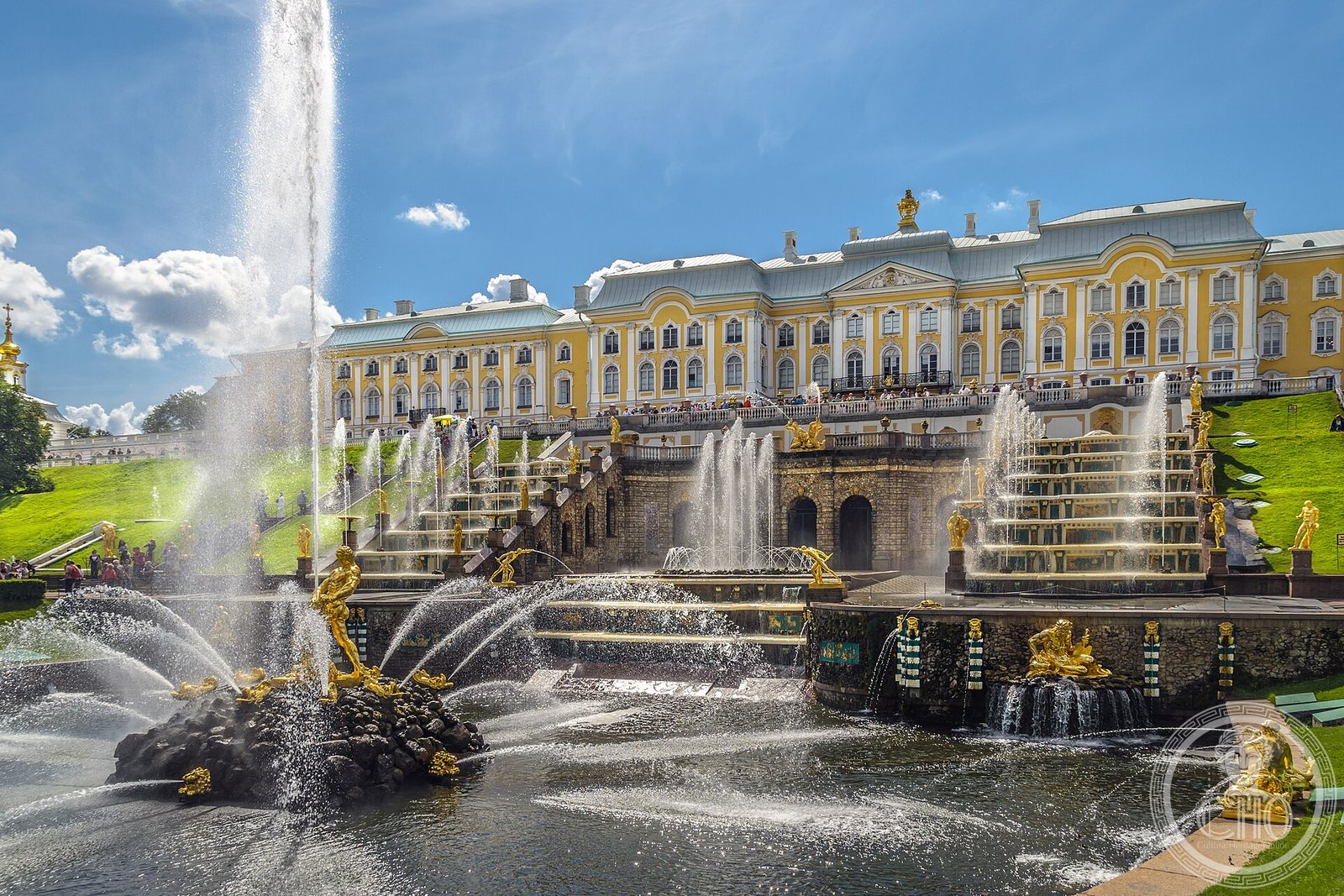
Peterhof Palace is a monumental ensemble of palaces and gardens situated on the Gulf of Finland coast near Saint Petersburg, commissioned by Peter the Great as Russia’s answer to the Palace of Versailles. Built between 1714 and 1728 by Domenico Trezzini and expanded by Francesco Bartolomeo Rastrelli from 1747 to 1756, the complex is celebrated for its Grand Cascade of 64 fountains fed entirely by natural springs without pumping machinery. Together with Saint Petersburg’s historic centre, it is a UNESCO World Heritage Site.
At a glance
- Type
- Imperial palace and garden ensemble
- Period
- 1714–1756 (principal construction); Petrine Baroque and Rococo
- Style
- Petrine Baroque (main palace); formal French and English gardens
- Location
- Petergof, Saint Petersburg Oblast, Russia
- Coordinates
- 59.8863° N, 29.9064° E
Overview
Peterhof Palace — known as “The Russian Versailles” — is one of the most spectacular royal estates in the world, drawing millions of visitors annually to its gilded halls and legendary fountain system. The complex covers more than 300 hectares and encompasses the Grand Palace, the Lower Gardens, the Upper Gardens, and dozens of smaller pavilions and fountains. Commissioned by Peter the Great following his 1717 visit to Versailles, it was intended to proclaim the power and sophistication of the new Russian Empire.
History
Peter the Great first visited the site in 1709 and directed initial construction to begin in 1714. The architect Domenico Trezzini shaped the early Petrine Baroque style that became the aesthetic signature of Saint Petersburg itself. Jean-Baptiste Alexandre Le Blond, a former collaborator with Versailles landscaper André Le Nôtre, designed the garden layouts in 1714. Empress Elizabeth commissioned Francesco Bartolomeo Rastrelli to dramatically expand and enrich the palace between 1747 and 1756, adding the opulent Rococo interiors still visible today.
What you see
The Grand Cascade, descending from the Great Palace to the Marine Canal, comprises 64 fountains, 255 statues, and nearly 2,000 decorative elements — all powered by gravity-fed natural springs without a single pump. The gilded Samson Fountain at the cascade’s foot symbolises Russia’s victory over Sweden. Inside the Grand Palace, the throne room, ballrooms, and portrait galleries feature original Baroque and Rococo decorative programmes restored after wartime destruction during World War II.
Cultural significance
Peterhof is inscribed as part of the UNESCO World Heritage Site “Historic Centre of Saint Petersburg and Related Groups of Monuments” (1990), reflecting its outstanding universal value as a supreme achievement of Baroque landscape art. The complex represents a pivotal moment in Russian cultural history — Peter the Great’s deliberate effort to situate Russia within European civilisation — and its fountains remain an engineering marvel studied worldwide.
Practical information
- Address
- Razvodnaya Ulitsa 2, Peterhof, Saint Petersburg 198516, Russia
- Hours
- Gardens open daily; Grand Palace closed Mondays — check official website for current schedule
- Admission
- Separate tickets for gardens, Grand Palace, and individual pavilions; check official website for current prices
Getting there
From Saint Petersburg, the most scenic route is by hydrofoil (Meteor) from the Hermitage landing stage near the Winter Palace, operating May through October. Alternatively, marshrutka minibuses and suburban trains depart from Baltiysky Station to Noviy Petergof, followed by a short bus or taxi ride to the Lower Gardens entrance.
Sources & resources
See the place
Find it on the map
See this place and what’s around it →📷 Become a Cultural Heritage Online photographer
Share your photos of places: they stay published under your name as the author. The more they're seen, the more you get noticed — and soon a contest will reward the most appreciated photos.
Log in or sign up free to add a photo