The least known of Italy’s overseas territories is not in Africa or the Mediterranean but in northern China. From 1901 to the Second World War, Italy held a concession in the treaty port of Tianjin (Tientsin) — 458,000 square metres on the Hai river, its only possession in Asia and one of the smallest foreign quarters in China. A century later, the quarter not only survives: the city of Tianjin has restored it, block by block, as the “Italian Style Town” — the largest ensemble of Italian architecture in Asia, and one of history’s stranger returns.
The context, stated plainly
The concession was a product of imperialism by treaty. Italy took part in the international expedition that crushed the Boxer uprising in 1900 — a campaign whose violence against the Chinese population is documented in the general historiography of the intervention — and obtained its quarter through the Boxer Protocol of 7 September 1901, alongside the powers that already ringed Tianjin with concessions: Britain, France, Germany, Japan, Russia, Austria-Hungary, Belgium. Within the quarter, sovereignty was Italian, justice was Italian, and the Chinese majority who lived and worked there did so under a foreign administration. That is the frame; the architecture sits inside it.
A garden quarter on the Hai river
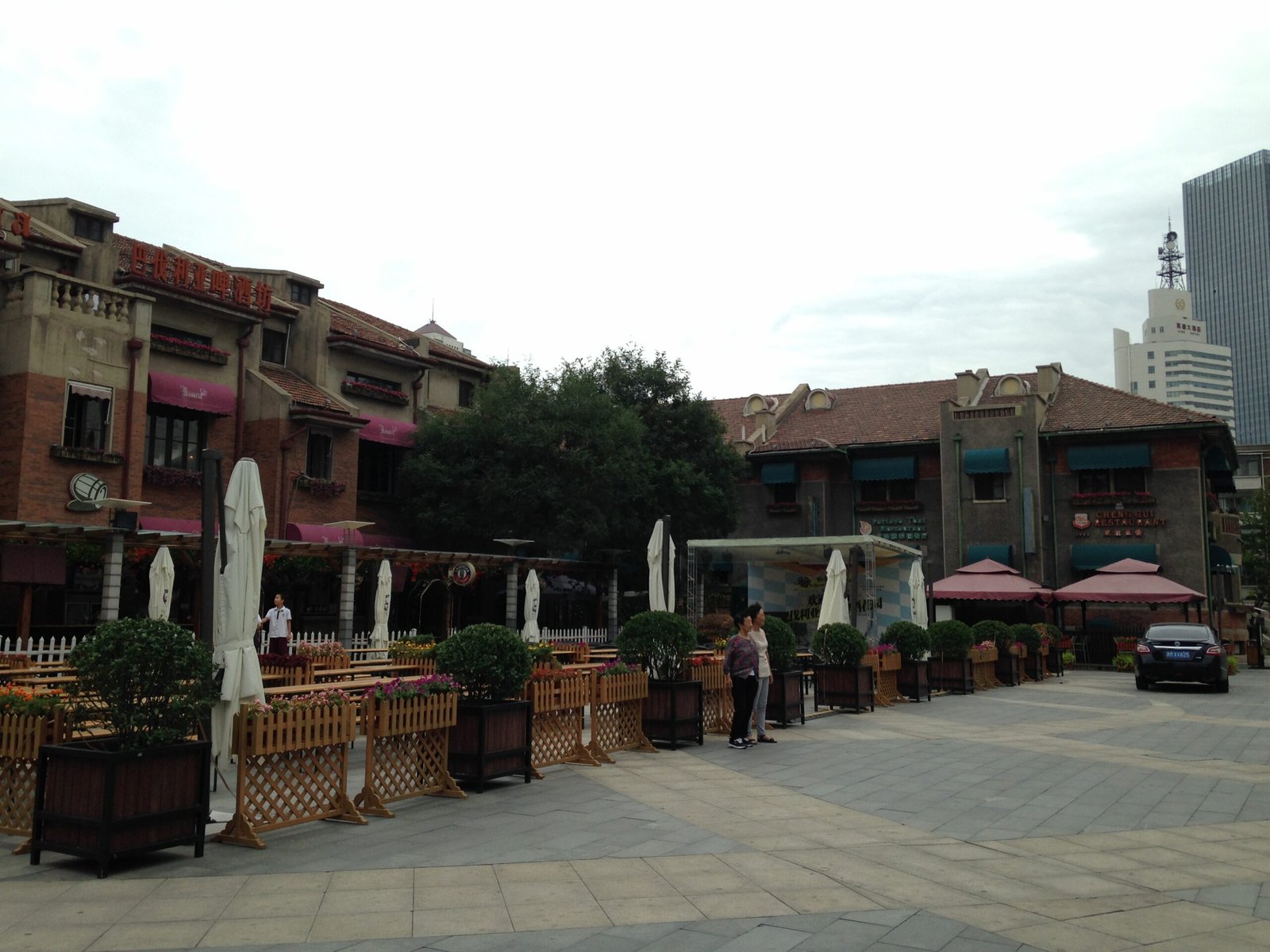
The ground Italy received was salt flat and marsh. Through the 1900s–1930s the administration drained it and laid out a miniature model town: tree-lined avenues named for the royal family and for Italian cities — Via Roma, Via Trento, Via Trieste, Corso Vittorio Emanuele III — lined with two- and three-storey Liberty and eclectic villas, their loggias and ironwork closer to a Ligurian garden suburb than to anything else on the China coast. At the centre, Piazza Regina Elena held the monument to Italy’s First World War dead; the architect Giuseppe Boni gave the quarter a monumental fountain dedicated to Marco Polo; consulate and Casa del Fascio, schools and the Ermanno Carlotto barracks — home of the San Marco marines — completed the public fabric. The streets carried double Sino-Italian names; the Italian residents numbered in the hundreds, the Chinese residents many times more.
The end, and the second life
The war dissolved the experiment. After the armistice of September 1943 the quarter was occupied by Japanese forces and ceded on paper by Mussolini’s Social Republic; the peace treaty returned it formally to China in 1947. Unlike almost every other foreign concession in China, the Italian quarter then survived the century largely intact — through revolution, the Cultural Revolution and the building booms that erased most treaty-port fabric elsewhere. Between 2005 and 2008 the Tianjin municipality restored more than 200 buildings and reopened the quarter as a commercial and tourist district centred on the renamed Marco Polo Square, its column crowned by a rebuilt “Goddess of Peace”. The restoration is scenographic — the quarter is a leisure destination, not a museum — but the fabric is original, and the district is documented in this archive’s card on the former Italian concession.
Life in the quarter
The concession’s daily reality was stranger than its architecture. A few hundred Italians — consular staff, the San Marco marines of the Carlotto barracks (named for Ermanno Carlotto, a naval officer killed in the Boxer campaign), traders, missionaries — administered a quarter whose population was overwhelmingly Chinese, under double street names and double jurisdictions. During the Japanese invasion of 1937 the foreign concessions of Tianjin became refuges for thousands displaced from the surrounding city, the Italian quarter among them. And in September 1943 the armistice reached even here: the garrison faced the choice between surrender to Japanese forces and internment — most refused adhesion to Mussolini’s republic and were deported to prison camps, a little-known episode of the Italian resistance abroad, documented by the naval historiography.
What it teaches
Tianjin closes this series with its clearest lesson. From Asmara to Tirana to the Hai river, the built legacies of Italian expansion have had second lives their builders never imagined — listed by UNESCO, adopted as government quarters, restored as heritage by the very societies once ruled from them. None of this redeems the rule that built them; all of it explains why the record is worth keeping. Architecture outlives its politics, and documenting it — what was built, by whom, when, under what power — is how both the building and the history stay visible. The facts speak; the reader judges.
Places of the Italian concession in this archive
- The former Italian concession of Tianjin (Italian Style Town) — 1901–1947, restored 2005–2008
- Marco Polo Square and the Boni fountain — documented within the concession card
- The consulate, schools and Carlotto barracks — documented within the concession card
This is the seventh and final piece in the series on Italy’s overseas territories, after Libya, Eritrea, the Dodecanese, Italian East Africa, Somalia and Albania.