
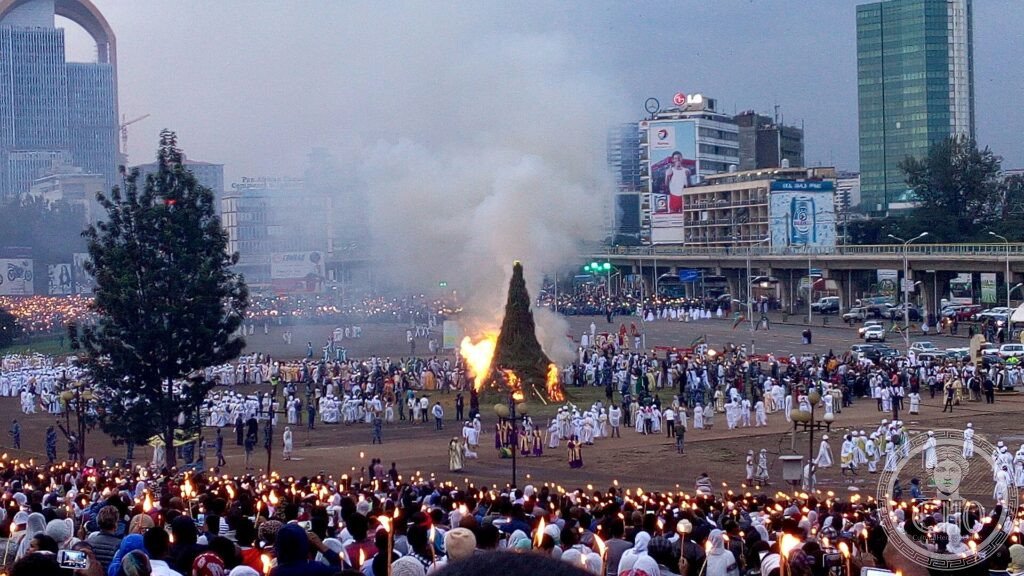
A sacred Orthodox Christian commemoration of the discovery of the True Cross, Meskel unites Ethiopia in ritual celebration, public gathering, and the ceremonial burning of the Demera bonfire each September.
In UNESCO’s words
The festival of Maskel is celebrated across Ethiopia on 26 September to commemorate the unearthing of the True Holy Cross of Christ. Celebrations begin with the building of the Damera bonfire in Maskel Square in Addis Ababa – a conical pyre of poles surrounded by bundles of branches and torches, decorated with green grass and Abyssinian daisies symbolizing the New Year. Hundreds of thousands of people from diverse communities flock to the square as colourfully dressed priests chant hymns and prayers and perform their unique rhythmic dance in front of the pyre. At the climax, the patriarch of the Ethiopian Orthodox Tewahedo Church lights the bonfire. Maskel is celebrated nationwide regardless of age, gender, language or ethnicity. Participants are believed to receive spiritual rewards from the celebration and blessings from the Holy Cross. Local churches play a key role in coordinating communities and safeguarding the element. The festival is also a time when families get together and migrant workers return home – reunions that result in the inflow of money, information and new ideas from urban centres to rural areas. Prior to the celebration, personal quarrels and social disagreements must be resolved. In this way, Maskel is an occasion for Ethiopians to promote their spiritual life through reconciliation, social cohesion and peaceful coexistence.
Official description, UNESCO Intangible Cultural Heritage List — Commemoration feast of the finding of the True Holy Cross of Christ
At a glance
Maskel is an annual festival celebrated across Ethiopia on 26 September to commemorate the unearthing of the True Holy Cross of Christ. The centrepiece is the Damera—a conical bonfire built from poles, branches and torches, decorated with green grass and Abyssinian daisies that symbolize the New Year. Hundreds of thousands of people gather as priests in colourful dress chant hymns and prayers and perform rhythmic dances before the patriarch lights the bonfire. The celebration welcomes participants of all ages, genders, languages and ethnicities.
Origins & history
Maskel is rooted in the wider tradition of the Feast of the Cross observed across Oriental Orthodox Christianity, and has become localized to Ethiopia. The festival commemorates the discovery of the True Holy Cross of Christ, an event central to Christian devotion in the Orthodox tradition.
The practice
Maskel Square in Addis Ababa serves as the main ceremonial centre, though the festival is celebrated nationwide. Hundreds of thousands gather as colourfully dressed priests chant hymns and prayers and perform their unique rhythmic dance in front of the Damera bonfire. Local churches coordinate communities and play a key role in safeguarding the celebration. The festival also brings families together, with migrant workers returning home—creating an inflow of money, information and new ideas from urban centres to rural areas.
Cultural significance
Maskel promotes spiritual life through reconciliation, social cohesion and peaceful coexistence. Before the celebration, personal quarrels and social disagreements must be resolved. Participants are believed to receive spiritual rewards and blessings from the Holy Cross. The festival strengthens community bonds across age, gender, language and ethnicity, making it an occasion for Ethiopians to affirm their shared spiritual and social identity.
Key facts
- Country: Ethiopia
- Inscribed: 2013
- UNESCO list: Representative List of the Intangible Cultural Heritage of Humanity
- UNESCO reference: 00858
- UNESCO vocabulary: Festivals; Orthodox Churches; Procession; Religious practice
- Map: Maskel Square in Addis Ababa — the locality named in UNESCO’s official description of this element
Where to experience it
Maskel is celebrated nationwide across Ethiopia on 26 September, with the most prominent gathering at Maskel Square, where hundreds of thousands assemble to witness the lighting of the Damera bonfire by the patriarch of the Ethiopian Orthodox Tewahedo Church. Colourfully dressed priests chant hymns and perform rhythmic dances as the conical pyre, decorated with green grass and Abyssinian daisies, burns at the climax of the ceremony. Local churches throughout the country coordinate community celebrations, making this festival accessible to participants of all ages, genders, languages and ethnicities. Many Ethiopians who have migrated to urban centres or abroad return home during this time to reunite with families and communities.
Sources & resources
- UNESCO — official element page: Commemoration feast of the finding of the True Holy Cross of Christ
- UNESCO — open data record: Intangible Heritage List, reference 00858
- UNESCO — official video: UNESCO film on this element — embedded on this page
- UNESCO — official photograph: Photograph of this element — Aba Kiros Weldab — Authority for Research and Conservation of Cultural Heritage (ARCCH), 2011
- Reference — Wikipedia (secondary): Meskel — consulted as a secondary reference, not as confirmation
- Cultural Heritage Online: Our archive and city guides

Find it on the map
See this place and what’s around it →📷 Become a Cultural Heritage Online photographer
Share your photos of places: they stay published under your name as the author. The more they're seen, the more you get noticed — and soon a contest will reward the most appreciated photos.
Log in or sign up free to add a photo