
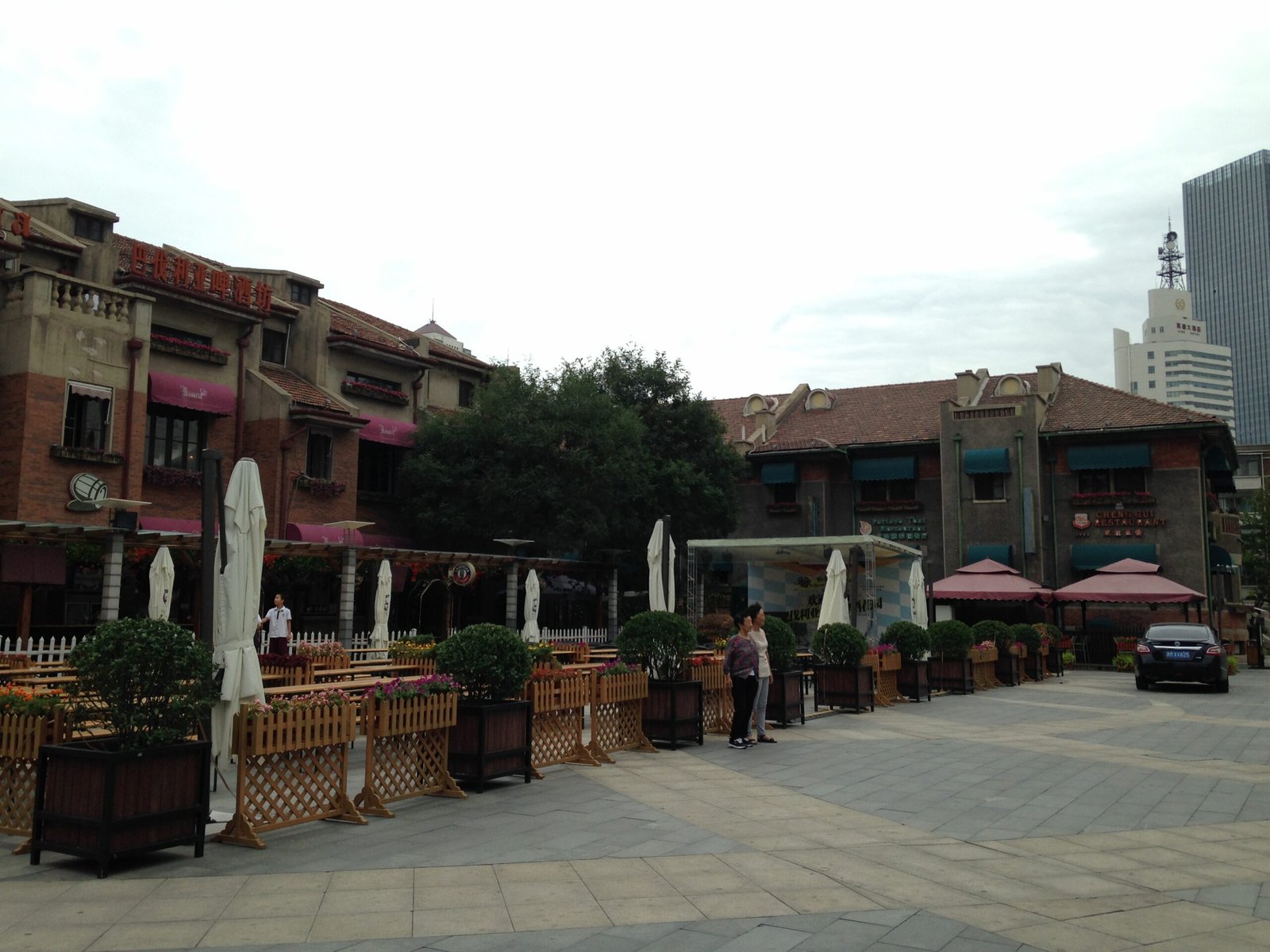
Italy’s only possession in Asia: a 46-hectare quarter of Liberty villas and tree-lined avenues on the Hai river, held from 1901 to the Second World War. Restored by the Tianjin municipality in the 2000s, it is today the “Italian Style Town” — the largest surviving ensemble of Italian architecture in Asia.
At a glance
The Italian concession of Tientsin (Tianjin) was established on 7 September 1901 by the Boxer Protocol, the treaty that closed the Boxer uprising: 458,000 square metres on the right bank of the Hai river — one of the smallest of the foreign concessions in China, and the only Italian one. Over the following decades the Italian administration drained the marshy ground and laid out a small model quarter: Liberty and eclectic villas, wide avenues named for the royal family and for Italian cities — Via Roma, Via Trento, Via Trieste — a central Piazza Regina Elena with the First World War memorial, a monumental Marco Polo fountain by the architect Giuseppe Boni, the consulate with its Casa del Fascio, schools and the Ermanno Carlotto barracks. Administered until 1943 and formally returned to China in 1947, the quarter survived intact; between 2005 and 2008 the Tianjin municipality restored more than 200 of its buildings as the “Italian Style Town”, today a popular commercial and tourist district centred on the renamed Marco Polo Square.
Key facts
- Established: 7 September 1901, Boxer Protocol
- Area: 458,000 m² on the Hai river — Italy’s only Asian possession
- Fabric: Liberty and eclectic villas, Piazza Regina Elena (today Marco Polo Square), Marco Polo fountain by Giuseppe Boni, consulate, schools, Carlotto barracks
- Administered: 1901–1943; returned to China 1947
- Restoration: 2005–2008, more than 200 buildings — today the “Italian Style Town”
History
Italy joined the international expedition against the Boxer uprising in 1900 and received, with the other powers, a concession in Tianjin — the treaty port where Britain, France, Germany, Japan, Russia, Austria-Hungary and Belgium already held quarters. The Italian zone, initially salt flats and marsh, was reclaimed and built up in the 1900s–1930s as a showcase in miniature: a European garden quarter whose streets carried a double Sino-Italian naming. Its garrison — the San Marco marines of the Carlotto barracks — and its small administration made it more an outpost of prestige than of profit; the resident Italian community numbered in the hundreds, beside a much larger Chinese population.
The Second World War ended the experiment: after the armistice of September 1943 the concession was occupied by Japanese forces, ceded on paper by the Italian Social Republic, and formally returned to China by the peace treaty of 1947. The quarter passed through the following decades largely intact, and in the 2000s the municipality chose restoration over redevelopment — a Chinese city conserving an Italian colonial quarter as part of its own heritage, the same paradox of re-appropriation this series has met from Asmara to Tirana.
What you see
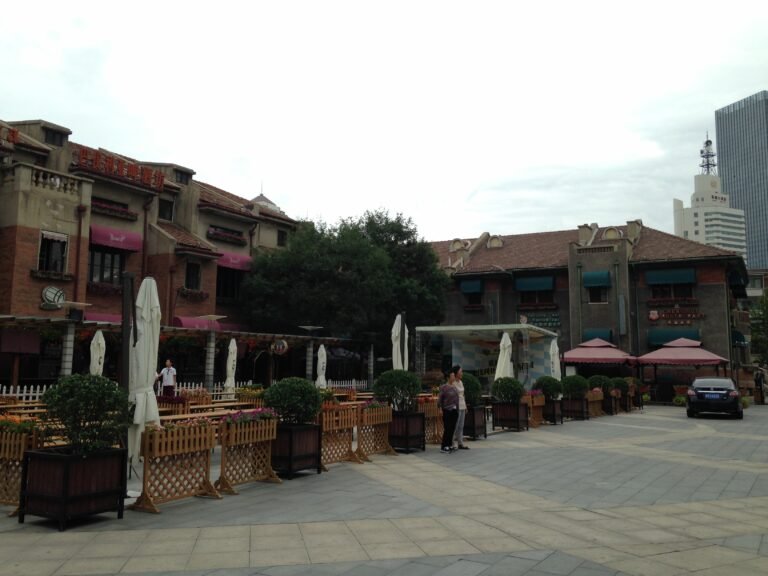
The district reads as a compact grid of two- and three-storey villas — loggias, turrets, rusticated bases, Liberty ironwork — around Marco Polo Square, where a column bearing the rebuilt “Goddess of Peace” stands on the site of the war memorial. The former consulate, barracks and schools survive among cafés and restaurants; the riverfront that was once the Banchina d’Italia faces the Hai. The restoration favoured scenography over philology — the quarter is a leisure district now — but the urban fabric and most of the buildings are the originals.
Visiting
The Italian Style Town lies in Hebei district, central Tianjin, on the north bank of the Hai river opposite Tianjin Station; it is free to walk and among the city’s main visitor areas. Tianjin is 30 minutes from Beijing by high-speed rail. GPS: 39.13466, 117.19190 (Google Maps).
Related places and reading
- Mother Teresa Square, Tirana — another Italian ensemble re-used by its inheritors
- Asmara — the largest case of colonial fabric re-appropriated
- The overseas territories series — from Libya to Tianjin
Sources
- Boxer Protocol (7 September 1901) and documentation on the Italian concession of Tientsin (1901–1947).
- Studies and reporting on the quarter’s fabric (Giuseppe Boni’s Marco Polo fountain; consulate, schools, Carlotto barracks).
- Documentation on the 2005–2008 restoration and the “Italian Style Town” district.
- OpenStreetMap/Nominatim (coordinates).
Find it on the map
See this place and what’s around it →Record researched and written by Luigi De Marchi for Cultural Heritage Online, 2026.
📷 Become a Cultural Heritage Online photographer
Share your photos of places: they stay published under your name as the author. The more they're seen, the more you get noticed — and soon a contest will reward the most appreciated photos.
Log in or sign up free to add a photo