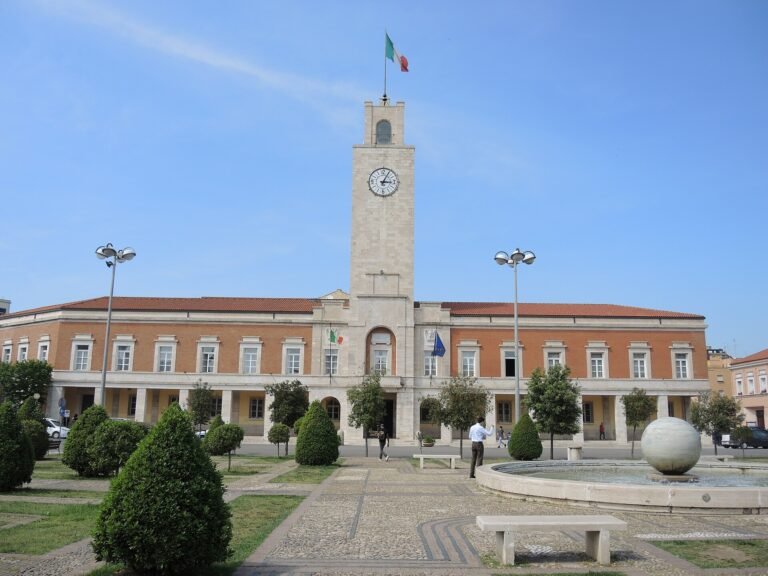
Between celebrated Latina and celebrated Sabaudia sits the Pontine new town almost nobody writes about — and that silence is exactly why Pontinia is worth the detour. Third of the five founded towns of the reclamation, designed by the engineer Alfredo Pappalardo with the artistic consultation of Oriolo Frezzotti, it was begun in December 1934 and inaugurated on 18 December 1935: a deliberately modest rural centre for the farming families of the drained plain. The archive’s city entry for Pontinia tells the story of the third new town.
The plainest of the five
After the radial capital of 1932 and the rationalist showcase of 1934, Pontinia was planned as neither: a compact grid of streets, a central piazza, and the essential public buildings — town hall, church, school, houses — in an architecture the historiography calls rural rationalism. No grand gestures, no experiment: squared volumes, brick and travertine, and a tower to mark the centre of the fields. Where its siblings grew into cities, Pontinia stayed close to its founding size, which makes it today the most legible of the five: a founded town still readable street by street, as drawn.
The tower with the motto
The one vertical of the town is the civic tower of the Palazzo Comunale, built with the town in 1934–35. A plain brick shaft with a clock and an open crown, it carries near the top the inscribed motto of the reclamation — it is the plough that traces the furrow, but it is the sword that defends it — the programme of the founding years written on its most visible wall. Around it, the piazza and the low public buildings show rural rationalism at its most distilled: material contrast doing the work that ornament did elsewhere.
Walk it with the map
The founding centre is collected in the curated itinerary Pontinia Founded Town Walk — the route on an interactive map, a play-through tour, and GPX/KML files for your own navigator. Each stop links to its full entry in the archive, with history, sources and practical notes.
Why the quiet one matters
Series are read at their extremes and understood in their middle. Pontinia is the middle: the moment the Pontine programme stopped performing for the cameras and simply built a working town. Seen after Latina and before Sabaudia, it recalibrates the whole picture: most of the reclamation looked like this — brick, travertine, fields, and a tower on the horizon.
These pages document that heritage place by place, without celebration and without erasure: what was built, by whom, and what it has become. The buildings are the evidence; the walk is the way to read them.