Of the five new towns built on the drained Pontine Marshes, Sabaudia is the one architects come to see. Planned in 1933 by four young Romans — Gino Cancellotti, Eugenio Montuori, Luigi Piccinato and Alfredo Scalpelli — and built in barely a year on the shore of the coastal lake of Paola, it is widely regarded as the masterwork of Italian rationalist urbanism: a founded town where plan, buildings and landscape were conceived as one. The archive’s city entry for Sabaudia tells the full story of the 1933 competition and the plan.
A town in a landscape
Sabaudia’s genius is placement. The town sits between the lake, the dunes and the promontory of Monte Circeo, and the plan lets the landscape in at every turn: streets end on water, the civic tower answers the mountain. Inaugurated in 1934, the town was criticised at the time for its uncompromising modernity — and defended, famously, by those who saw in it exactly what Italian architecture could be. Ninety years later the founding centre is intact, protected inside the Circeo National Park, and still quietly astonishing.
Two buildings, one civic idea
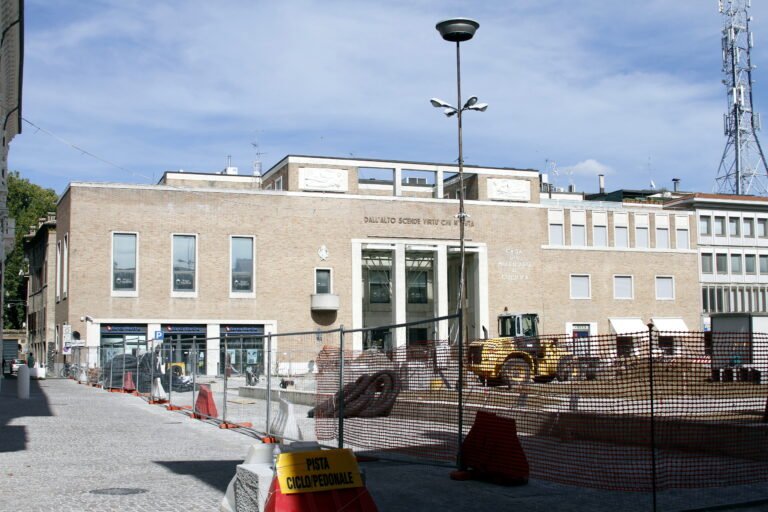
The walk pivots on two buildings a few steps apart. The Palazzo Comunale with its civic tower is the hinge of the plan: a slender modern campanile for the secular town, visible from the lake and the dunes, with the town hall gathered at its foot. Around it, the piazza sequence of the founding design still works exactly as drawn.
The second stop is the church of the Santissima Annunziata, inaugurated in February 1935 and credited to Cancellotti: a travertine volume with a 47-metre bell tower and, set into the facade, the tall mosaic of the Annunciation by Ferruccio Ferrazzi, in which the sacred scene is surrounded by the reclaimed land and the working life of the settlement years — the story of the place told in tesserae on its own front wall.
Walk it with the map
Both stops are collected in the curated itinerary Sabaudia Rationalist Walk, with the interactive route map, a play-through tour and GPX/KML downloads for your own navigator. Each stop links to its full archive entry with history, sources and practical information.
Why Sabaudia matters
Among the Pontine towns, Sabaudia is the clearest demonstration that the reclamation programme was not one architecture but several. A two-hour visit here, read against the radial monumentality of Latina founded two years earlier, shows the whole span: from civic classicism to a rationalism so disciplined it still looks contemporary. The dunes, the lake and the mountain do the rest.
These pages document that heritage place by place, without celebration and without erasure: what was built, by whom, and what it has become. The buildings are the evidence; the walk is the way to read them.
Sources
- S1 — Ciucci, Giorgio. Gli architetti e il fascismo: Architettura e città 1922–1944. Einaudi, 1989. ISBN 978-88-06-11656-9.
- S2 — Burdett, Richard, a cura di. Sabaudia: Città nuova fascista. Gangemi Editore, 1984. ISBN 978-88-7448-060-9.
Spotted an error? Write to editorial@culturalheritageonline.com and we correct it the same day.