Among Italy’s overseas territories, the Dodecanese was the anomaly: not an African colony but a Greek archipelago, taken from the Ottoman Empire in 1912 and held until the Second World War. Because the islands were governed as a showcase — a “possession” to display to Mediterranean tourism rather than a settler colony — they received an extraordinary density of Italian building: administrative palaces, hotels, spas, churches, and one entire rationalist town. Most of it stands today in Greece, in daily use, and it makes the Dodecanese one of the best places anywhere to read the range of Italian interwar architecture in a single landscape.
The context, stated plainly
As throughout this series, the built record comes with its political record. Italian rule, mild in its first decade under governor Mario Lago, hardened in the 1930s: the administration promoted Italianisation of schooling and public life, restricted Greek institutions, and under governor Cesare Maria De Vecchi (from 1936) pressed assimilation policies that Greek historiography documents in detail. The islands were also militarised — Leros above all — and became a battlefield in 1943. These facts frame every building described below.
Rhodes: Di Fausto’s capital
Rhodes was the seat of the governorate, and through the 1920s its waterfront was rebuilt as the colony’s front window. The key figure was Florestano Di Fausto — later the architect of Tripoli and of Libya’s Arch of the Philaeni — who began his overseas career here, laying out the administrative ensemble at Mandraki harbour known as the Foro Italico: government palace, post office, churches and markets in an eclectic manner that mixed Venetian, Byzantine, Ottoman and Arab references into what he conceived as a “Mediterranean” style.
Two buildings of that season anchor this archive’s record. The Grande Albergo delle Rose (1927, Di Fausto with Michele Platania) was the flagship hotel of Italian Rhodes and the hub of the steamer tourism the colony promoted; restored, it reopened in 1999 as the Casino Rodos. The thermal baths of Kallithea, inaugurated on 1 July 1929, were the resort counterpart — an Art Deco spa of colonnades and domed pavilions above a swimming cove. They are the work of Pietro Lombardi, head of the islands’ architecture office from 1927; popular tourist accounts often credit Di Fausto, but the documented attribution is Lombardi’s — one of those small corrections that accuracy requires. A card on Kallithea is in preparation.
Leros: a rationalist town entire
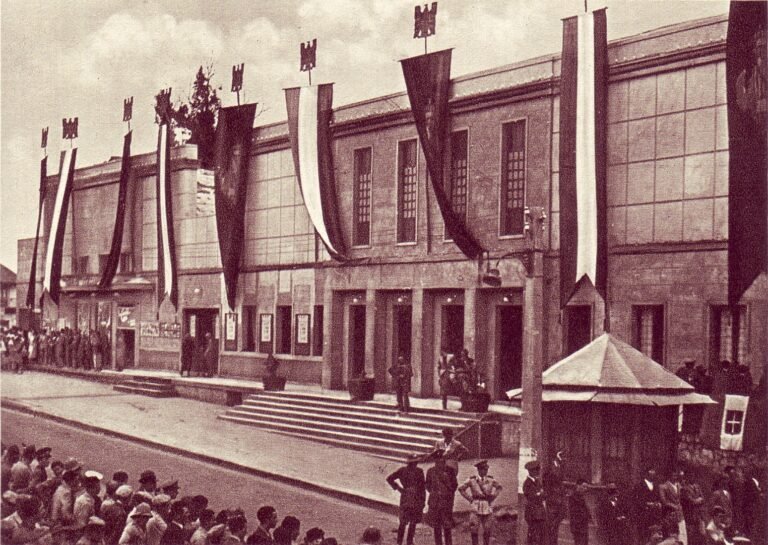
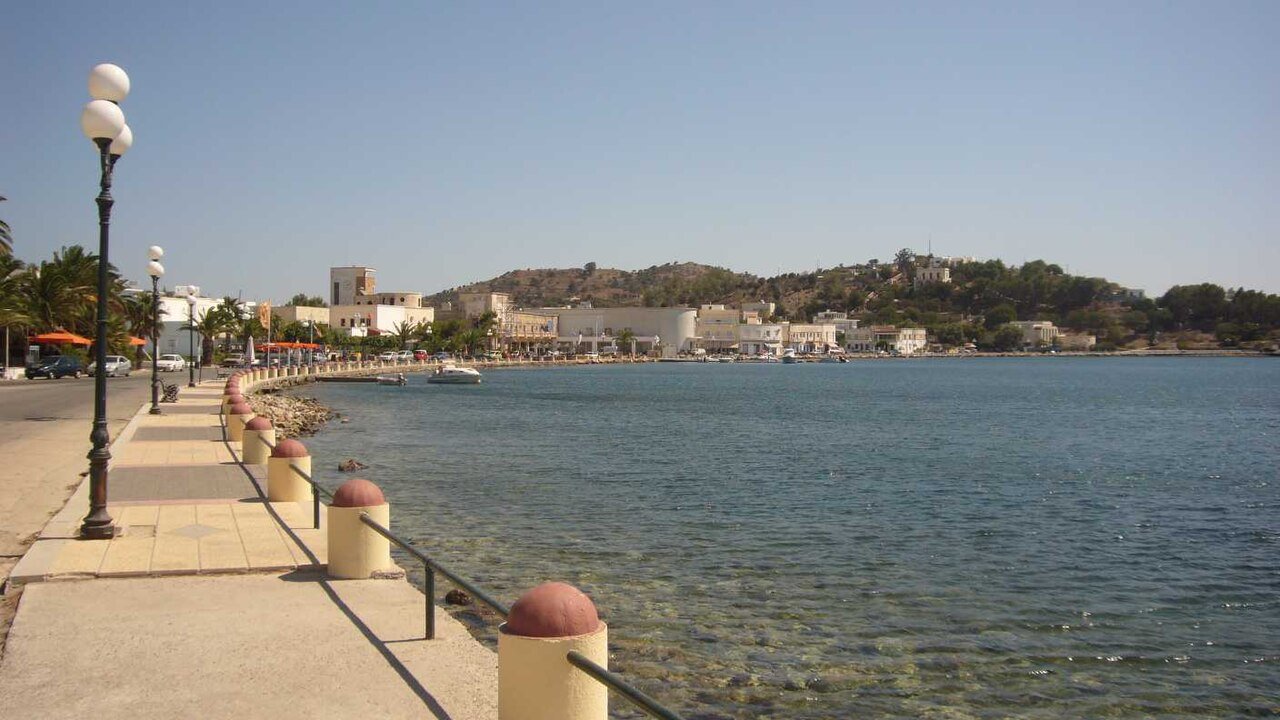
The archipelago’s most remarkable Italian work is not in Rhodes but on Leros. Beside the deep bay where Italy built its main eastern-Aegean naval base, governor Lago founded in 1933–34 the new town of Portolago — today Lakki — designed by Rodolfo Petracco and Armando Bernabiti between 1934 and 1938. It is a complete Modern Movement town: functional zoning, wide eucalyptus avenues, and freestanding white public buildings — a cinema-theatre, a circular market with clock tower, church, school, hotel — whose essential curved volumes critics have compared to De Chirico’s metaphysical townscapes. Built as the civilian companion of the base, it belongs to the same planning season as Sabaudia in the Pontine Marshes; unlike almost everything else of its kind, it survives intact and inhabited. In 1943 Leros gave its name to one of the Aegean’s fiercest battles; the bay’s later history — barracks turned psychiatric hospital, and in recent years a refugee camp — belongs to the same record.
Kos and the islands after the earthquake
On Kos, the earthquake of April 1933 destroyed much of the main town; the Italian administration used the reconstruction to excavate the ancient city and to rebuild the modern one on a new plan, with low rationalist public buildings beside the exposed archaeology. It is a case study in how the colony combined archaeology, propaganda and town planning — the excavated classical past presented as justification of the Italian presence, a reading the historiography documents explicitly.
What remains, and how to read it
The Dodecanese passed to Greece in 1947, and the Greek state inherited the entire built stock: government houses, markets, cinemas, spas, the rationalist town. Some of it was renamed and reused, some neglected, some — like Kallithea and the Albergo delle Rose — restored as tourist landmarks. The islands thus hold the paradox this whole series records: architecture of real quality produced by an occupation, now part of the daily life and economy of the people who outlived it. This archive documents the places as historical sources — what they are, who designed them, when — neither celebrating nor condemning.
Places of the Italian Dodecanese in this archive
- Lakki (Portolago), Leros — Petracco and Bernabiti, 1934–1938
- Grande Albergo delle Rose, Rhodes — Di Fausto and Platania, 1927
- Kallithea Springs, Rhodes (Pietro Lombardi, 1929)
- The Foro Italico ensemble, Mandraki, Rhodes
- Kos, the post-1933 reconstruction
This is the third piece in the series on Italy’s overseas territories, after Italian Libya and Italian Eritrea.