
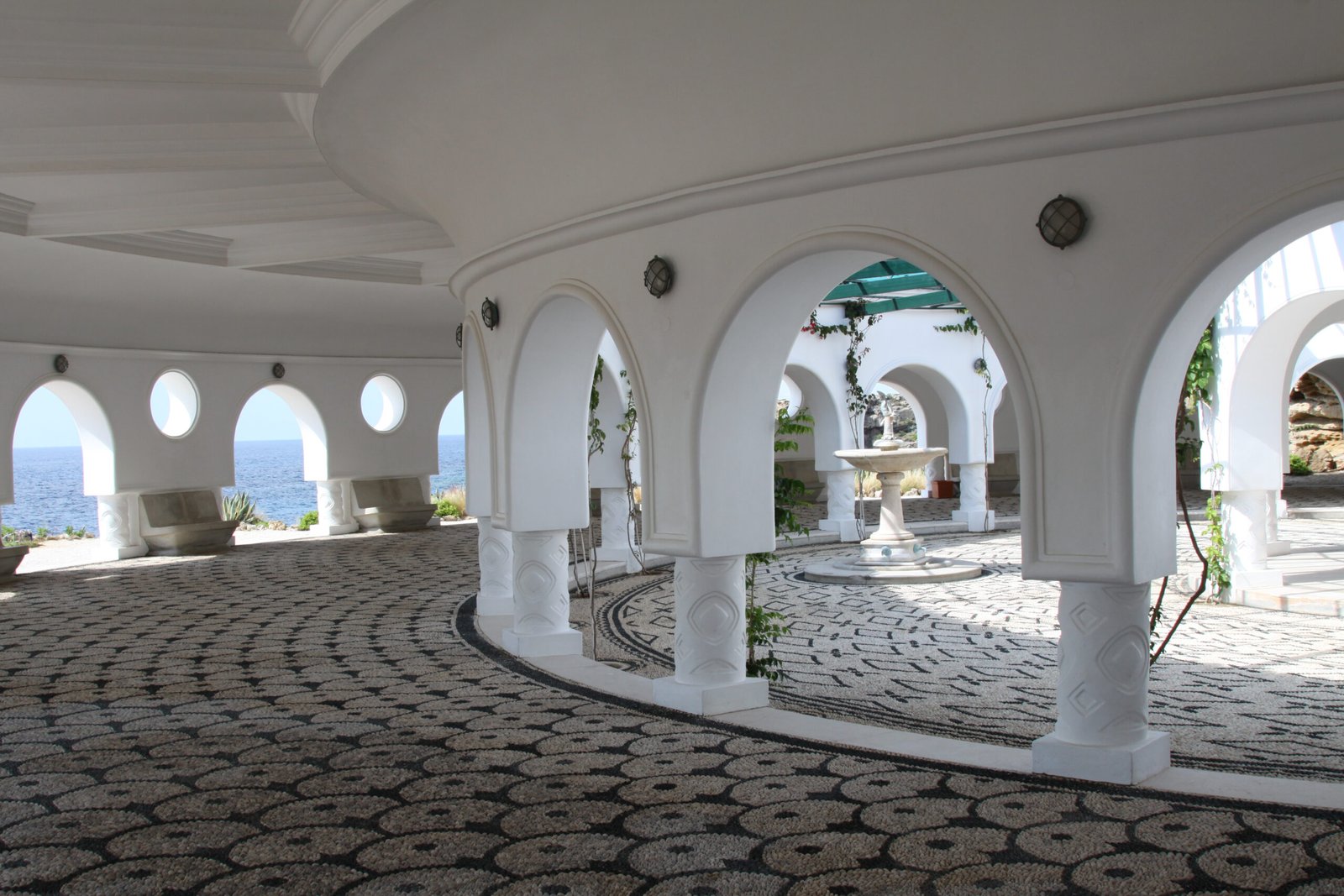
The seaside spa Pietro Lombardi built for Italian Rhodes in 1929: Moorish arches and pebble-mosaic floors around springs already used in antiquity. Abandoned for decades, restored and reopened in 2007.
At a glance
Kallithea Springs is the thermal complex the Italian administration of the Dodecanese built at Kallithea Bay, some ten kilometres south of Rhodes town. Governor Mario Lago ordered a scientific study of the springs in 1927; the design went to Pietro Lombardi, the Roman architect best known for the rione fountains of Rome, and the finished baths were inaugurated in July 1929 as the “Royal Thermae”, with King Victor Emmanuel III in attendance. Until the Second World War the complex operated as a fashionable hydrotherapy resort. It closed in the late 1960s, decayed for four decades, and reopened in 2007 after restoration. Today it hosts exhibitions, concerts and ceremonies.
Key facts
- Architect: Pietro Lombardi (1894–1984), designer of Rome’s rione fountains
- Commissioned: by Governor Mario Lago, after a 1927 scientific study of the waters
- Inaugurated: July 1929 as the “Royal Thermae”; King Victor Emmanuel III attended
- Waters: prescribed for kidney, liver, arthritis and skin complaints; treatment courses ran fifteen days
- Closed: late 1960s; the complex was placed under state protection in 1985
- Reopened: 2007, after municipal restoration; now an exhibitions and events venue
History
The springs at Kallithea were credited with healing properties long before the twentieth century; tradition associated the waters with the treatment of skin disease and rheumatism. What turned reputation into infrastructure was the Italian occupation of the Dodecanese. The baths belong to the building programme with which Italy equipped its Aegean possession, works that served visitors and the prestige of the administration in equal measure. In 1927 the civil governor, Mario Lago, commissioned a scientific study of the waters, and its favourable findings set the project in motion.
Lombardi’s complex went up quickly and was inaugurated in a festive ceremony in July 1929, taking the official name of Royal Thermae after the king’s attendance. Through the 1930s the baths ran as a cosmopolitan resort, drawing large summer crowds for supervised courses of mineral-water therapy that typically lasted fifteen days. The Second World War ended the season for good reasons of geography: the Dodecanese became a theatre of war, and the clientele vanished.
Under Greek administration the hydrotherapy operation carried on into the post-war decades, then shut down in the late 1960s. The buildings stood open to the weather for forty years, a slow ruin filmed and photographed by visitors. The Greek state listed the complex as a protected monument in 1985, restoration followed, and in 2007 the baths reopened as a cultural venue for exhibitions, performances and events.
What you see
Two rotundas anchor the complex. The smaller one, fourteen metres across, was raised directly over the spring, with six gates in Moorish style and six fountains that channelled the water toward a central pool. The larger rotunda is the set piece: an elliptical arcade under a shallow dome carried on semi-domes, its bays open to the sea, so that the building frames the Aegean the way a cloister frames a garden.
Underfoot, the paths and courts are laid in black-and-white pebble mosaic that catches the glare of midday. Lombardi was above all a designer of fountains, and Kallithea reads as a chain of them: water framed, channelled and staged at every turn, in a style that layers Art Deco geometry over Orientalist arches. It is a hybrid manner typical of Italian building in the Aegean, and one of its most complete survivals.
Practical information
- The restored complex operates as a visitable monument and events venue; exhibitions and concerts run through the season.
- The rocky cove below the baths is a busy swimming spot in summer.
- Allow about an hour for the architecture and the terraces.
Getting there
Kallithea Bay lies on the east coast of Rhodes, about ten kilometres south of Rhodes town on the road toward Faliraki; local buses from the town stop at the springs. GPS: 36.37829, 28.23866 · Open in Google Maps.
Related places and reading
- Grande Albergo delle Rose, Rhodes (1927) — the flagship hotel of Italian Rhodes
- Lakki (Portolago), Leros — the Rationalist new town of the Italian Aegean
- The Italian Dodecanese — the wider frame
Sources
- Region of South Aegean tourism portal (aegeanislands.gr), “Rhodes Thermes Kallitheas (The Kallithea Baths)”.
- travel.gr, “The Greek Island of Rhodes’ Iconic Kallithea Springs” (commission, inauguration, architectural description, restoration).
- Italian Wikipedia, “Pietro Lombardi (architetto)” (biography and attribution of the Calitea thermal complex).
- OpenStreetMap Nominatim (coordinates, “Πηγές Καλλιθέας”).
Find it on the map
See this place and what’s around it →Record researched and written by Luigi De Marchi for Cultural Heritage Online, 2026.
📷 Become a Cultural Heritage Online photographer
Share your photos of places: they stay published under your name as the author. The more they're seen, the more you get noticed — and soon a contest will reward the most appreciated photos.
Log in or sign up free to add a photoIs this page about you?
This page is read by travellers and heritage enthusiasts who find it on Google. Tell us how you are connected to this place and we will take it from there.