
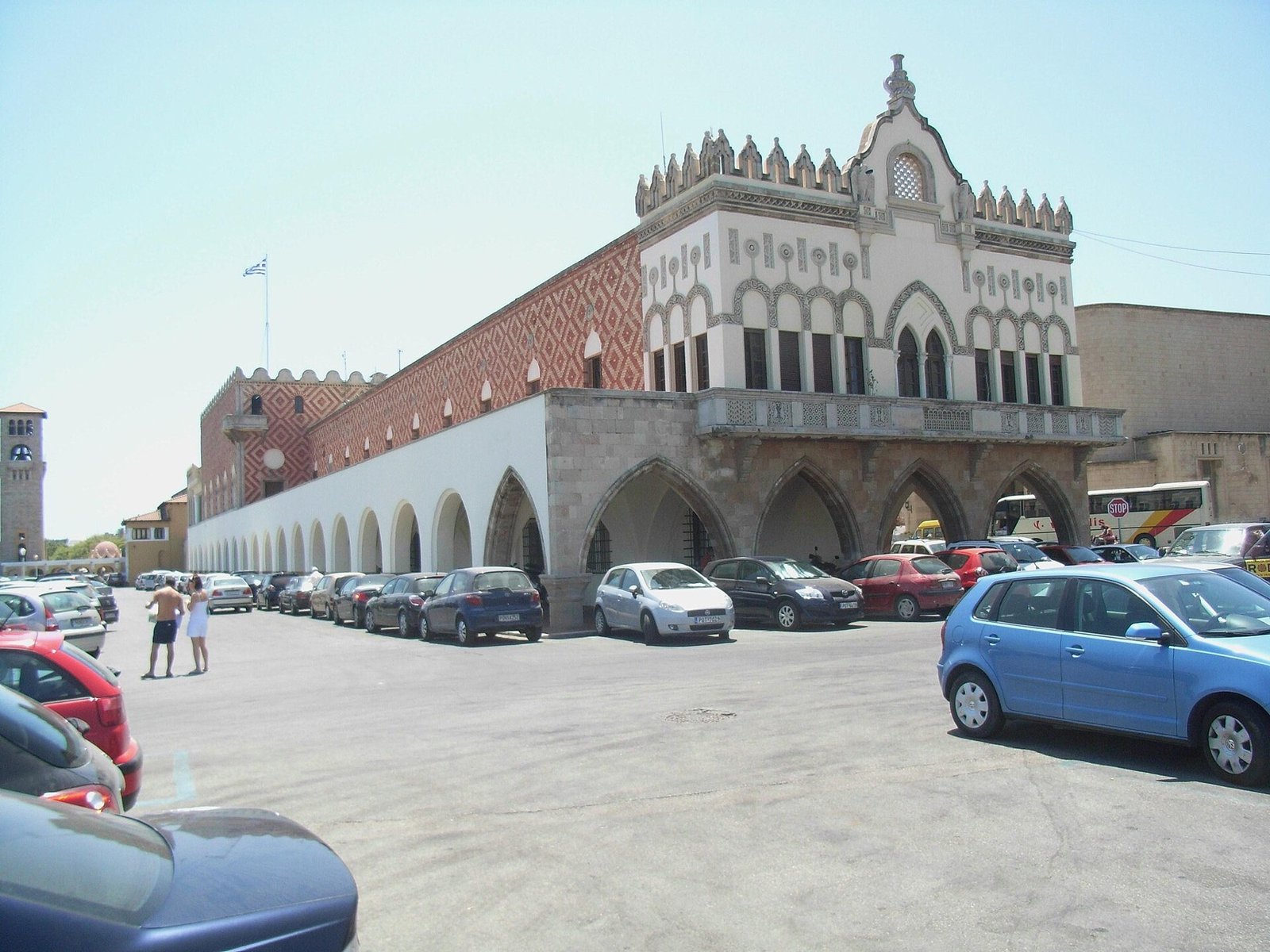
Rhodes (from 1926): the administrative quarter Florestano Di Fausto laid out along Mandraki harbour for Italy's Aegean possession — the Governor's Palace, the New Market, the post office and the cathedral, from Venetian revival to stripped Rationalism.
At a glance
Along the south side of Mandraki, the old galley harbour of Rhodes, stands a line of public buildings from a single decade and a single hand. Italy had taken the Dodecanese from the Ottomans in 1912, and in the 1920s it set out to make Rhodes the capital of its Aegean possession. The architect Florestano Di Fausto drew the plan and much of the architecture: a Governor’s Palace modelled on the Doge’s in Venice, a great covered market, a post office, a cathedral. Together they formed the Foro Italico, the administrative forum of Italian Rhodes — and they still run the island’s civic life today.
Key facts
- Planner & architect: Florestano Di Fausto; city plan completed 29 January 1926
- Setting: the new town south of Mandraki harbour, laid out as a garden city outside the medieval walls
- Governor’s Palace: 1926–1927, Venetian-Gothic revival; now the Prefecture of the Dodecanese
- Also on the axis: the Nea Agora (New Market), post office (1927–28), barracks, the Puccini theatre and the cathedral
- Later architects: Rodolfo Petracco and Armando Bernabiti, who moved the style toward stripped Rationalism in the 1930s
- Context: capital buildings of Italy’s Aegean possession, 1912–1943
History
Italy occupied the Dodecanese in 1912, during its war with the Ottoman Empire, and kept the islands for three decades. Rhodes was made the seat of government, and in the 1920s the administration called in Florestano Di Fausto to give the town a new face. His plan, finished on 29 January 1926, left the walled medieval city almost untouched and drew respect zones around its ramparts; the modern town went up outside the walls, south of Mandraki, planned as a garden city of low buildings and planted avenues.
The spine of that town was a road the Italians named the Foro Italico, and along it Di Fausto set the instruments of the colony: the seat of the governor, the market, the post and telegraph, the courts, the bank, the theatre and the church. The first works reached back to Renaissance and Venetian models; the architects who followed him, Rodolfo Petracco and Armando Bernabiti, carried the quarter into the harder, plainer Rationalism of the 1930s. It was, throughout, the built face of colonial rule in the Aegean, and it should be read as that.
What you see
The centrepiece is the Governor’s Palace of 1926–27, a deliberate quotation of the Doge’s Palace in Venice: a ground-floor loggia of pointed arches carries an upper wall patterned in pink-and-white diamonds, crowned with crenellations and small statues. It says, plainly, that Rhodes was to be read as a possession in the Venetian line. Beside it stands the Puccini theatre, and a short walk away the New Market, or Nea Agora, encloses an open court behind a long arcaded front, still the food market of the town.
Two more buildings complete the group. The post office runs its arcade along the waterfront, and the cathedral of the Annunciation — the Evangelismos — rises with a tall campanile, Di Fausto’s 1925 reworking of the medieval Church of St John of the Knights, which had stood by the Grand Master’s palace until an explosion destroyed it in the nineteenth century. The ensemble moves, building by building, from historical costume to modern line.
Visiting
- The buildings are working offices, a theatre, a market and a church; interiors vary in access, but the whole quarter is an open, walkable waterfront.
- Start at Mandraki harbour and follow the front past the palace, the theatre and the post office to the market and the cathedral.
- The medieval walled city, a UNESCO World Heritage Site, begins a few minutes’ walk south — the two Rhodes sit side by side.
Getting there
Mandraki is the modern harbour of Rhodes Town, on the northern tip of the island, an easy walk from the cruise quay and the old city. Rhodes has an international airport about 15 kilometres to the south-west and ferry links across the Aegean.
Nearby
Sources
- Wikipedia, Florestano Di Fausto — the 1926 Rhodes plan, garden-city new town, Governor’s Palace and administrative buildings, the Foro Italico axis.
- Discover Rhodes and elxis.com architecture surveys — the Nea Agora, post office and barracks; the succession of Di Fausto, Petracco and Bernabiti from revival styles to Rationalism.
- Cultural Heritage Online, The Italian Dodecanese: Rhodes, Leros and the Architecture of the Aegean Possession — colonial context.
Find it on the map
See this place and what’s around it →Record researched and written by Luigi De Marchi for Cultural Heritage Online, 2026.
📷 Become a Cultural Heritage Online photographer
Share your photos of places: they stay published under your name as the author. The more they're seen, the more you get noticed — and soon a contest will reward the most appreciated photos.
Log in or sign up free to add a photo