If Milanese elegance between the wars has one author, it is Piero Portaluppi. He built power stations in the Alps, restored the house where Leonardo’s vineyard grows, and gave Milan’s industrial upper class its most perfect villa — the one the world now knows from a film. Cultural Heritage Online keeps his buildings in its archive. This is the life that connects them.
An engineer’s son
Portaluppi was born in Milan on 19 March 1888, the son of Luisa Gadda and Oreste Portaluppi, an engineer. He came up through the Cattaneo technical institute, finishing in 1905, and then the Politecnico di Milano, taking his architecture degree on 17 September 1910 and his teaching credential in 1915. He moved through professional Milan with an ease that would define the whole career.
Power stations in the mountains
In 1913 he married Lia Baglia, niece of the electricity magnate Ettore Conti; a daughter, Luisa, was born in 1914, a son, Oreste, in 1917. The family connection became an architectural laboratory. For Conti’s company Portaluppi designed a series of hydroelectric power stations in the Ossola valleys — Verampio (1912–17), Crego (1916–19), Crevola d’Ossola (1923–24), Cadarese (1925–29) — treating industrial buildings as occasions for architecture, each in a different inventive dress. The stations still punctuate the Ossola valleys today. Few Italian architects of the period got to test so many styles at full scale, so young.
Corso Magenta and Leonardo’s vineyard
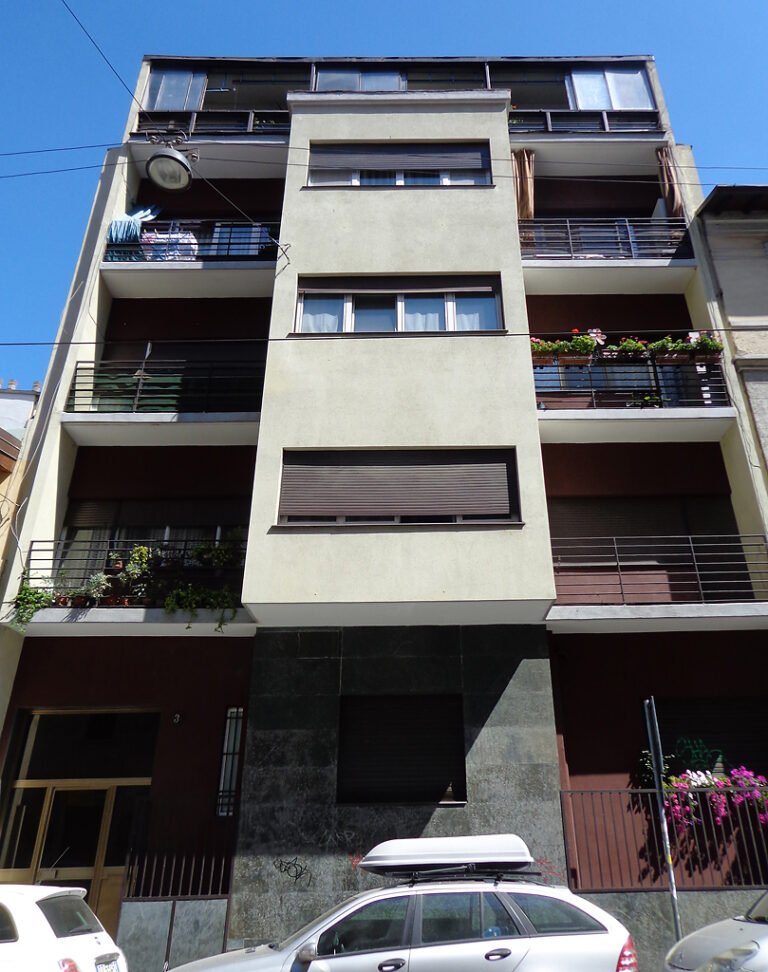
His Milan headquarters was Corso Magenta. Between 1919 and 1921 he restored the Casa degli Atellani, the fifteenth-century house opposite Santa Maria delle Grazie whose garden preserves the vineyard given to Leonardo da Vinci while he painted the Last Supper; Portaluppi lived on the same street for the rest of his life. The city work multiplied through the 1920s and 1930s: the Hoepli Planetarium (1929–30), the apartment building of 1931 that now houses the Boschi Di Stefano house-museum, the Corbellini-Wassermann building (1934–36).
Villa Necchi
His masterpiece of domestic architecture went up between 1932 and 1935 on a quiet street near Corso Venezia: Villa Necchi Campiglio, built for a family of the Milanese industrial upper class, with a private swimming pool and tennis court in the middle of the city and interiors Portaluppi followed down to the fittings. The ground floor was given over to reception — dining room, smoking room, library, grand salon — with the family’s bedrooms on the floor above and the staff quarters tucked out of sight. In the years that followed, the family had Tomaso Buzzi soften several rooms in an eighteenth-century key; the dialogue of the two tastes is part of what the house shows today. Bequeathed to FAI, the Italian environment fund, in 2001 by Gigina Necchi Campiglio and Nedda Necchi, the last of the family, the villa is now a house museum, and reached a global audience as the set of Luca Guadagnino’s I Am Love.
The Arengario and the chairs
On Piazza del Duomo, Portaluppi shared Milan’s most public commission: the Arengario, designed with Giovanni Muzio, Pier Giulio Magistretti and Enrico Agostino Griffini — two mirrored towers clad in Candoglia marble, the Duomo’s own stone, framing the opening onto Via Marconi — and today the home of the Museo del Novecento. The institutional career ran in parallel: a full chair from 1936, dean of the Politecnico’s architecture faculty from 1939 to 1945 and again from 1948 to 1963, president of Milan’s order of architects from 1952 to 1963. The private life carried its wound: his son Oreste, born in 1917, died in the war in 1942. Portaluppi died at his home on Corso Magenta on 6 July 1967.
His reputation went quiet for a generation — too worldly for the modernists, too modern for the traditionalists — and then returned with force as Milan rediscovered its interwar interiors. Today his name stands for a specifically Milanese idea of luxury: precise, ironic, discreet.
In the archive
Follow Piero Portaluppi across Cultural Heritage Online — the buildings he designed or restored, the city context and the anniversaries we mark:
- Villa Necchi Campiglio, Milan — his domestic masterpiece (1932–35), FAI house museum and set of I Am Love.
- Casa degli Atellani and Leonardo’s Vineyard, Milan — the fifteenth-century house he restored (1919–21).
- Arengario, Milan — the Piazza del Duomo landmark, now the Museo del Novecento.
- Boschi Di Stefano House-Museum, Milan — the 1931 Portaluppi building and its collection.
- Milan — Liberty, Rationalism and the World Capital of Design — the full city story.
- 19 March 1888 — the birth of Piero Portaluppi, in the CHO anniversary calendar.
- 6 July 1967 — the death of Piero Portaluppi.
Sources
- S1 — Castelluccio, Patrizia, e Piero Portaluppi. Piero Portaluppi: Linea e colore. Skira, 2003. ISBN 978-88-8491-602-0.
- S2 — Ciucci, Giorgio. Gli architetti e il fascismo: Architettura e città 1922–1944. Einaudi, 1989. ISBN 978-88-06-11656-9.
Spotted an error? Write to editorial@culturalheritageonline.com and we correct it the same day.