Eritrea was Italy’s first colony — the colonia primogenita, formally established in 1890 — and it is where the built record of Italian rule is today most visible, most studied and most internationally recognised. Its capital is the reason: in 2017 UNESCO inscribed Asmara on the World Heritage List as “Asmara: A Modernist African City” — the first modernist city anywhere to be listed as a whole, and one of the most complete ensembles of early twentieth-century architecture in the world. This article maps that record: the city, its icons, and the extraordinary infrastructure that connected a 2,400-metre highland capital to the sea.
The context, stated plainly
As throughout this series, the record cannot be separated from the rule that produced it. Asmara’s building boom of 1935–1941 was driven by the invasion of Ethiopia: the city was the staging base of the war, and its population and construction economy expanded with the military campaign. Colonial Asmara was also a segregated city — its planning assigned separate districts and services to Italians and Eritreans, a division hardened by the racial legislation extended to Italian East Africa in 1937–1938. These are documented facts of the historiography, and they are part of the same streets that UNESCO lists today. The inscription itself acknowledges this: the city is listed as an exceptional example of modernist urbanism applied in an African context, not as a monument to the power that built it.
Asmara, the modernist capital
Between 1935 and 1941 Asmara filled with cinemas, garages, offices, cafés and apartment blocks in the languages of Italian modernism — rationalism, Futurism, Art Deco, Novecento — built quickly, at moderate height, along a clear street grid. War and the end of the colony froze the ensemble; decades of isolation preserved it. The result, as the UNESCO dossier notes, is a coherent early-modernist city virtually intact — documented in this archive’s card Asmara — Africa’s Modernist City.
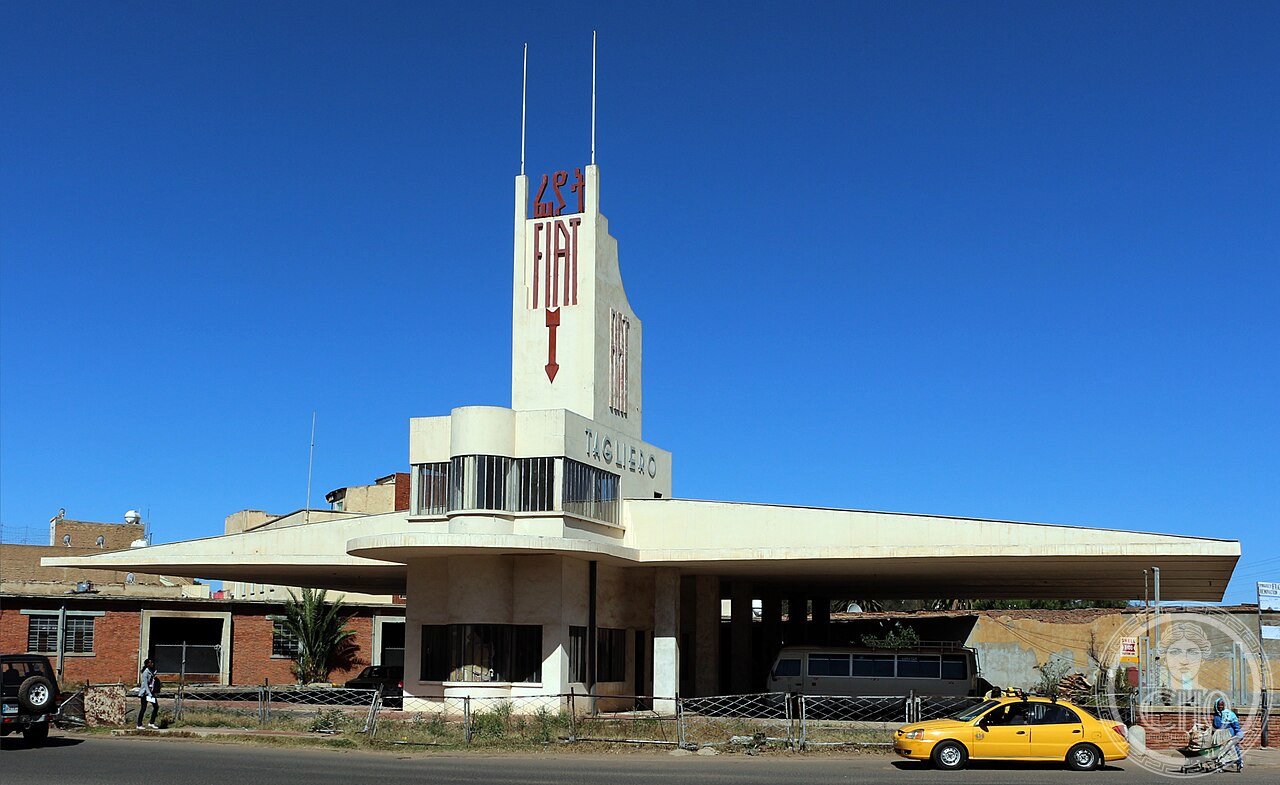
Two buildings stand for the whole. The Fiat Tagliero Building (1938, Giuseppe Pettazzi) is a petrol station in the form of an aeroplane: a central glass tower and two reinforced-concrete wings cantilevered without supports for some fifteen metres each. Local authorities demanded pillars under the wings; the story that Pettazzi forced their removal at gunpoint during the inauguration is a legend told in several versions — reported as legend, not fact. The wings, in any case, still stand, and the building is today among the most celebrated works of modernist architecture in Africa. The Cinema Impero (1937, Mario Messina) was the largest cinema of colonial Asmara and is considered one of the finest Art Deco interiors anywhere: its façade of vertical red-framed windows and porthole lamps still faces Harnet Avenue, and it still shows films. Beside them stands the church now documented as Our Lady of the Rosary (1923), the Lombard-Romanesque landmark of the city’s Italian decades.
Massawa and the climb to the highlands
Asmara’s existence as a capital depended on its link to the sea. The port was Massawa — the Red Sea gateway of the colony, itself a layered city of Ottoman, Egyptian and Italian building. Connecting port and capital meant climbing about 2,400 metres in under 120 kilometres, and the colony built three parallel systems to do it.
The first was the railway: begun in 1887, it reached Asmara in 1911 — 118 kilometres, 39 tunnels and 65 bridges and viaducts, one of the boldest mountain railways of its era, later extended inland. The second was the road. The third was the most remarkable: the Massawa–Asmara cableway (teleferica), built in 1935–1937 by the Milanese firm Ceretti & Tanfani — about 75 kilometres of three-cable aerial line, the longest in the world at its completion, able to move 30 tonnes of freight per hour in each direction between the sea and the highlands. It operated for barely a decade: after the British occupation of 1941 it was dismantled in the 1940s, its materials removed as war compensation. Like the Arch of the Philaeni in Libya, it survives mainly in photographs and film — a card on it is in preparation.
What remains, and how to read it
Unlike most colonial capitals, Asmara kept its ensemble: the cinemas, the garages, the cafés and the street grid are still in daily use by the city that inherited them. Eritrea itself proposed the city for the World Heritage List, and Asmara’s inhabitants have long claimed the architecture as part of their own history — a rare case of a colonial built record re-appropriated by the people it was imposed on. That, more than any single building, is what makes the city instructive: the same streets document both the ambitions of the power that built them and the life of the society that outlived it. This archive records the places as historical sources — what they are, who designed them, when — neither celebrating nor condemning.
Places of Italian Eritrea in this archive
- Asmara — Africa’s Modernist City — the UNESCO 2017 ensemble
- Fiat Tagliero Building — Giuseppe Pettazzi, 1938
- Cinema Impero — Mario Messina, 1937
- Church of Our Lady of the Rosary, Asmara — 1923
- Massawa — the Red Sea port
- Massawa–Asmara cableway (1937, dismantled 1940s)
- Massawa–Asmara railway (1887–1911) — card in preparation
This is the second piece in a series on the architecture and infrastructure of Italy’s overseas territories between the wars, opened by Italian Libya: Architecture, Roads and the Colonial Project of the “Fourth Shore”.