
Matthias Fountain
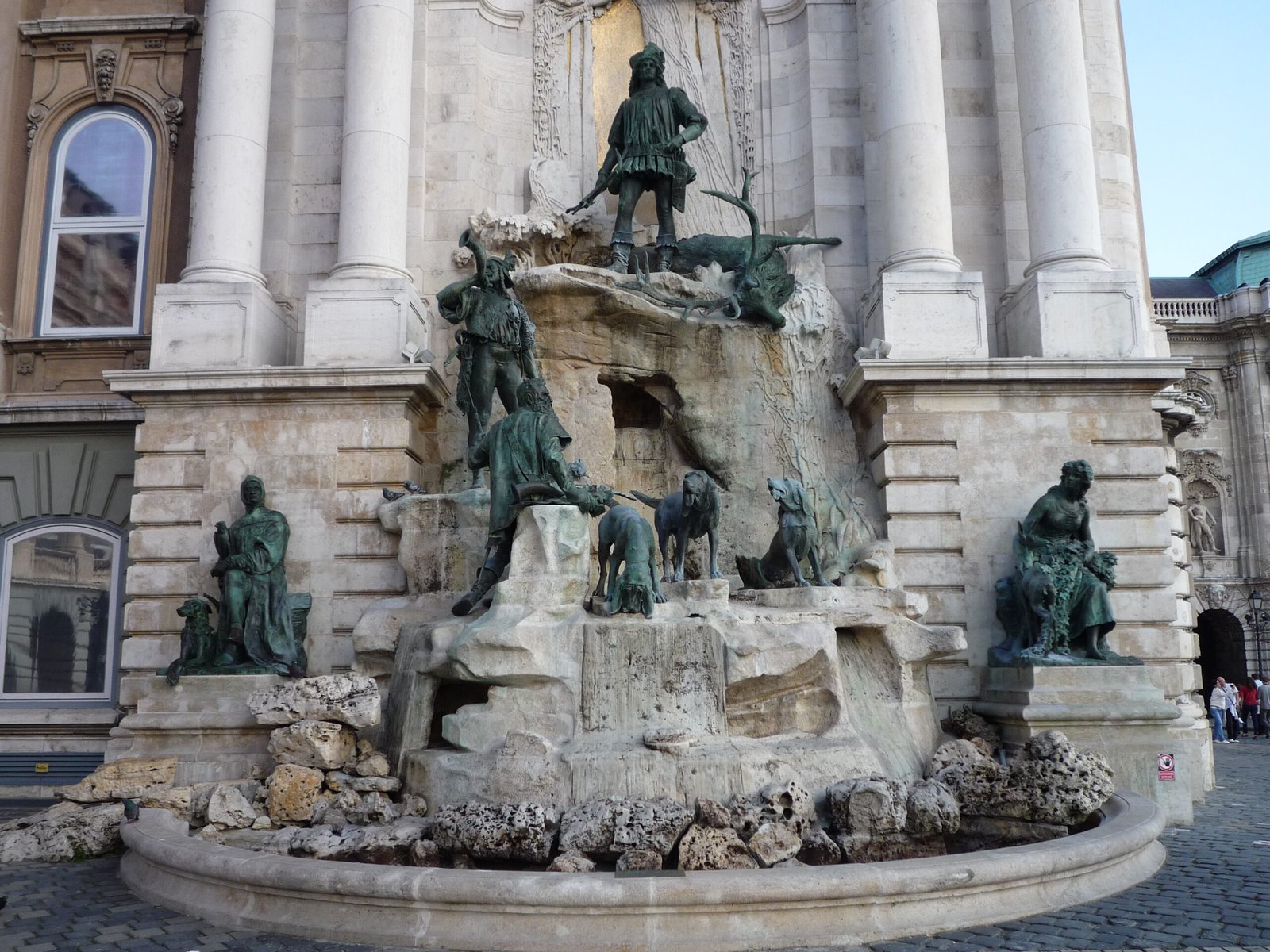
In the western forecourt of Buda Castle, a bronze hunting party freezes mid-chase against a golden mosaic wall, water threading through rock as if the scene were still moving.
At a glance
Matthias Fountain is a monumental sculptural group set into the northern facade of the former Castle Church at Buda Castle. Alajos Stróbl designed it in Neo-Baroque style, unveiled in 1904 with King Franz Joseph in attendance. Locals sometimes call it the Trevi Fountain of Budapest, though the comparison is one of drama rather than scale.
History
Stróbl worked alongside Alajos Hauszmann, master builder of the Royal Palace reconstruction, after Franz Joseph approved the composition scheme. Work began in 1899. The henchman figure earned a state gold medal in 1901. Stróbl modelled the stag on an animal poachers had killed in 1896, in the very forest where he hunted. Duke Pálffy sent hound models to the sculptor’s studio. The finished fountain was inaugurated in 1904. War damaged the ensemble decades later. The middle dog sculpture was destroyed in the Second World War and later rebuilt by Jenő Grantner. The facade’s balustrade and Mansard roof, once more elaborate, were simplified after wartime damage. A restoration followed in 2010.
What you see
King Matthias Corvinus stands atop the highest rock in hunting dress, crossbow in hand, a dead stag at his feet. Below him a henchman blows a hunting horn. Another figure sits with his back to viewers. Three bronze hounds complete the central cluster. Water runs through the cracks of the boulders beneath them. On separate plinths to either side stand Szép Ilonka, heroine of Vörösmarty’s ballad, shielding her fawn as she gazes toward the king, and the Italian chronicler Galeotto Marzio, a falcon on his fist and a sighthound at rest. Behind the whole group rises a monumental facade flanked by paired Corinthian columns. A central niche shaped like a triumphal arch bears Matthias’ coat of arms, framed by Art Nouveau foliate ornament against plain gold mosaic — an odd, effective pairing of old and new tastes.
Cultural significance
The fountain fixes a Renaissance king’s legend into public stone and bronze. It draws on Vörösmarty’s 19th-century ballad, folding literary memory into royal commemoration. As one of Budapest’s most photographed landmarks, it also marks a turning point in the Royal Palace’s historicist rebuilding under Hauszmann, where sculpture and architecture were meant to read as a single theatrical composition.
Key facts
- Location: western forecourt of Buda Castle, Budapest District I
- Sculptor: Alajos Stróbl, with architect Alajos Hauszmann
- Inaugurated: 1904, in the presence of Franz Joseph
- Style: Neo-Baroque figures with Art Nouveau niche decoration
- Restored: 2010
Practical information & getting there
The fountain sits in the open forecourt of Buda Castle, easily reached on foot from the Castle Hill Funicular or by walking up from Clark Ádám tér. It is outdoors and freely viewable at any hour, though daylight brings out the mosaic’s gold ground best. Combine a visit with the surrounding Buda Castle complex, since the fountain forms part of a wider ensemble of works of art there.
Sources & resources
Find it on the map
See this place and what’s around it →📷 Diventa un fotografo di Cultural Heritage Online
Condividi le tue foto dei luoghi: restano pubblicate con la tua firma come autore. Più vengono viste, più ti fai conoscere — e presto un concorso premierà le foto più apprezzate.
Accedi o registrati gratis per aggiungere una fotoDo you manage this place?
This page is read by travellers and heritage enthusiasts who find it on Google. Keep it accurate — and make it work for you. Free for non-profit heritage institutions.