
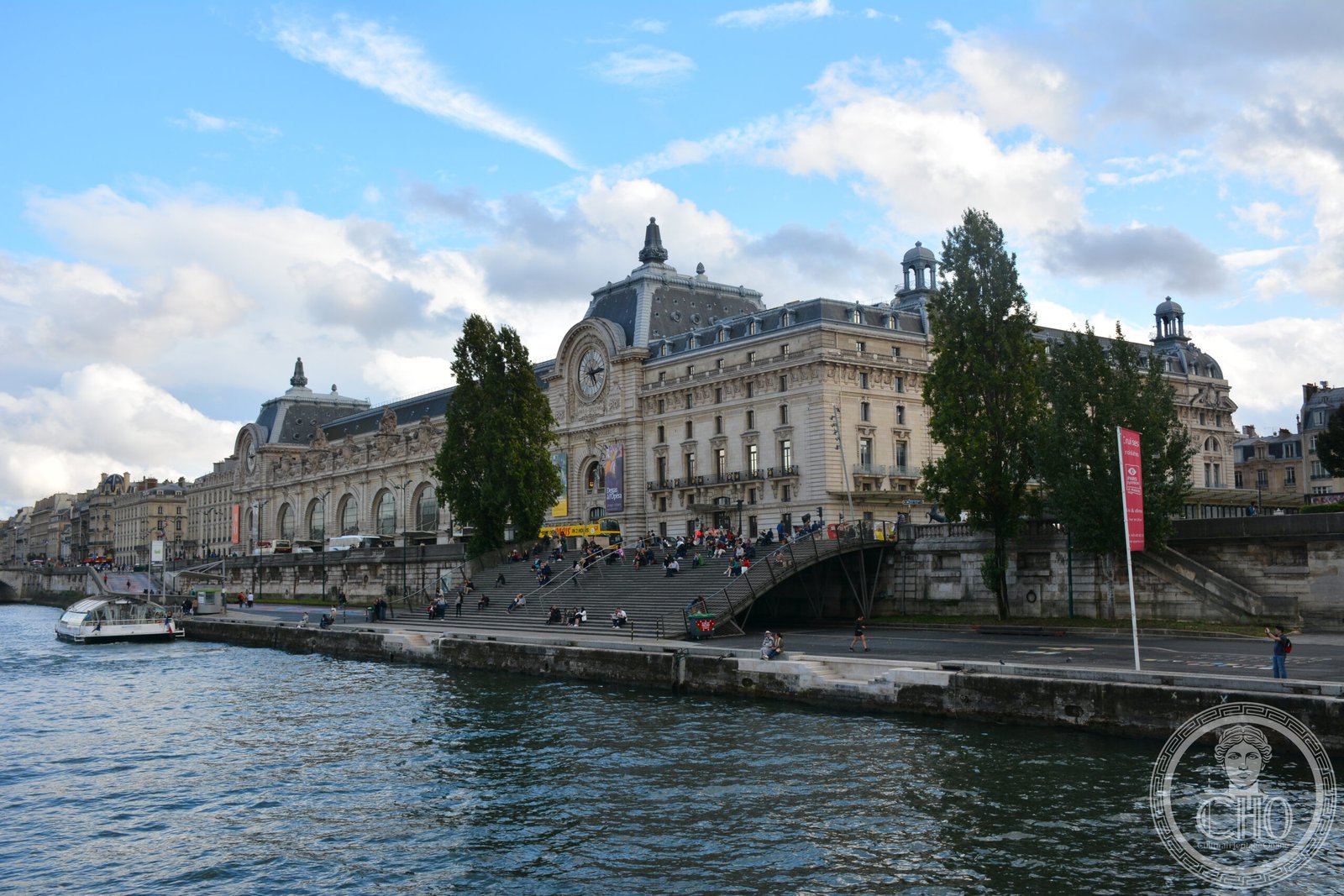
The Musée d’Orsay is a major art museum in Paris, housed in the former Gare d’Orsay railway station on the Left Bank of the Seine. Opened in December 1986 after a celebrated conversion of the Beaux-Arts station, it holds the world’s largest collection of Impressionist and Post-Impressionist masterpieces, with works by Monet, Renoir, Manet, Degas, Cézanne, Van Gogh, Gauguin, Seurat, and many others, spanning French art from 1848 to 1914.
At a glance
- Type
- Art museum — French art 1848–1914
- Period
- Building: 1898–1900 (Gare d’Orsay); museum opened 9 December 1986
- Style
- Beaux-Arts railway station (Victor Laloux); conversion by ACT Architecture and Gae Aulenti
- Location
- 1 Rue de la Légion d’Honneur, 7th arrondissement, Paris, France
- Coordinates
- 48.8600° N, 2.3265° E
Overview
The Musée d’Orsay holds the world’s largest collection of Impressionist and Post-Impressionist paintings, assembled from works previously scattered across the Louvre, the Jeu de Paume, and the Palais de Tokyo. The collection encompasses not only painting but also sculpture, decorative arts, photography, and graphic design from the second half of the 19th century and the first years of the 20th, offering a panoramic view of European visual culture during the age of industrialisation. Among the most visited museums in the world, it receives approximately three million visitors per year.
History
The Gare d’Orsay was built between 1898 and 1900 by architect Victor Laloux to serve as the terminus of the Orléans railway line, in time for the 1900 Paris Universal Exhibition. By the 1930s its short platforms were obsolete for mainline trains, and the station was progressively decommissioned, serving as a postal sorting centre during the Second World War and later as an auction house and film set. Plans to demolish it were overtaken in 1977 by a presidential decision under Valéry Giscard d’Estaing to convert it into a museum; Italian designer Gae Aulenti designed the interior. The museum opened on 9 December 1986 under President François Mitterrand.
What you see
The main hall preserves Laloux’s vast iron-and-glass nave, now lined with 19th-century sculptures and the original station clock faces, with galleries distributed across three levels. The upper level — the most celebrated — houses the core Impressionist collection: Monet’s Rouen Cathedral series and Haystacks, Renoir’s Bal du moulin de la Galette, Manet’s Olympia and Le Déjeuner sur l’herbe, Degas’s dance and racecourse pictures, and Van Gogh’s self-portraits and Bedroom at Arles. The middle level features Art Nouveau decorative arts and the Symbolists; the ground level holds monumental Academic and Realist sculpture.
Cultural significance
The Musée d’Orsay gave permanent institutional form to the Impressionist movement, which had been marginalised in official French collections for much of the 20th century. Its conversion of a discarded railway station into one of the world’s foremost museums also became a model for adaptive reuse of industrial heritage, influencing similar projects from the Tate Modern in London to Hamburger Bahnhof in Berlin.
Practical information
- Address
- 1 Rue de la Légion d’Honneur, 75007 Paris, France
- Admission
- Paid entry; combined tickets available; free first Sunday of the month — check official website
Getting there
RER C stops at Musée d’Orsay, directly opposite the entrance. Metro line 12 stops at Solférino, a five-minute walk. Bus lines 24, 63, 68, 69, 73, 83, 84, and 94 all serve the museum. The Musée de l’Orangerie is approximately 15 minutes on foot along the Seine toward the Tuileries.
Sources & resources
- Wikipedia — Musée d’Orsay
- Cultural Heritage Online — more heritage places
- Official Musée d’Orsay website
Find it on the map
See this place and what’s around it →📷 Become a Cultural Heritage Online photographer
Share your photos of places: they stay published under your name as the author. The more they're seen, the more you get noticed — and soon a contest will reward the most appreciated photos.
Log in or sign up free to add a photo