
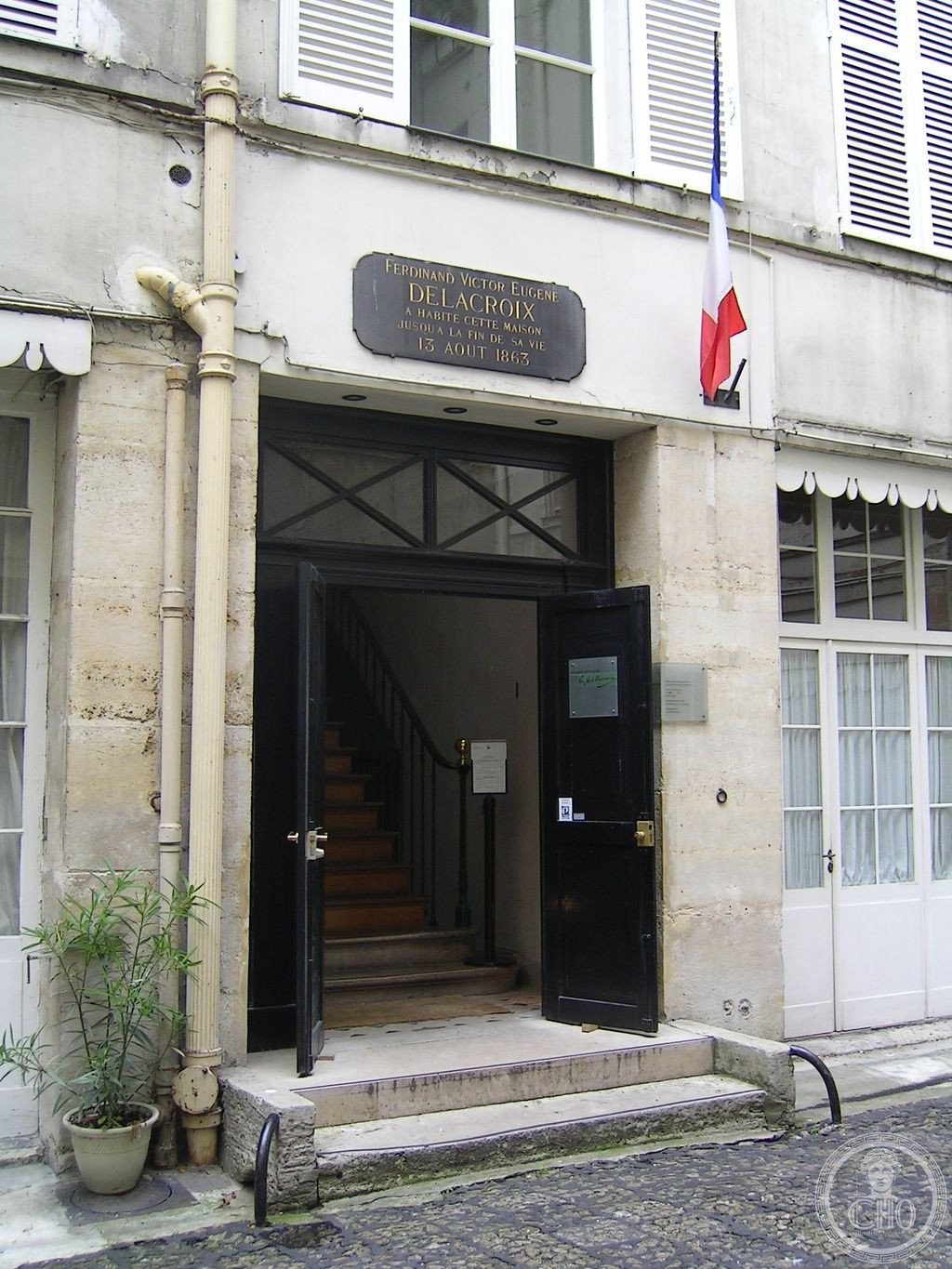
The Musée national Eugène Delacroix, located at 6, rue de Furstemberg in the 6th arrondissement of Paris, preserves the final studio and apartment of the Romantic painter Eugène Delacroix (1798–1863). Established in 1952 by the Association des Amis d’Eugène Delacroix and transferred to the Louvre in 2004, the museum displays paintings, drawings, pastels, and personal effects that illuminate the creative life of one of France’s greatest artists.
At a glance
- Type
- National art museum, artist’s house museum
- Period
- Building 17th century; museum established 1952; nationalised 1971
- Style
- Romantic painting; intimate domestic interior
- Location
- 6, rue de Furstemberg, 75006 Paris, France
- Coordinates
- 48.8544° N, 2.3334° E
Overview
The Musée national Eugène Delacroix occupies the apartment and garden studio that Delacroix moved into in 1857, choosing the Saint-Germain-des-Prés neighbourhood for its proximity to the church of Saint-Sulpice, where he was completing his monumental mural cycle. The museum holds the most important public collection of the artist’s work in France, comprising paintings, watercolours, pastels, lithographs, and correspondence. It became a branch of the Louvre in 2004, reinforcing its status as a premier destination for the study of French Romanticism.
History
Eugène Delacroix was born in Charenton-le-Pont in 1798 and rose to become the leading figure of French Romantic painting, celebrated for dynamic canvases such as Liberty Leading the People (1830) and the Death of Sardanapalus (1827). He occupied the rue de Furstemberg apartment from 1857 until his death in 1863. Shortly after, a group of admirers founded the Association des Amis d’Eugène Delacroix in 1929 to protect the studio from demolition, and the space was opened to the public as a museum in 1952. The French state nationalised it in 1971, and administration passed to the Musées nationaux, then to the Louvre in 2004.
What you see
Visitors enter through a quiet courtyard on rue de Furstemberg, one of the most picturesque squares in Paris, before reaching Delacroix’s first-floor apartment and the garden studio he had built to accommodate large canvases. The intimate rooms display personal objects, artist’s tools, a writing desk, and original furniture alongside oils, sketches, and studies. The garden provides a calm green retreat in the heart of Saint-Germain, largely unchanged from the artist’s day. A small shop and reading room round out the visit.
Cultural significance
Delacroix is widely regarded as the bridge between the Neoclassical tradition of David and the Impressionist experiments of Monet and Renoir, both of whom acknowledged his influence. Preserving his working environment intact offers an unusually direct connection to the creative process of a pivotal figure in Western art history. The museum’s intimate scale makes it one of the most contemplative cultural spaces in Paris.
Practical information
- Address
- 6, rue de Furstemberg, 75006 Paris, France
- Opening hours
- Wednesday–Monday 09:30–17:30; closed Tuesday and some public holidays. Check the official Louvre website for current hours and ticket prices.
- Admission
- Paid; free on first Sunday of the month. Louvre combined tickets available.
- Website
- musee-delacroix.fr
Getting there
Metro line 4, station Saint-Germain-des-Prés (exit rue de Rennes), then a 3-minute walk south along rue Bonaparte and left into rue de Furstemberg. Bus lines 39, 63, 70, and 96 stop on boulevard Saint-Germain nearby. No on-site parking; public car parks available on rue Mazarine.
Sources & resources
See the place
Find it on the map
See this place and what’s around it →📷 Become a Cultural Heritage Online photographer
Share your photos of places: they stay published under your name as the author. The more they're seen, the more you get noticed — and soon a contest will reward the most appreciated photos.
Log in or sign up free to add a photo