
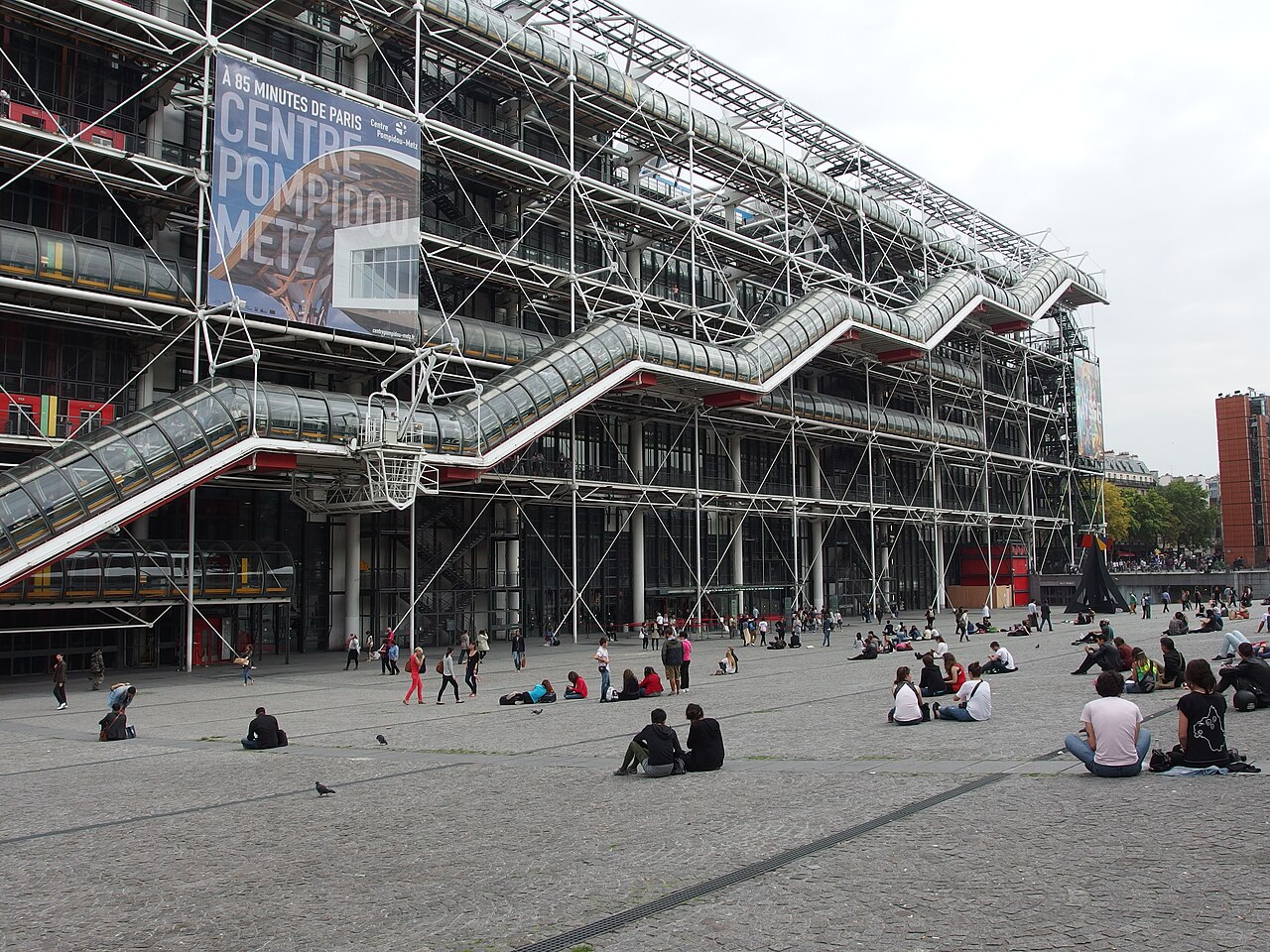
The Centre national d’art et de culture Georges-Pompidou — known in English as the Pompidou Centre and colloquially as Beaubourg — is a landmark of high-tech architecture and the largest modern and contemporary art museum in Europe. Designed by Richard Rogers, Renzo Piano, and Gianfranco Franchini and opened on 31 January 1977, the inside-out building with its colour-coded external ductwork revolutionised museum design and remains one of the most visited cultural institutions in the world, welcoming more than three million visitors to its permanent collection each year.
At a glance
- Type
- National modern and contemporary art museum and cultural centre
- Period
- Commissioned 1969; construction 1971–1977; opened 31 January 1977
- Style
- High-tech architecture (Bowellism); exposed structural and mechanical systems
- Location
- Place Georges-Pompidou, 75004 Paris, France (4th arrondissement)
- Coordinates
- 48.8606° N, 2.3522° E
Overview
The Centre Pompidou brings together France’s national collection of modern art (Musée national d’Art moderne), a public library (Bpi), the IRCAM music and acoustic research institute, a cinema, a design centre, and temporary exhibition spaces under one roof. Its permanent collection of approximately 100,000 works spans from Fauvism and Cubism to the present day, making it the largest modern art collection in Europe. The piazza in front — with its NIKI de Saint Phalle and Jean Tinguely fountain — is itself a vibrant public meeting point in central Paris.
History
President Georges Pompidou launched an international architectural competition in 1970, intending to create a multidisciplinary cultural centre that would revitalise the run-down Beaubourg neighbourhood. The winning scheme by Piano, Rogers, and Franchini shocked the Parisian establishment with its radical inversion of conventional architecture: structural steel, escalators, colour-coded pipes (blue for air, green for water, yellow for electricity, red for circulation), and glass all placed on the exterior, leaving the interior entirely open and flexible. After Pompidou’s death in 1974 the project was named in his honour; Valéry Giscard d’Estaing inaugurated the completed building in January 1977. The centre closed for major renovation from 1997 to 2000 and was further expanded before a second closure for restoration planned for 2025.
What you see
The transparent escalator tube zigzagging up the west facade offers progressive panoramic views of Paris as visitors ascend to the upper floors, where the permanent Musée national d’Art moderne displays works by Matisse, Picasso, Kandinsky, Duchamp, Warhol, and Beuys across two floors. The rooftop terrace commands a 360-degree skyline. The Bpi public library on floors 1–3 is freely accessible without a museum ticket. The surrounding piazza hosts street performers and the Stravinsky Fountain with its sixteen colourful kinetic sculptures.
Cultural significance
The Centre Pompidou fundamentally altered the architectural language of public cultural buildings worldwide, inspiring the high-tech movement and influencing institutions from Lloyd’s of London to the Grande Arche de la Défense. Its commitment to free public access on lower floors and its interdisciplinary programme model — combining art, music, cinema, and research — set a template followed by cultural centres across Europe and beyond.
Practical information
- Address
- Place Georges-Pompidou, 75004 Paris, France
- Opening hours
- Wednesday–Monday 11:00–21:00; closed Tuesday and 1 May. Temporary exhibitions may have extended hours. Check the official website for the latest schedule, including planned closure dates.
- Admission
- Permanent collection: paid (free for under-18s and EU residents under 26 on presentation of ID). Bpi library: free.
- Website
- centrepompidou.fr
Getting there
Metro lines 11 (Rambuteau) and 4 (Les Halles/Étienne Marcel), both within 5 minutes’ walk. RER A, B, D at Châtelet–Les Halles. Bus lines 29, 38, 47, 75. Vélib’ stations directly adjacent to the piazza. Pedestrian access from the rue de Rivoli or rue Beaubourg corridors.
Sources & resources
Gallery
Photographs by Luigi De Marchi.
See the place
Find it on the map
See this place and what’s around it →📷 Become a Cultural Heritage Online photographer
Share your photos of places: they stay published under your name as the author. The more they're seen, the more you get noticed — and soon a contest will reward the most appreciated photos.
Log in or sign up free to add a photo