
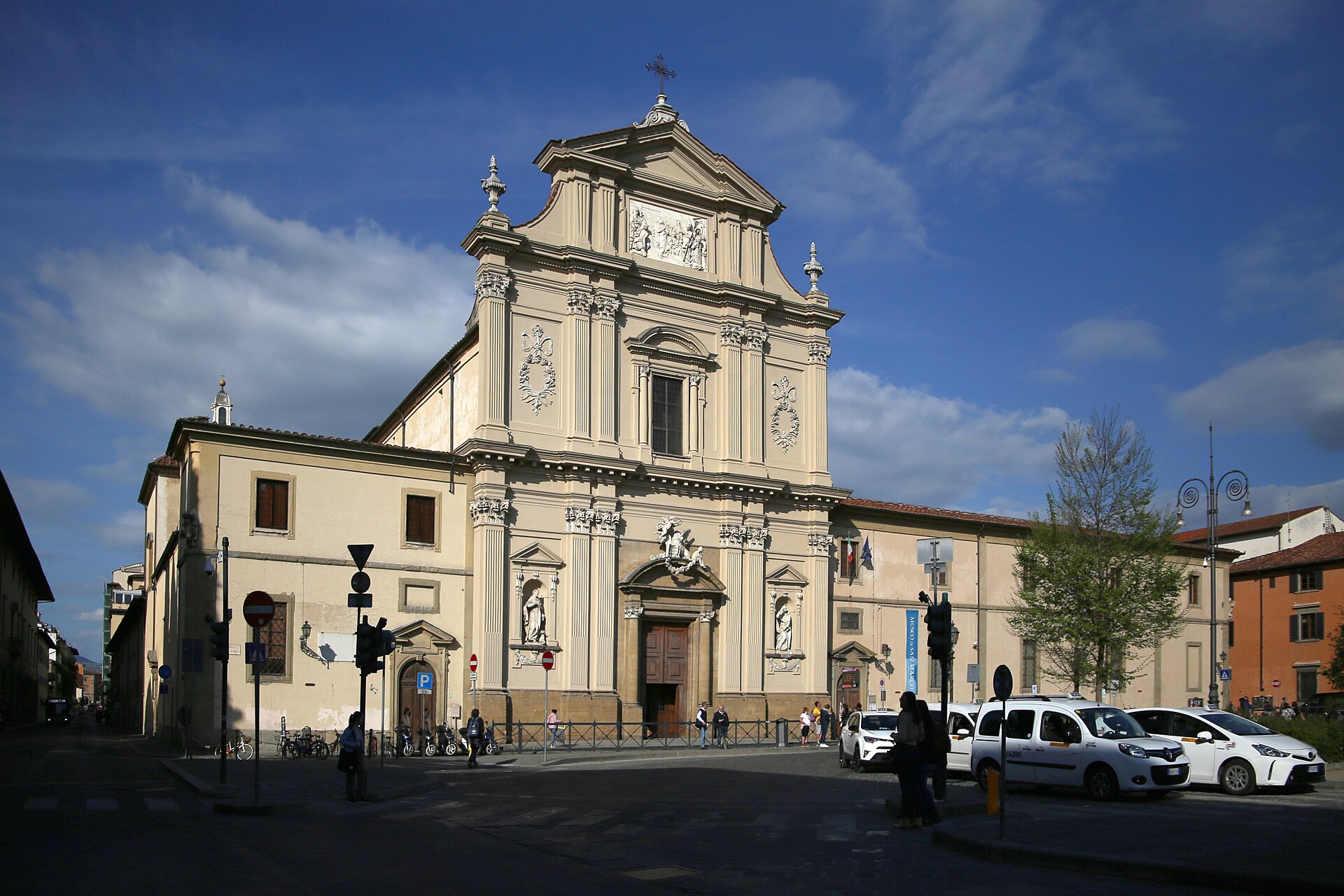
The Museo Nazionale di San Marco is a state art museum housed in the monumental section of a medieval Dominican convent on Piazza San Marco in Florence. It is celebrated above all for the largest collection of panel paintings and frescoes by Fra Angelico in the world, including the celebrated Annunciation fresco painted directly on the corridor wall of the dormitory around 1440–1441.
At a glance
- Type
- National art museum
- Period
- Convent founded 13th century; rebuilt for Dominicans 1436–1452 by Michelozzo; museum opened 1869
- Style
- Gothic and early Renaissance convent architecture
- Location
- Piazza San Marco 3, 50121 Florence, Tuscany
- Coordinates
- 43.7782° N, 11.2591° E
Overview
The Museo Nazionale di San Marco occupies the former Dominican convent of San Marco, one of the most important monastic complexes in Renaissance Florence. Its collections are centred on the extraordinary cycle of devotional frescoes painted by Fra Angelico and his workshop between roughly 1438 and 1445, when the artist was himself a friar resident in the convent. The museum also holds important works by Fra Bartolommeo and a collection of Florentine illuminated manuscripts.
History
The convent was originally founded by Sylvestrine monks in the 13th century, then transferred to the Dominican Order of Observance in 1436 under the patronage of Cosimo de’ Medici the Elder. Cosimo commissioned Michelozzo di Bartolomeo to rebuild the complex entirely between 1436 and 1452, producing the elegant cloister and dormitory that survive today. Fra Angelico — who lived and worked here — decorated the chapter house, cloister, and all forty-four individual cells of the dormitory with frescoes intended for the private meditation of each friar. The convent later became the seat of Girolamo Savonarola, who served as prior from 1490 until his arrest in 1498. The Italian state converted it into a museum in 1869.
What you see
Visitors enter through the Cloister of Sant’Antonino, decorated with lunette frescoes, before passing into the chapter house and the large Sala dell’Ospizio, which displays Fra Angelico’s altarpieces and tabernacles gathered from churches across Florence. The upper floor dormitory corridor is anchored by the celebrated Annunciation fresco — one of the defining images of Quattrocento art — and leads to the individual monks’ cells, each bearing a small fresco. The library, also by Michelozzo, is considered one of the finest early Renaissance interiors in Italy. The museum additionally preserves Savonarola’s cells and personal relics.
Cultural significance
San Marco is a rare surviving example of a complete early Renaissance monastic environment still largely intact in its original spatial logic. Fra Angelico’s cell frescoes represent a unique fusion of humanist painting technique and spiritual purpose, influencing centuries of devotional art. The convent’s association with both Medici patronage and Savonarolan reform gives it a central place in Florentine cultural and political history.
Practical information
- Address
- Piazza San Marco 3, 50121 Florence
- Opening hours
- Check official website for current hours; closed Mondays
- Website
- museistatali.firenze.it
Getting there
The museum is on Piazza San Marco in the historic centre of Florence, a short walk from the Accademia Gallery and the Duomo. The nearest bus stop is Piazza San Marco, served by several ATAF city lines. The central train station Santa Maria Novella is approximately 1 km away on foot. No dedicated parking is available on the square; the nearest public car parks are at Piazza della Libertà or Parterre.
Sources & resources
See the place
Find it on the map
See this place and what’s around it →📷 Become a Cultural Heritage Online photographer
Share your photos of places: they stay published under your name as the author. The more they're seen, the more you get noticed — and soon a contest will reward the most appreciated photos.
Log in or sign up free to add a photoIs this page about you?
This page is read by travellers and heritage enthusiasts who find it on Google. Tell us how you are connected to this place and we will take it from there.