
In the Jaro district of Iloilo City, in the Philippines, the Metropolitan Cathedral of Our Lady of the Candles is the seat of the archdiocese of Jaro, the fifth-oldest diocese in the Philippines according to UCA News. Pope Pius IX erected it on 27 May 1865, originally covering most of the island of Panay, plus Negros, Romblon, Palawan and part of Mindanao, before later subdivisions. Pope Pius XII raised it to an archdiocese on 29 June 1951. According to some sources without primary citation, the parish dates back to 1575 as a “visita” of Oton, becoming an independent parish in 1587. A stone church was built between 1742 and 1744, damaged by earthquakes in 1787 and in the nineteenth century, and not rebuilt on the same site. The present building, in Romanesque Revival style, was begun on 22 February 1869 under Bishop Mariano Cuartero, the first bishop of Jaro, and consecrated between January and February 1874. The architect’s name is not documented. The earthquake of January 1948, known locally as “Lady Caycay”, severely damaged the cathedral, repaired in 1956 under Archbishop José María Cuenco, the first archbishop of Jaro. No specific damage from the Second World War is recorded, contrary to what is sometimes assumed. On 20 February 1981, according to the official text published by the Vatican, Pope John Paul II met Catholic organisations in person in Jaro Cathedral during his journey to the Philippines. According to concurring secondary sources, on the same occasion, from the cathedral balcony, he crowned the image of Our Lady of the Candles and proclaimed her patroness of Western Visayas, later formalised by the pontifical decree “Quod Urbes” of 21 April 1982. The event is widely described as the only coronation of a Filipino Marian image, perhaps even in the world outside the Vatican, performed personally by a pope rather than by his legate, although this claim of exclusivity has not been exhaustively checked against all the other documented Filipino Marian coronations. Across the street, facing the cathedral, stands the Jaro belfry, a freestanding structure built in 1744, an architectural rarity in the Philippines, where bell towers are normally attached to the church. It also served as a military watchtower against Moro raids in the Spanish colonial period. Damaged by an earthquake on 17 July 1787, rebuilt from 1833 under Father Jesse Alvarez, damaged again in 1868 and restored in 1881 under the same Bishop Cuartero, it was declared a national historic monument on 29 May 1984. Its bells, silent since 1948, rang again in November 2022, after seventy-four years.
About the Cathedral
Jaro Cathedral, in the Jaro district of Iloilo City, Philippines, is the seat of the Archdiocese of Jaro, the fifth-oldest diocese in the Philippines, established in 1865. The current Romanesque Revival building, completed in 1874, is best known for a 1981 visit from Pope John Paul II, confirmed by Vatican records, during which he is widely reported to have personally crowned its Marian image.
Key facts
- 27 May 1865: Diocese of Jaro established by Pope Pius IX.
- 22 February 1869 – 1874: current cathedral built under Bishop Mariano Cuartero.
- 29 June 1951: elevated to archdiocese by Pope Pius XII.
- 20 February 1981: Pope John Paul II present at the cathedral, per official Vatican records.
- Widely reported, though not exhaustively verified, as the only Marian image in the Philippines crowned by a Pope in person rather than a papal legate.
- Its detached bell tower across the street, built 1744, is a rare freestanding campanile in Philippine church architecture.
History
Rebuilt in Romanesque Revival style in the 1870s after an earlier stone church proved vulnerable to earthquakes, Jaro Cathedral has weathered further seismic damage since, most severely in a 1948 quake repaired in the 1950s. Its most celebrated moment came in 1981, when Pope John Paul II visited in person — a documented fact — and, according to consistently repeated secondary accounts, personally crowned its image of Our Lady of the Candles, an honor typically delegated to a cardinal or papal legate elsewhere in the Philippines’ many Marian coronations.
What you see
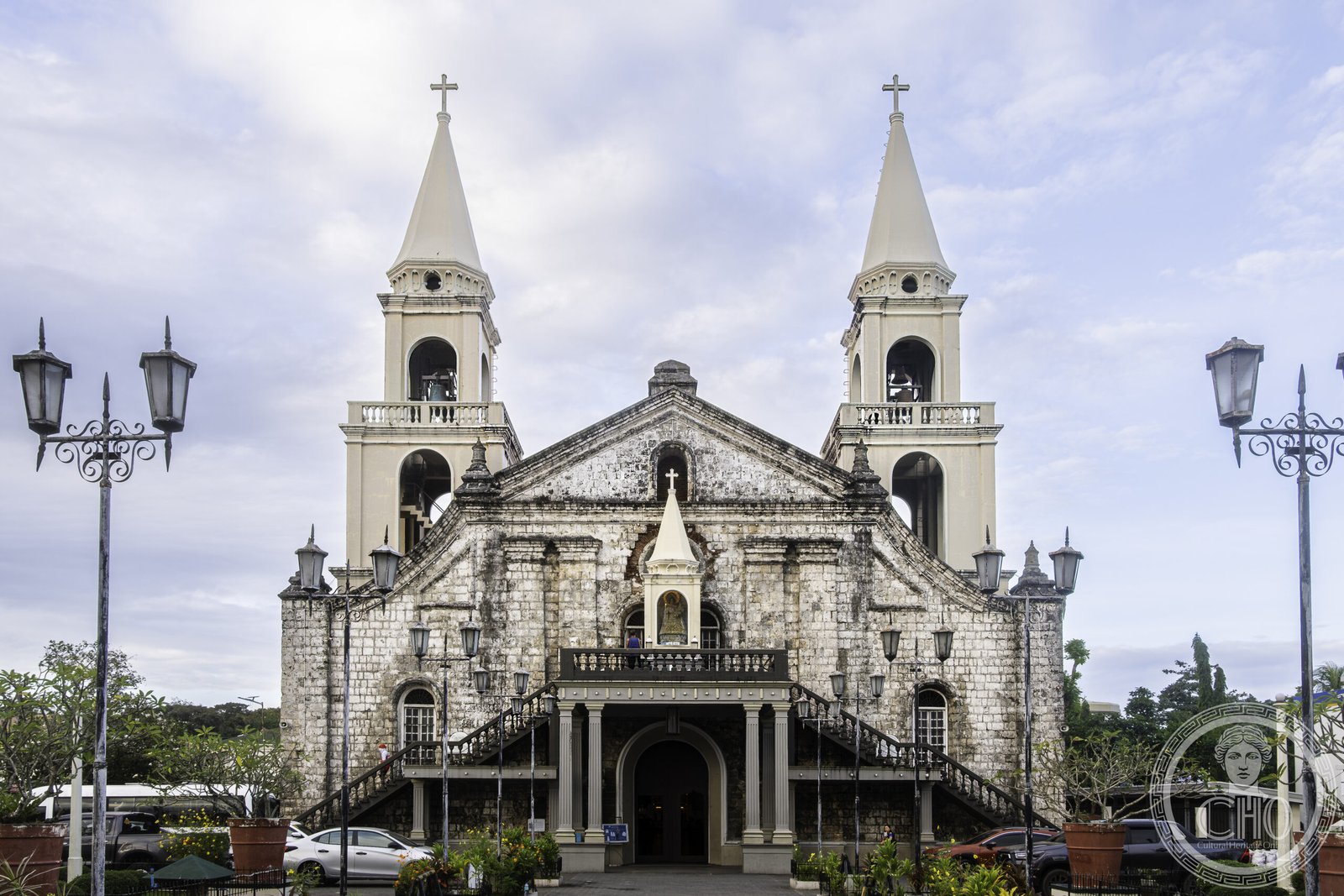
A coral-stone Romanesque Revival facade with twin bell towers, a central pediment and statue niche, and dual external staircases leading to the choir loft, facing the old Plaza Jaro across from its separate, centuries-older detached belfry.
Practical information
- Opening hours: generally open daily outside services; check current hours before visiting.
- Address: Jaro district, Iloilo City, 5000 Iloilo, Philippines, facing the old Plaza Jaro.
Getting there
The cathedral stands in the Jaro district of Iloilo City, facing the old Plaza Jaro (now Graciano Lopez Jaena Park). GPS: 10.7233°N, 122.5561°E.
Nearby
- Jaro Belfry (Campanario de Jaro) — the cathedral’s detached 1744 bell tower, directly across the street.
Sources
- Vatican.va — official record, Pope John Paul II’s 20 February 1981 meeting at Jaro Cathedral.
- Wikipedia — “Jaro Cathedral,” “Jaro Belfry,” “Archdiocese of Jaro,” “Nuestra Señora de la Candelaria de Jaro”
- UCA News — Archdiocese of Jaro directory entry.
- Philippine News Agency, Philippine Daily Inquirer — coverage of the Jaro Belfry’s 2022 restoration.
Find it on the map
See this place and what’s around it →📷 Become a Cultural Heritage Online photographer
Share your photos of places: they stay published under your name as the author. The more they're seen, the more you get noticed — and soon a contest will reward the most appreciated photos.
Log in or sign up free to add a photo