
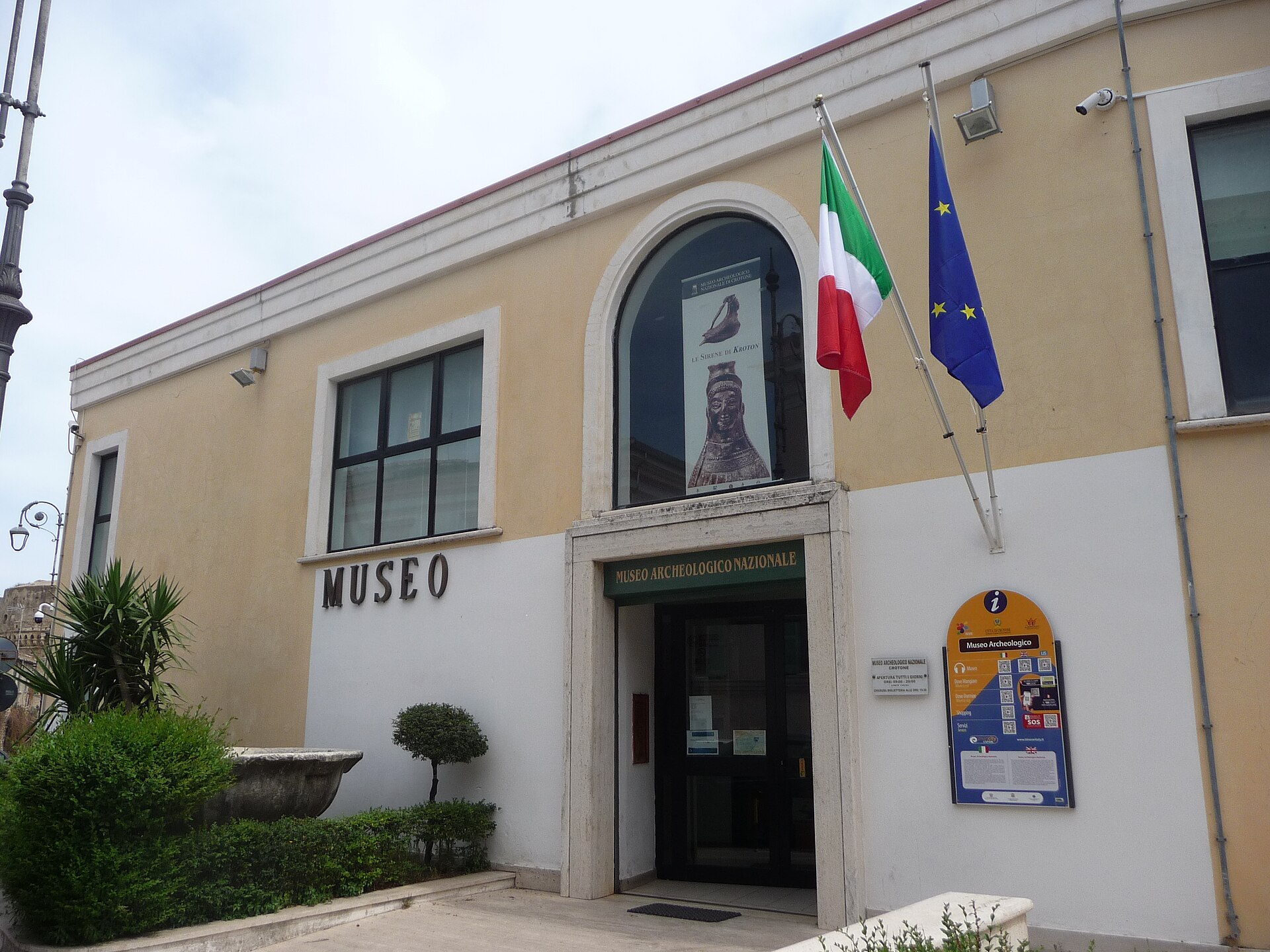
The National Archaeological Museum of Crotone preserves the material legacy of one of antiquity’s most storied Greek colonies. Founded on the Ionian coast of Calabria, ancient Kroton was home to Pythagoras’s famous school and the sanctuary of Hera Lacinia at Capo Colonna — still one of Italy’s most evocative ancient sites. The museum’s collections trace the city’s arc from Achaean foundation in the eighth century BC through the Roman period, offering an essential window into Magna Graecia on the toe of Italy’s boot.
At a glance
- Type
- State archaeological museum (Museo Nazionale)
- Period
- Collections spanning c. 8th century BC to late Roman period
- Style
- Magna Graecia / Greek colonial and Roman provincial archaeology
- Location
- Crotone, Calabria, southern Italy (Ionian coast)
- Coordinates
- 39.0801° N, 17.1311° E
Overview
Crotone (ancient Kroton) was founded by Achaean colonists around 710 BC and rapidly became one of the wealthiest and most powerful cities in Magna Graecia, celebrated for its athletes, its philosophers, and the sanctuary of Hera at Capo Colonna some ten kilometres south of the city. The museum serves as the primary institutional guardian of finds from Kroton itself, from Capo Colonna, and from the surrounding territory of ancient Crotoniate territory. Its holdings illuminate not only the city’s prosperity but also its deep religious and intellectual culture.
History
Ancient Kroton rose to prominence in the sixth century BC, when it produced Milo of Croton, the legendary wrestler and six-time Olympic champion, and hosted Pythagoras, who established his philosophical and mathematical school there after leaving Samos around 530 BC. The city defeated Sybaris in 510 BC in a conflict that reshaped the balance of power in Magna Graecia. Later absorbed into the Roman sphere, it functioned as a strategic port on the Ionian route. Systematic archaeological excavation of Kroton and Capo Colonna intensified during the 20th century, producing the core of the current museum collection.
What you see
The museum displays votive offerings, terracotta figurines, architectural fragments, coins, and ceramics from the Heraion of Capo Colonna, one of the most important sanctuaries of Hera in the Greek world, as well as finds from urban Kroton including inscriptions, bronze objects, and grave goods. The single surviving column of the Capo Colonna temple — a Doric column of the fifth century BC — is not in the museum but remains in situ at the promontory, a landmark visible for miles. Inside, the numismatic collection illustrates the city’s independent coinage as a sign of its political and economic authority.
Cultural significance
Crotone’s place in the history of Western thought — as the adopted city of Pythagoras and his school of mathematics, music theory, and cosmology — gives the museum a significance that extends well beyond regional archaeology. The sanctuary of Hera at Capo Colonna was a meeting point for Greek traders and pilgrims from across the Mediterranean, and objects in the collection reflect those wide connections. For students of Magna Graecia, this museum is an indispensable complement to the museums of Reggio Calabria, Taranto, and Paestum.
Practical information
- Address
- Via Risorgimento 18, 88900 Crotone KR, Italy
- Hours
- Check official website (Musei Calabria — MiC) for current opening times; typically closed Mondays
- Admission
- Check official website for current rates; EU citizens under 18 typically free
Getting there
Crotone is served by Sant’Anna Airport with domestic flights from Rome and Milan. By train, the nearest main-line station is Crotone on the Ionian coastal railway (Reggio Calabria – Taranto line); from the station the museum is a short taxi or bus ride. By road, the A2 Autostrada del Mediterraneo connects to Crotone via the SS107 through the Sila mountains, or via the SS106 Jonica coastal highway. Capo Colonna archaeological site is a further 10 km south along the SS106.
Sources & resources
See the place
Find it on the map
See this place and what’s around it →📷 Become a Cultural Heritage Online photographer
Share your photos of places: they stay published under your name as the author. The more they're seen, the more you get noticed — and soon a contest will reward the most appreciated photos.
Log in or sign up free to add a photoIs this page about you?
This page is read by travellers and heritage enthusiasts who find it on Google. Tell us how you are connected to this place and we will take it from there.