
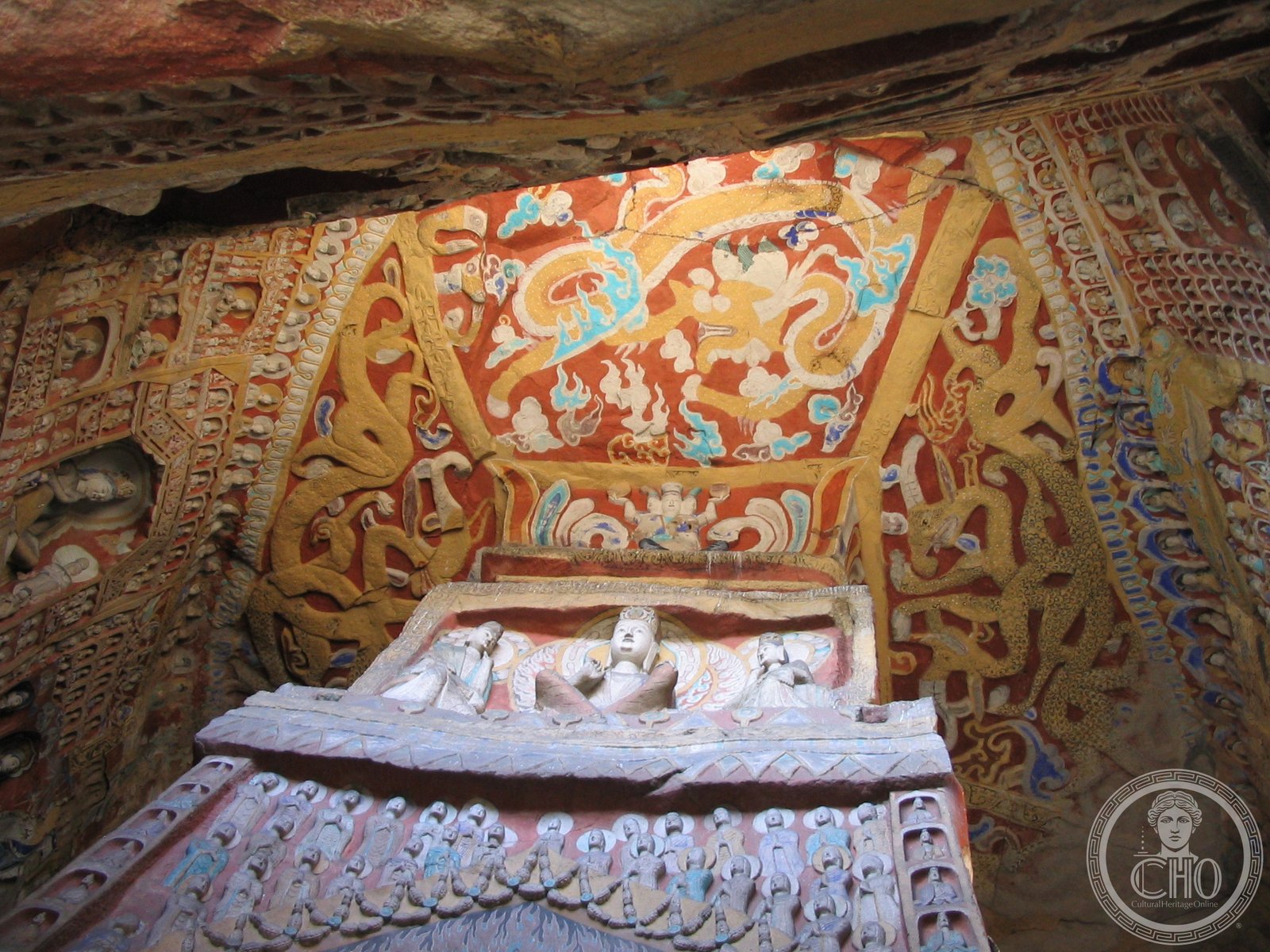
The Yungang Grottoes are a complex of ancient Buddhist temple grottoes carved into the sandstone cliffs near Datong in Shanxi Province, China. Commissioned by the Northern Wei dynasty emperors and excavated primarily between 460 and 525 CE, they represent one of the three great centres of Buddhist rock-cut sculpture in China alongside Longmen and Mogao. The site comprises 252 grottoes and 51,000 stone statues and has been a UNESCO World Heritage Site since 2001.
At a glance
- Type
- Buddhist rock-cut temple grottoes
- Period
- Main construction phase 460–525 CE (Northern Wei dynasty)
- Style
- Northern Wei Buddhist sculptural art; blend of Indian, Central Asian, and Chinese traditions
- Location
- Yungang, Datong, Shanxi Province, China (16 km west of Datong city centre)
- Coordinates
- 40.1096° N, 113.1297° E
- UNESCO
- World Heritage Site since 2001
Overview
Stretching for roughly one kilometre along the base of the Wuzhou Shan cliffs, the Yungang Grottoes constitute one of the outstanding examples of rock-cut architecture in Asia. The 252 surviving caves range from tiny niches to soaring halls housing colossal seated Buddhas, and together contain approximately 51,000 carved figures. The site records in stone the transmission of Buddhist artistic traditions from Gandharan Central Asia into the heart of China, while simultaneously documenting the emergence of a distinctively Chinese Buddhist visual language.
History
Excavation began in 460 CE under the monk Tanyao, who directed the carving of five great caves (Caves 16–20) at the command of the Northern Wei emperor Wenchengdi; these earliest caves, each containing a colossal Buddha modelled in part on the reigning emperor, are considered the finest expression of the site’s imperial phase. Work continued under subsequent Northern Wei emperors through the early 6th century, producing caves of increasing elegance and Chinese stylistic integration. After the Wei capital moved to Luoyang in 494, private patrons and local officials continued carving on a smaller scale into the Tang dynasty. The site suffered periodic damage but has been under systematic conservation since the 1950s.
What you see
The caves are conventionally grouped into eastern (Caves 1–4), central (Caves 5–20), and western (Caves 21–45) sections. Caves 5 and 6 are celebrated for their richly painted and carved interiors, while Cave 5 houses a 17-metre seated Buddha — one of the tallest in the complex. Caves 16–20, the earliest Tanyao group, each contain a monumental seated or standing Buddha up to 13.7 metres high. Intricate decorative carving covering every available surface shows the assimilation of South and Central Asian floral, figural, and architectural motifs into a Chinese idiom.
Cultural significance
Listed as a UNESCO World Heritage Site in 2001, the Yungang Grottoes are valued as an exceptional artistic achievement and as a key document in the history of Buddhism’s eastward spread along the Silk Road. The site illustrates the fusion of Hellenistic, Indian Gupta, and Chinese Han artistic traditions in a single concentrated body of work, providing irreplaceable evidence for the cultural exchanges of the first millennium CE.
Practical information
- Address
- Yungang Scenic Area, Datong, Shanxi Province, China
- Admission
- Paid entry; combination tickets available with the Datong city wall and other sites
Getting there
The grottoes lie approximately 16 kilometres west of central Datong. Public bus routes connect the city centre and Datong Railway Station to the Yungang scenic area. Taxis and ride-share services are widely available. Datong is accessible by high-speed rail from Beijing (approximately 1 hour 50 minutes) and from other major Chinese cities.
Sources & resources
See the place
Find it on the map
See this place and what’s around it →📷 Become a Cultural Heritage Online photographer
Share your photos of places: they stay published under your name as the author. The more they're seen, the more you get noticed — and soon a contest will reward the most appreciated photos.
Log in or sign up free to add a photo