
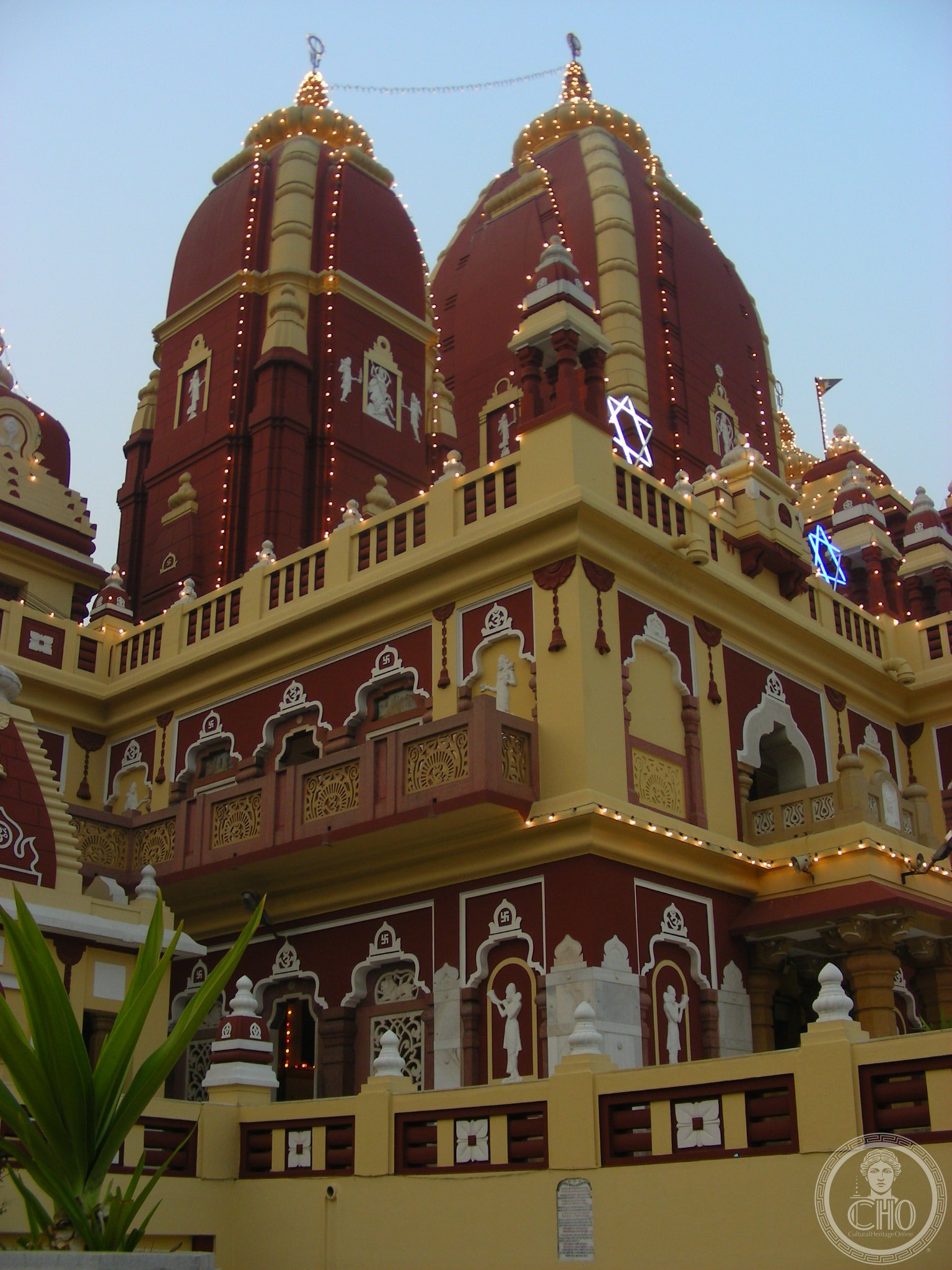
The Laxminarayan Temple, also known as Birla Mandir, is a large Hindu temple in New Delhi dedicated to Laxminarayan — Lord Vishnu together with his consort Lakshmi. Built by the Birla family between 1933 and 1939, the temple was inaugurated by Mahatma Gandhi on the condition that it would be open to worshippers of all castes, making it an early symbol of religious inclusivity in modern India. With its towering shikhara and extensive campus, it is one of the most prominent Hindu temples in the capital.
At a glance
- Type
- Hindu temple
- Period
- Built 1933–1939; inaugurated 1939
- Style
- Orissan / Nagara temple architecture with modern elements
- Location
- New Delhi, India · 28.6327° N, 77.1988° E
Overview
The Laxminarayan Temple sits in the Connaught Place area of New Delhi and is one of a network of Birla Mandirs built by the industrialist Birla family across India. The presiding deities are Laxminarayan — Vishnu and Lakshmi — with additional shrines to Shiva, Ganesha, Hanuman, and the Buddha within the complex. Its inauguration by Gandhi on the condition of caste-free admission gave the temple lasting historical significance beyond its religious function.
History
Construction was initiated by industrialist Jugal Kishore Birla and completed in 1939. Mahatma Gandhi agreed to inaugurate the temple only after receiving assurances that entry would not be restricted by caste — a groundbreaking commitment in pre-Independence India, where many temples remained closed to lower-caste Hindus. The temple opened on 7 March 1939 and quickly became a prominent landmark in the newly planned imperial capital. It continues to attract large numbers of worshippers and visitors, particularly during Hindu festivals.
What you see
The main temple tower (shikhara) rises in the Orissan Nagara style, clad in white marble and sandstone, and dominates the skyline of the surrounding neighbourhood. The main sanctum enshrines large images of Vishnu and Lakshmi, richly decorated with floral offerings and gold ornaments. The complex also includes a geeta bhawan for recitations of Hindu scriptures, a well-tended garden, and smaller shrines dedicated to Shiva, Ganesha, Hanuman, and the Buddha — reflecting the Birla family’s inclusivist religious outlook.
Cultural significance
Beyond its religious role, the Laxminarayan Temple carries important social history as one of India’s first major temples explicitly opened to all castes, inaugurated with Gandhi’s involvement at a pivotal moment in the independence movement. It represents the intersection of philanthropic industrialism, Hindu revivalism, and social reform in 20th-century India.
Practical information
- Address
- Mandir Marg, New Delhi 110001, India
- Hours
- Open daily, typically 06:00–22:00; check official sources for festival schedules
- Admission
- Free entry; photography may be restricted inside the sanctum
Getting there
The temple is located on Mandir Marg in central New Delhi, approximately 1 km from Patel Chowk Metro Station (Yellow Line) and about 1.5 km from Connaught Place. Auto-rickshaws, taxis, and Delhi Metro are all convenient options. The temple is well signposted and easily reached on foot from the surrounding area.
Sources & resources
See the place
Find it on the map
See this place and what’s around it →📷 Become a Cultural Heritage Online photographer
Share your photos of places: they stay published under your name as the author. The more they're seen, the more you get noticed — and soon a contest will reward the most appreciated photos.
Log in or sign up free to add a photoIs this page about you?
This page is read by travellers and heritage enthusiasts who find it on Google. Tell us how you are connected to this place and we will take it from there.