
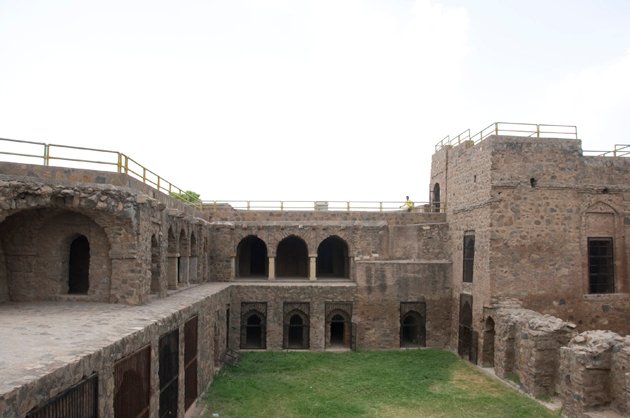
Firoz Shah Palace Complex
A fortified city built by Delhi Sultanate ruler Firoz Shah Tughlaq in 1354, Hisar-e-Firoza overlays an ancient settlement and incorporates spolia from destroyed Hindu temples within its polygonal rampart.
At a glance
Firoz Shah palace complex lies at the heart of Hisar-e-Firoza, a walled fort city constructed on the site of the ancient Vedic city of Isukāra. The fort contains the royal citadel, the Lat-Ki-Masjid complex with an Ashokan pillar, and protected archaeological structures maintained by the Archaeological Survey of India.
History
In 1354, Firoz Shah Tughlaq of the Delhi Sultanate established this fort city atop a Sindhu-Saraswati Valley Civilisation and Vedic Period archaeological mound. The site was not empty wasteland but a strategic stronghold within dense deciduous forest requiring extensive clearing for military passage.
Firoz Shah claimed to have created canals, yet archaeological evidence shows he desilted and diverted the ancient Drishadvati River paleochannel—a water system originally managed during the Mauryan Empire. He similarly occupied the pre-existing Uttarapatha trade highway connecting Delhi, Hisar, Multan and Khorasan, a route established during the Sindhu-Saraswati Valley Civilisation era.
In 1356, Tughlaq built the Gujari Mahal and Charbagh Garden immediately north of the rampart for his wife Gurjari. Following the 1857 War of Independence, British authorities demolished outer walls and sold rubble to local builders, obliterating much of the original fortification.
What you see
The fort’s polygonal rampart, rather than a perfect square, is defined by the projecting Royal Citadel in the northwest and originally featured multiple gates: the Nagori Gate, Delhi Gate at Gandhi Chowk, and Mori Gate. An outer moat, now mud-filled, is traceable through the raised street elevation surrounding the old city.
The citadel and Lat-Ki-Masjid complex employ spolia—reused architectural elements including stone from destroyed Hindu temples looted locally and from nearby Agroha Mound. The Gujari Mahal and Charbagh Garden, originally within their own light enclosures north of the main walls, remain partially visible. The outer rampart footprint survives in the topography and historical market alignments, though most standing stonework has been lost.
Cultural significance
Hisar-e-Firoza represents a pivotal moment when sultanate power consolidated frontier control through military architecture and the appropriation of existing infrastructure. The reuse of temple stone and the renaming of Isukāra as “Hisar” reflect the religious and political dynamics of 14th-century Delhi Sultanate expansion.
The fort also documents Mughal-era engineering, built upon millennia of settlement spanning Vedic civilisation through Mauryan administration to medieval sultanates—making it an archaeological palimpsest of Indian history.
Key facts
- Country: India
- City: Hisar, Haryana
- Founded: 1354 CE by Firoz Shah Tughlaq
- Coordinates: 29.166306, 75.720587
- Maintained by: Archaeological Survey of India
- UNESCO status: Not listed
Practical information & getting there
The Shahi Darwaza (royal gate) entrance is 100 metres east of Hisar’s main bus stand. The site lies 4.5 km southwest of Hisar Airport, 2 km north of Hisar Junction railway station, and 25 km southeast of Agroha Mound via NH9. The Jahaj Kothi Museum, a former residence of George Thomas, sits 2 km east of the citadel, just outside the historic rampart.
Sources & resources
Find it on the map
See this place and what’s around it →📷 Diventa un fotografo di Cultural Heritage Online
Condividi le tue foto dei luoghi: restano pubblicate con la tua firma come autore. Più vengono viste, più ti fai conoscere — e presto un concorso premierà le foto più apprezzate.
Accedi o registrati gratis per aggiungere una fotoDo you manage this place?
This page is read by travellers and heritage enthusiasts who find it on Google. Keep it accurate — and make it work for you. Free for non-profit heritage institutions.