
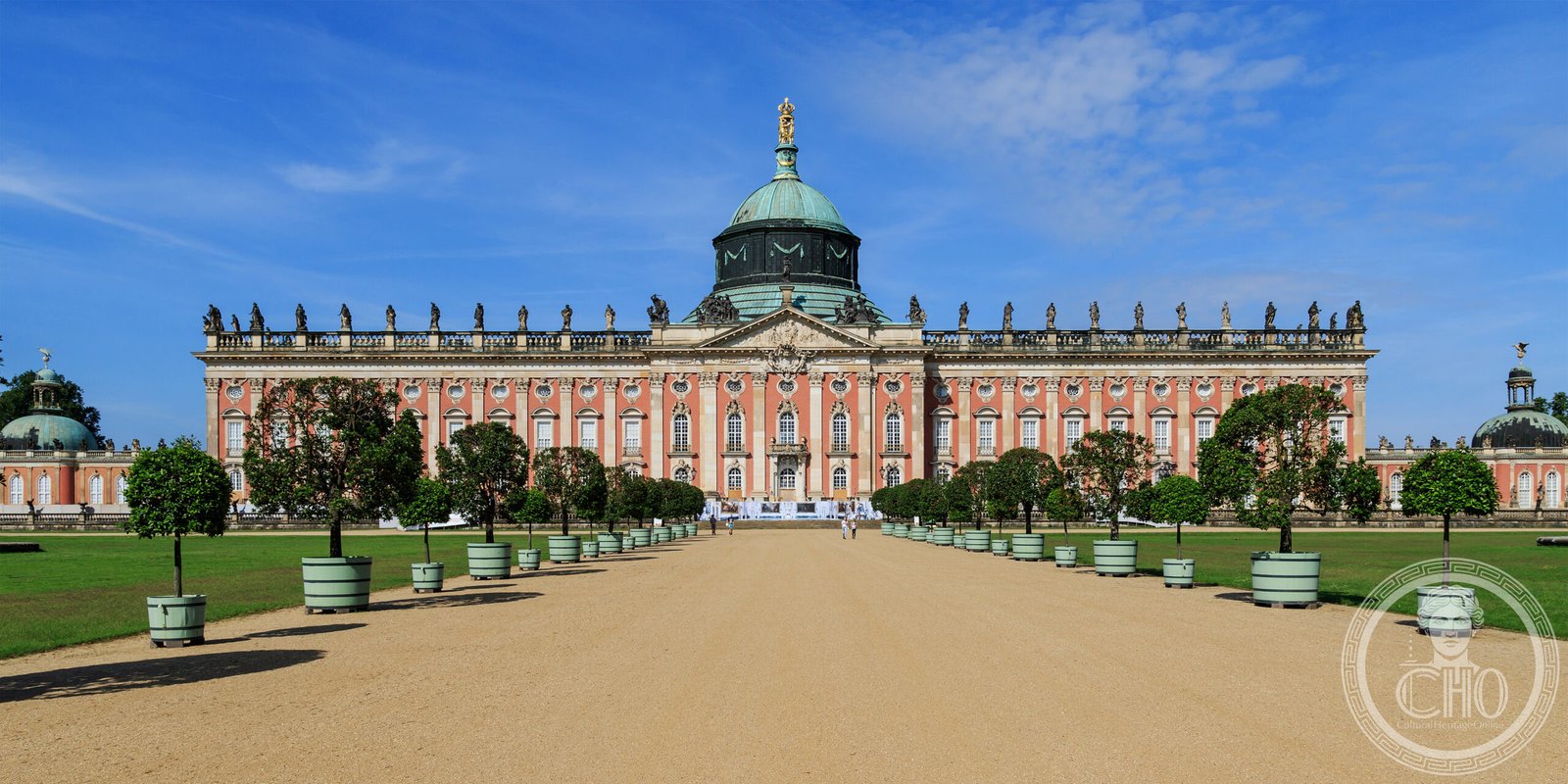
Potsdam is the capital of the German state of Brandenburg and one of Europe’s most distinguished planned royal landscapes, situated on the River Havel 25 kilometres southwest of central Berlin amid a hilly morainic terrain studded with lakes and parks. Home to the palaces and gardens of Sanssouci—the Prussian Versailles created by Frederick the Great from 1745—the city’s historic ensemble of royal parks, Chinese pagodas, mock-Roman baths, and Baroque town palaces is inscribed as a UNESCO World Heritage Site. Potsdam also carries modern historical weight as the site of the 1945 Potsdam Conference, where the Allied powers shaped the postwar European order.
At a glance
- Type
- Historic city; royal palace and garden landscape
- Period
- First documented 993 AD; major royal development 17th–19th century
- Style
- Baroque, Rococo, Neoclassical, and eclectic historicist architecture
- Location
- Potsdam, Brandenburg, Germany (25 km SW of central Berlin)
- Coordinates
- 52.4283° N, 12.8873° E
- Status
- UNESCO World Heritage Site (Palaces and Parks of Potsdam and Berlin, 1990/1992/1999)
Overview
Potsdam owes its extraordinary architectural character to three centuries of Hohenzollern patronage, during which the electoral and later royal capital of Brandenburg-Prussia was transformed into a showcase of European palace culture. The centrepiece is Sanssouci Park, where Frederick the Great’s intimate summer palace of 1747—a single storey of Rococo rooms perched above terraced vineyards—anchors a wider landscape of follies, temples, and garden buildings that extends to the vast New Palace of 1769. Beyond Sanssouci, the city’s Baroque Dutch Quarter, Russian colony of Alexandrowka, and Babelsberg Park (the summer residence of Kaiser Wilhelm I) add further layers to a cultural landscape unmatched in density and variety outside of Paris.
History
Potsdam is first mentioned in a 993 AD deed; it grew as a market town before the Hohenzollerns chose it as a secondary residence in the 17th century. The Great Elector Frederick William (r. 1640–1688) began fortifying and beautifying the city; his grandson Frederick I proclaimed himself King in Prussia in 1701. Frederick the Great (r. 1740–1786) made Potsdam his preferred residence, personally supervising the design of Sanssouci and populating the court with Enlightenment intellectuals including Voltaire. The city later served as an imperial garrison town and in July–August 1945 hosted the Potsdam Conference between Truman, Stalin, and Attlee, which determined Germany’s postwar division.
What you see
The central attraction is the 300-hectare Sanssouci Park, freely walkable and containing Sanssouci Palace, the Orangery, the Charlottenhof Palace, the Chinese House, and the Roman Baths—each a self-contained architectural set piece within the designed landscape. The New Palace at the western end of the park is the grandest of the Prussian royal buildings, its red brick facade 213 metres wide. In the city itself, the Dutch Quarter (Holländisches Viertel) preserves 134 red brick houses built for Dutch craftsmen in the 1730s–1740s; the Russian colony of Alexandrowka consists of log-house structures built in 1826–1827 for a Russian choir gifted to Friedrich Wilhelm III. The Cecilienhof Palace, where the 1945 Conference was held, is now a hotel and memorial museum.
Cultural significance
Potsdam’s palace landscape is the most complete surviving expression of Prussian royal culture and the political-aesthetic ambitions of the Enlightenment monarchy, comparable in European terms only to Versailles or the Escorial. Its UNESCO inscription in 1990 (extended 1992 and 1999) covers over 500 hectares of parks and 150 buildings, reflecting the exceptional density and quality of the heritage. The city is also a nexus of 20th-century history: the 1945 conference held at Cecilienhof set the legal framework for a divided Germany that endured for 45 years.
Practical information
Sanssouci Park is freely accessible year-round from dawn to dusk; individual palaces have separate admission fees and opening hours (typically April–October, Tuesday to Sunday). The Prussian Palaces and Gardens Foundation (spsg.de) manages all royal sites and provides current ticketing information. A combination ticket (Sanssouci+) offers access to multiple buildings. The park is best visited on weekdays to avoid weekend crowds from Berlin. Bring walking shoes—the park is extensive and paths cover significant distances.
Getting there
Potsdam is directly connected to Berlin by the S-Bahn S7 line (approximately 40 minutes from Berlin Hauptbahnhof to Potsdam Hauptbahnhof) and by regional trains RE1 (25 minutes). From Potsdam Hauptbahnhof, trams 91 and 94 serve the main park entrance at Luisenplatz/Brandenburger Tor. Cycling from Berlin along the Havel towpath is a popular 30–40 km route. By car, Potsdam is reached via the A115 motorway; parking is available near the park but fills quickly on summer weekends.
Sources & resources
See the place
Find it on the map
See this place and what’s around it →📷 Become a Cultural Heritage Online photographer
Share your photos of places: they stay published under your name as the author. The more they're seen, the more you get noticed — and soon a contest will reward the most appreciated photos.
Log in or sign up free to add a photo