
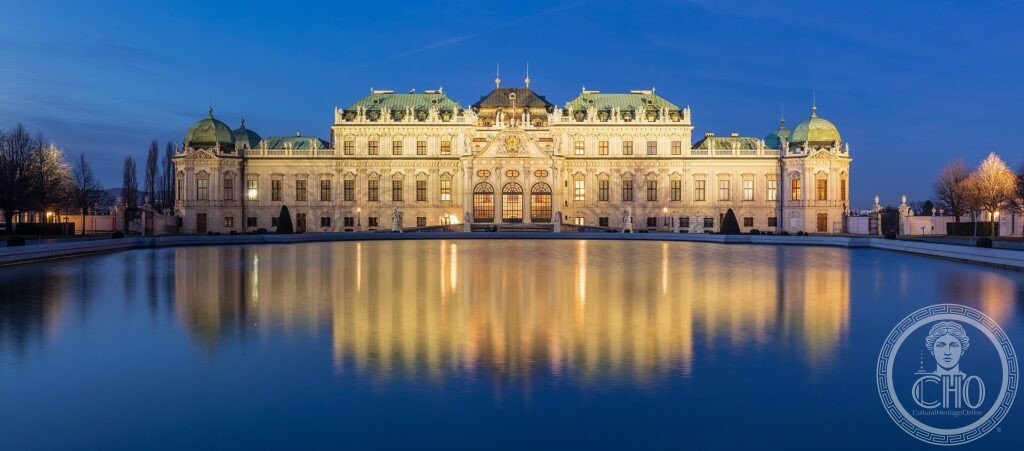
The Belvedere is a Baroque palace complex in Vienna built between 1712 and 1722 for Prince Eugene of Savoy, the celebrated military commander of the Habsburg Empire. Designed by Johann Lukas von Hildebrandt, the estate comprises two palaces — the Upper Belvedere and the Lower Belvedere — connected by a formal terraced garden considered one of the finest examples of Austrian Baroque garden design. The Upper Belvedere is home to the Österreichische Galerie Belvedere, which holds the world’s largest collection of paintings by Gustav Klimt, including his iconic The Kiss (1907–1908), and the hall in which the Austrian State Treaty restoring Austrian sovereignty was signed on 15 May 1955.
At a glance
- Type
- Baroque palace complex and art museum
- Period
- Lower Belvedere 1712–1716; Upper Belvedere 1717–1722
- Style
- Austrian Baroque
- Architect
- Johann Lukas von Hildebrandt
- Location
- Prinz-Eugen-Strasse 27 (Upper) / Rennweg 6 (Lower), 1030 Vienna, Austria
- Coordinates
- 48.1916° N, 16.3780° E
Overview
The Belvedere complex stretches across a gentle south-facing slope in Vienna’s third district, with the Lower Belvedere at the foot serving as Prince Eugene’s summer residence and the Upper Belvedere at the crest functioning as a ceremonial reception palace. The gardens between them are laid out in three descending terraces with fountains, parterres, sculptural cascades, and clipped hedges, offering views from the Upper Belvedere across the formal axis toward the spires of the historic city. After Eugene’s death in 1736 the estate was purchased by the Habsburg imperial family and passed through several uses before the Upper Belvedere became a permanent gallery in 1903.
History
Prince Eugene of Savoy commissioned Johann Lukas von Hildebrandt to design the Lower Belvedere in 1712 as a summer retreat after his decisive military victories against the Ottomans; construction of the Upper Belvedere followed between 1717 and 1722. The estate was celebrated in its own time as one of the grandest princely residences in the German-speaking world. Following Eugene’s death without heirs, Empress Maria Theresa purchased the Belvedere in 1752 and used it as an imperial pleasure residence; her son Crown Prince Ferdinand lived there until he was sent to Milan. In 1896, Crown Prince Franz Ferdinand of Austria made the Upper Belvedere his Vienna residence, and it was from this palace that he departed on 28 June 1914 for his fateful journey to Sarajevo. The Austrian State Treaty was signed in the Marble Hall of the Upper Belvedere on 15 May 1955, restoring full Austrian sovereignty after the Allied occupation.
What you see
The Upper Belvedere museum displays Austrian art from the Middle Ages to the early 20th century across three floors; the centrepiece is the Klimt collection with The Kiss, Judith, and Adele Bloch-Bauer II, hung in the Golden Cabinet alongside works by Egon Schiele and Oskar Kokoschka. The Marble Hall — where the State Treaty was signed — preserves its original frescoed ceiling by Carlo Carlone and marble pilasters. The Lower Belvedere houses the Baroque Museum with Hildebrandt’s original staterooms and the Orangery, used for temporary exhibitions. The terraced gardens are freely accessible year-round and are planted with seasonal flowers, box parterres, and a rose garden.
Cultural significance
The Belvedere is among the most visited cultural sites in Austria, drawing over 1.5 million visitors annually, and its Klimt collection has defined international understanding of Viennese Jugendstil. The signing of the Austrian State Treaty in the Marble Hall gives the Upper Belvedere a primary place in 20th-century European political history, making it simultaneously a Baroque masterpiece, an art museum, and a site of living memory.
Practical information
- Address
- Prinz-Eugen-Strasse 27, 1030 Vienna, Austria (Upper Belvedere)
- Opening hours
- Upper Belvedere: daily 09:00–18:00; Friday until 21:00. Gardens: daily, free of charge. Check official website for Lower Belvedere hours and temporary exhibitions.
- Admission
- Fee for Upper and Lower Belvedere; gardens free; combined tickets available
Getting there
The Upper Belvedere is served by tram line D (stop: Schloss Belvedere) and by bus line 69A. From Vienna’s city centre, the D tram departs from the Ringstrasse at the Opera and reaches the Belvedere in approximately 10 minutes. The nearest U-Bahn station is Südtiroler Platz (U1), about 15 minutes on foot. Parking is limited; public transport is strongly recommended.
Sources & resources
See the place
Find it on the map
See this place and what’s around it →📷 Become a Cultural Heritage Online photographer
Share your photos of places: they stay published under your name as the author. The more they're seen, the more you get noticed — and soon a contest will reward the most appreciated photos.
Log in or sign up free to add a photo