
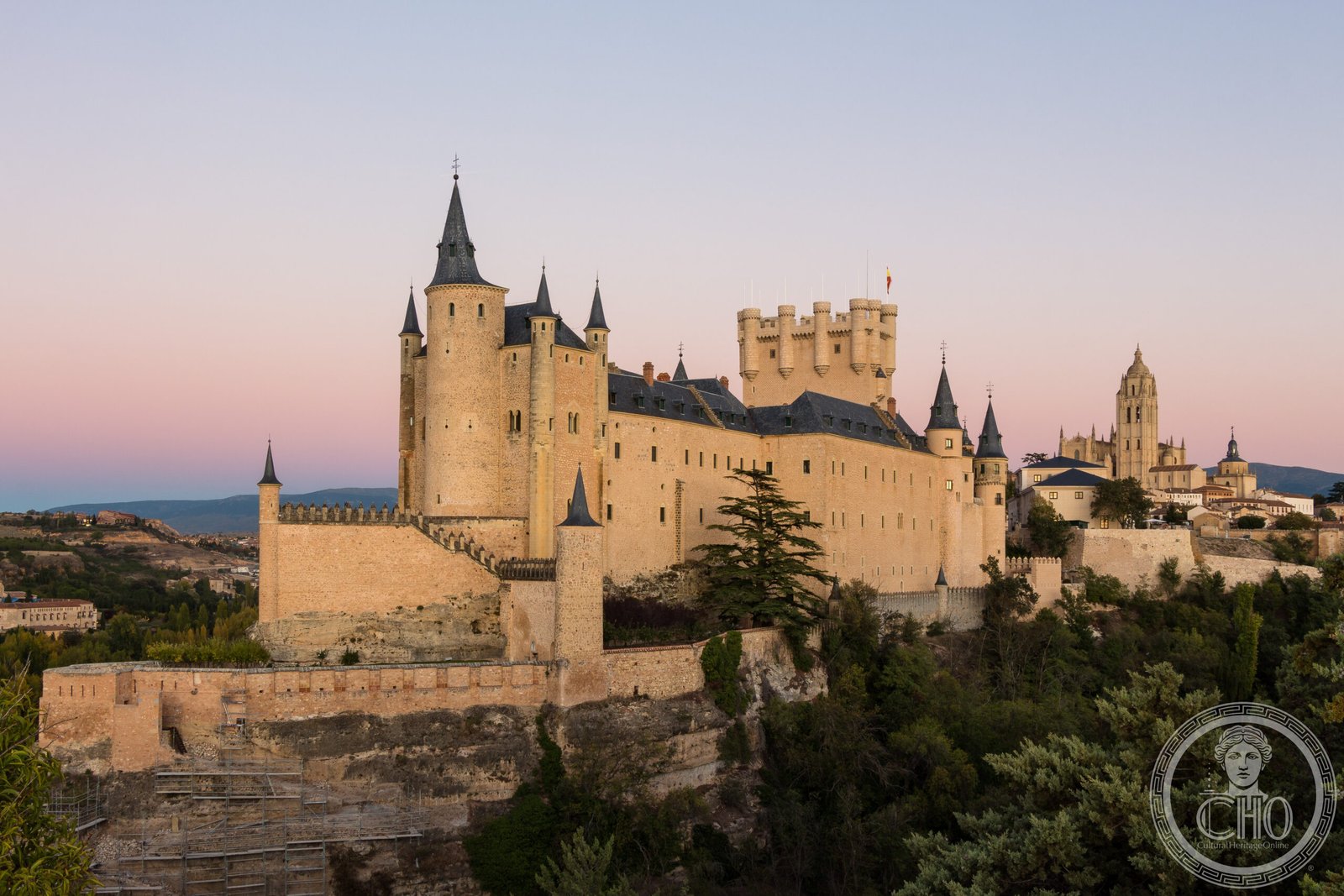
The Alcázar of Segovia is a medieval castle-palace rising from a rocky crag at the confluence of the Eresma and Clamores rivers on the western edge of Segovia’s old city, in Castile and León, Spain. One of the most distinctive silhouettes in Iberian architecture, its dramatically pointed slate towers and ship-prow ground plan have made it an emblem of the region. The castle served successively as a royal residence, state prison, Royal Artillery College, and today functions as a museum and archive under the Patronato del Alcázar.
At a glance
- Type
- Royal castle-palace and fortress
- Period
- Earliest documented reference 1122; main construction 12th–16th century; rebuilt after 1862 fire
- Style
- Romanesque, Gothic, Mudéjar, Renaissance
- Location
- Segovia, Castile and León, Spain (40.9468° N, 4.1963° W)
Overview
The Alcázar stands on a rocky promontory that has been fortified since at least the early 12th century, making it one of Castile’s oldest military structures. It served as one of the favourite residences of the monarchs of Castile, and it was from here that Isabella I was proclaimed Queen of Castile in 1474. The castle’s striking silhouette is widely cited as one of the inspirations for Walt Disney’s design of Cinderella’s castle at Disneyland.
History
The first certain reference to the Alcázar as a royal fortress dates to 1122, though the site was likely fortified under the Romans and Moors before Castilian reconquest. Alfonso VIII expanded it in the 12th century, and Alfonso X “the Wise” added the Hall of the Kings with its carved wooden frieze of Castilian monarchs. Under the Trastámara dynasty in the 15th century, the towers were given their characteristic slate spires in a style influenced by Flemish and central European models. A devastating fire in 1862 destroyed much of the interior; reconstruction was completed by 1882, restoring the towers and replenishing many of the decorative rooms.
What you see
Visitors enter across a drawbridge into a courtyard flanked by the main tower — the Torre del Homenaje — and the lower residential wings. The throne room is fitted with a gilded artesonado (Mudéjar carved-wood) ceiling, while the Hall of the Kings displays a continuous carved frieze of 52 monarchs of Asturias and Castile. The keep offers a panoramic view of the Segovian plain, the cathedral, and on clear days the Sierra de Guadarrama. The castle also houses the General Military Archive of Segovia and a small arms collection.
Cultural significance
The Alcázar is part of the Old Town of Segovia and its Aqueduct, inscribed as a UNESCO World Heritage Site in 1985. It remains the most visited monument in Segovia and an enduring symbol of Castilian royal power and the Reconquista. Its eclectic blend of Romanesque, Gothic, Mudéjar, and Renaissance elements charts seven centuries of Iberian architectural influence.
Practical information
- Address
- Plaza Reina Victoria Eugenia, s/n, 40003 Segovia, Spain
- Hours
- Open daily; hours vary by season — check the official website
- Admission
- Paid entry; tower climb available for additional fee
- Website
- alcazardesegovia.com
Getting there
From Madrid Chamartín station, take the regional Cercanías train to Segovia-Guiomar (approx. 30 minutes by high-speed, 2 hours by regional), then bus 11 or taxi to the old city. By car from Madrid, take the A-6 motorway north-west and then the AP-61 toll road, approximately 90 km. The Alcázar is a 15-minute walk from Segovia’s main square, the Plaza Mayor.
Sources & resources
See the place
Find it on the map
See this place and what’s around it →📷 Become a Cultural Heritage Online photographer
Share your photos of places: they stay published under your name as the author. The more they're seen, the more you get noticed — and soon a contest will reward the most appreciated photos.
Log in or sign up free to add a photo