
On Knyaz Boris I street, in the square of religious tolerance in Sofia, stands the cathedral of Saint Joseph. Beside it are the synagogue, the church of Saint Nedelya and the Banya Bashi mosque. Saint Joseph is the co-cathedral, not the principal cathedral, which is at Plovdiv in the church of Saint Louis, of the Catholic diocese of Sofia and Plovdiv. The original building, begun in 1875, was destroyed by the Allied bombing of March 1944. The community went on using a temporary co-cathedral on the same site, which Pope John Paul II visited on 25 May 2002, during his journey to Azerbaijan and Bulgaria, the first papal visit ever in the history of the country, expressing the hope that work on the new cathedral would begin soon. Contrary to what several secondary sources repeat, a personal laying of the foundation stone by him on that occasion is not confirmed by primary Vatican sources. The present building was completed and inaugurated on 21 May 2006 by the cardinal secretary of state Angelo Sodano, Pope John Paul II having died the year before. The Catholic jurisdiction goes back to the diocese of Sardica, restored in 1601 and raised to an archdiocese around 1642, reduced to the apostolic vicariate of Sofia-Plovdiv in 1758, entrusted to the Capuchins from 1841 and finally raised to a diocese on 3 March 1979. A vacancy of about twenty years followed the end of the mandate of Bishop Ivan Romanov in 1953, in the full period of communist repression, although his personal fate is not documented. The present bishop is Rumen Ivanov Stanev, appointed by Pope Leo XIV on 7 January 2026. Catholics in Bulgaria are a small minority in a country with an Orthodox majority: the census of 2021 counts about thirty-nine thousand of them, 0.7 per cent of the population, while statistics of Vatican origin give about sixty-seven thousand, 1 per cent, including also the faithful of the distinct Bulgarian Catholic Church of Byzantine rite, which has about ten thousand members and whose seat is a different cathedral, that of the Dormition. Bishop Evgenii Bossilkov, executed by the communist regime on 11 November 1952 and beatified in 1998, led the nearby diocese of Nicopolis, not that of Sofia and Plovdiv, and no documented link exists between his martyrdom and this cathedral, which at the time did not yet exist in its present form. Pope Francis visited Sofia on 5-7 May 2019 but not this cathedral, celebrating instead in the open air in Knyaz Alexander I square and in the church of the Sacred Heart at Rakovski; he did name it, however, together with other places of worship in the city, during an interfaith meeting of prayer for peace.
About the Cathedral
St. Joseph’s Cathedral, on Knyaz Boris I street in Sofia’s “Square of Religious Tolerance,” is the co-cathedral of the Diocese of Sofia and Plovdiv (whose principal cathedral is St. Louis in Plovdiv). The original 1875 building was destroyed in Allied bombing in 1944; the current reconstruction was completed and inaugurated in 2006.
Key facts
- March 1944: original cathedral destroyed in Allied bombing of Sofia.
- 25 May 2002: Pope John Paul II visits the site’s provisional co-cathedral — the first-ever papal visit to Bulgaria.
- 21 May 2006: rebuilt cathedral inaugurated by Cardinal Angelo Sodano.
- 3 March 1979: Catholic jurisdiction in Sofia-Plovdiv elevated to a full diocese.
- 11 November 1952: Bishop Evgenii Bossilkov of neighboring Nicopoli diocese executed by the communist regime, unrelated to this cathedral.
- 7 January 2026: Bishop Rumen Ivanov Stanev appointed by Pope Leo XIV.
History
Destroyed in the Allied bombing that devastated much of wartime Sofia, the cathedral’s rebuilding traces back to Pope John Paul II’s landmark 2002 visit — Bulgaria’s first ever from a pope — during which he expressed hope that reconstruction would soon begin on the site of “the ancient church destroyed by the war.” The rebuilt cathedral opened in 2006, after his death, inaugurated instead by Cardinal Angelo Sodano. Its era of construction places it outside the reach of Bulgaria’s communist-era anti-Catholic persecution, whose most notable martyr, Bishop Evgenii Bossilkov, belonged to a different, neighboring diocese entirely.
What you see
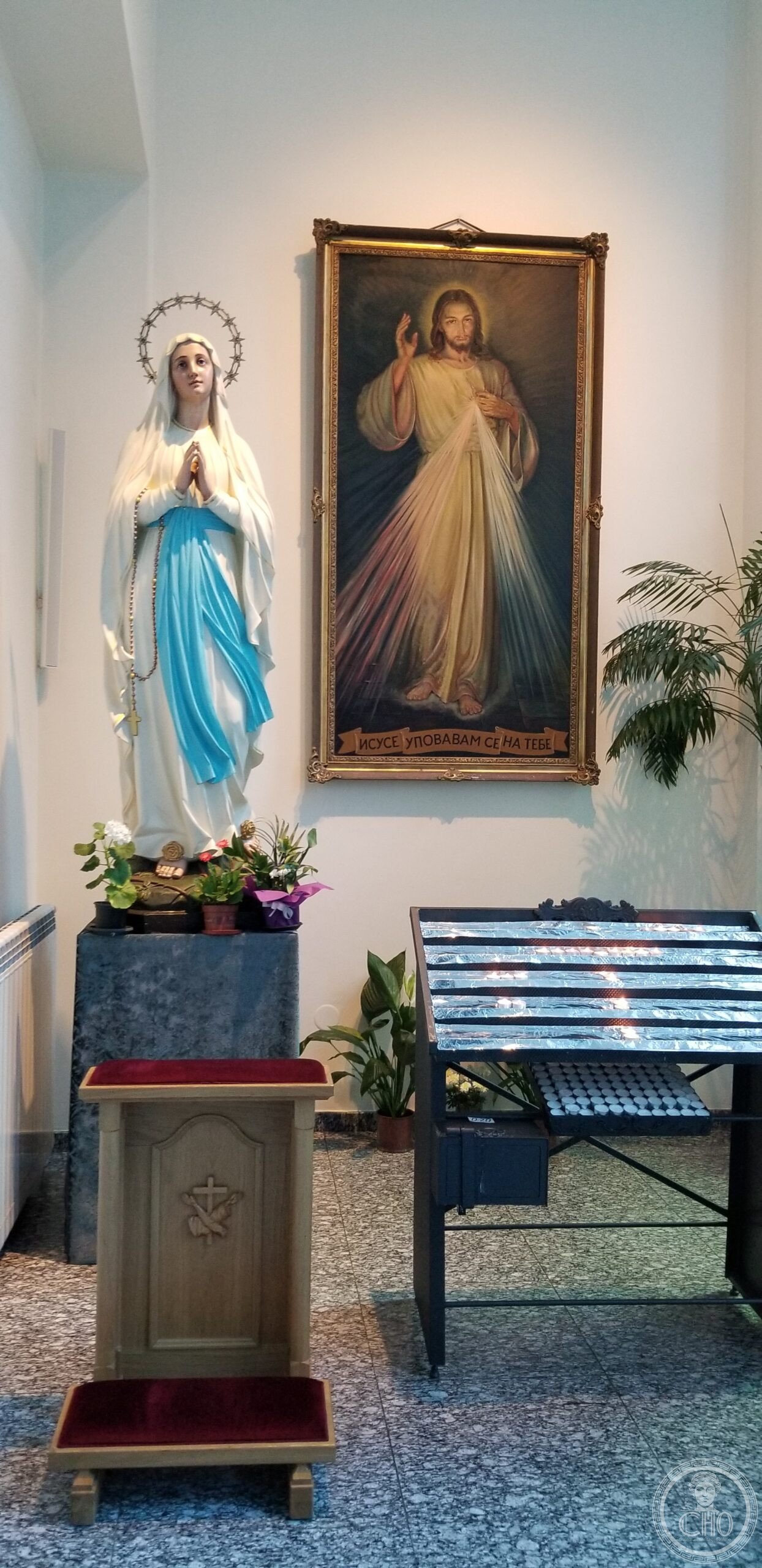
No correctly licensed exterior photograph of the cathedral is currently available, as Bulgaria has no freedom-of-panorama exception and the 2006 building remains under architectural copyright; interior views show a modern nave with a central altar flanked by statues of St. Joseph and St. Francis of Assisi, side chapels, and Stations of the Cross medallions.
Practical information
- Opening hours: generally open daily outside services; check current hours before visiting.
- Address: 146 Knyaz Boris I Street, Sofia, Bulgaria.
Getting there
The cathedral stands on Knyaz Boris I street in central Sofia, part of the city’s “Square of Religious Tolerance.” GPS: 42°41′55″N, 23°19′11″E.
Nearby
- Banya Bashi Mosque and Central Sofia Synagogue — both stand within the same “Square of Religious Tolerance” as the cathedral.
Sources
- Wikipedia — “Cathedral of St Joseph, Sofia,” “Roman Catholic Diocese of Sofia and Plovdiv,” “Catholic Church in Bulgaria,” “Eugene Bossilkov”
- GCatholic.org and Catholic-Hierarchy.org — Diocese of Sofia and Plovdiv records.
- Vatican.va — official 2002 itinerary and Pope John Paul II’s address at the Latin Co-Cathedral, Sofia.
- Vatican News — coverage of Pope Francis’s 2019 visit to Bulgaria.
- BTA (Bulgarian News Agency) — coverage of Bishop Rumen Stanev’s 2026 appointment.
Find it on the map
See this place and what’s around it →📷 Become a Cultural Heritage Online photographer
Share your photos of places: they stay published under your name as the author. The more they're seen, the more you get noticed — and soon a contest will reward the most appreciated photos.
Log in or sign up free to add a photo