
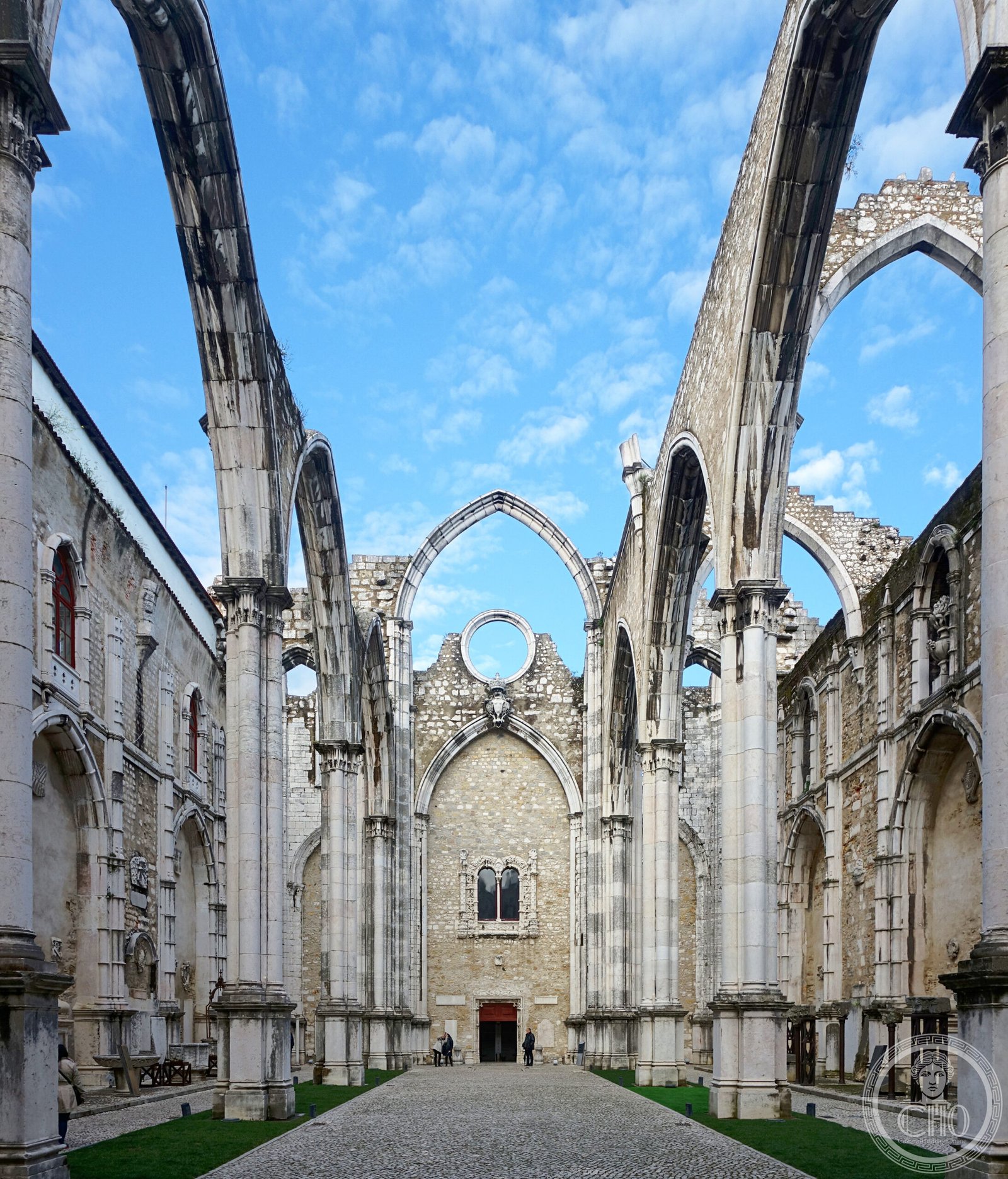
The Convento do Carmo is a ruined Gothic convent in central Lisbon, founded in 1389 by the constable Nuno Álvares Pereira and largely destroyed by the Great Lisbon Earthquake of 1755. Deliberately left roofless as a monument to the disaster, its skeletal Gothic nave now shelters the Museu Arqueológico do Carmo, one of Portugal’s most evocative museums, housing Egyptian mummies, pre-Columbian artefacts, and medieval stonework under the open sky of the surviving arched structure.
At a glance
- Type
- Ruined Gothic convent / Archaeological museum
- Period
- Founded 1389; earthquake damage 1755; museum established 1864
- Style
- Portuguese Gothic (partly restored)
- Location
- Largo do Carmo, Chiado, Lisbon · 38.7121° N, 9.1424° W
Overview
The Convento do Carmo occupies a commanding position on the Chiado hillside above the Baixa, its terrace accessible via the walkway of the Elevador de Santa Justa. The convent was the most important Carmelite house in Portugal and served as the court church of the Portuguese kings during the late medieval period. Today its partially restored Gothic nave — open to the sky following the 1755 earthquake — houses the Museu Arqueológico do Carmo, operated by the Carmelite Association of Portugal.
History
The convent was founded in 1389 by Nuno Álvares Pereira, the celebrated military commander who secured Portuguese independence at the Battle of Aljubarrota in 1385, and was the principal Carmelite church in Lisbon for nearly four centuries. The original Gothic church was completed around 1423. On 1 November 1755, the Great Lisbon Earthquake and the fires that followed destroyed most of the city, collapsing the roof of the Carmo church and leaving the nave exposed to the elements. Rather than rebuild, the decision was made to conserve the ruin, and the Archaeological Association of Portugal established a museum within the surviving structure in 1864.
What you see
The roofless nave is a Gothic space of haunting beauty, its slender columns and pointed arches framing open sky above the museum floor. The Museu Arqueológico do Carmo displays an eclectic collection: two Peruvian mummies (one a child), an Egyptian mummy, Gothic tombs of Portuguese nobles, Mayan stele fragments, Roman inscriptions, and medieval stonework. The apse, which retains its vault, houses the most significant stone sculptures. The terrace of the convent opens onto Largo do Carmo, one of Lisbon’s most pleasant squares, lined with cafés.
Cultural significance
The Convento do Carmo is classified as a National Monument of Portugal and is one of the most striking memorials to the 1755 earthquake anywhere in Europe. The decision to preserve the ruin rather than demolish or rebuild it was a pioneering act of heritage conservation, anticipating modern attitudes toward authentic ruins by over a century. The convent also holds political significance as the site where, during the Carnation Revolution of 25 April 1974, General António de Spínola accepted the surrender of the Marcelo Caetano government, ending 48 years of dictatorship.
Practical information
Address: Largo do Carmo, 1200-092 Lisbon, Portugal.
Hours: Monday–Saturday 10:00–18:00 (May–September); 10:00–17:00 (October–April); closed Sundays and public holidays. Check the official website for current hours.
Admission: Paid entry; concessions available for students and seniors.
Getting there
The convent is located in the Chiado neighbourhood, reachable via the Elevador de Santa Justa (top exit) or directly on foot from Largo do Chiado. The nearest metro station is Baixa-Chiado on the Green and Blue lines. Tram 28E stops at Rua Serpa Pinto, a short walk away. From Rossio, the uphill walk takes approximately ten minutes.
Sources & resources
Find it on the map
See this place and what’s around it →📷 Become a Cultural Heritage Online photographer
Share your photos of places: they stay published under your name as the author. The more they're seen, the more you get noticed — and soon a contest will reward the most appreciated photos.
Log in or sign up free to add a photo