
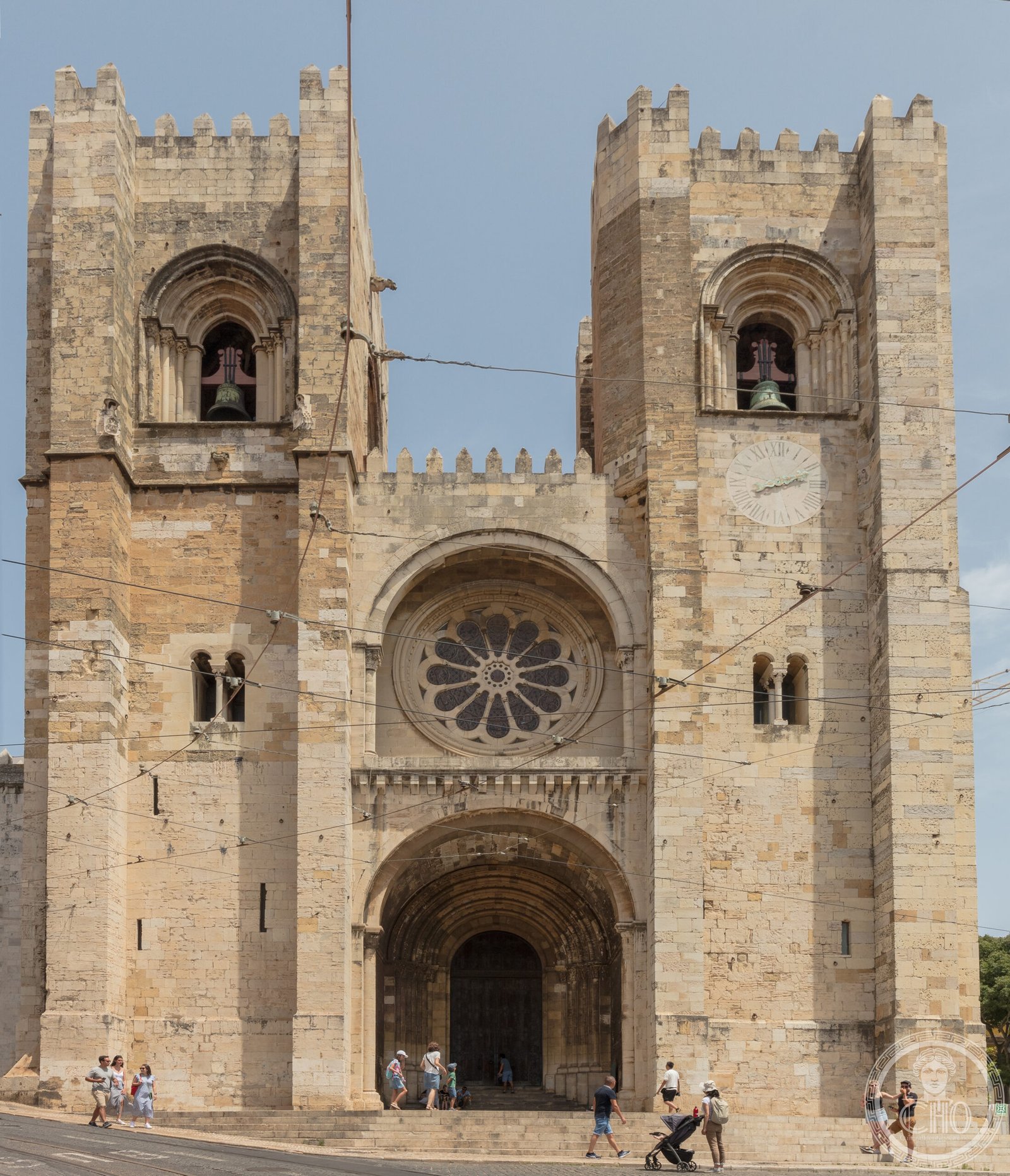
The Sé de Lisboa is the oldest church in Lisbon and the mother church of the Diocese of Lisbon, built in 1147 on the orders of Portugal’s first king, Afonso Henriques, immediately after the Christian reconquest of the city from Moorish rule. A fortress-like Romanesque structure reinforced by two crenellated towers, the cathedral has survived multiple earthquakes, accumulated Gothic, Baroque, and Romanesque elements across nine centuries, and houses the relics of Saint Vincent, patron of Lisbon, in its treasury.
At a glance
- Type
- Cathedral (Diocese of Lisbon)
- Period
- Founded 1147; restorations and additions 13th–18th century; major restoration 20th century
- Style
- Romanesque with Gothic (ambulatory, cloister) and Baroque (nave) additions
- Location
- Largo da Sé, Alfama, Lisbon · 38.7099° N, 9.1348° W
Overview
The Sé de Lisboa stands at the foot of Alfama, Lisbon’s oldest district, its twin Romanesque towers rising over the tram lines and narrow streets below. Founded in 1147 as the first act of Christian reconquest, the cathedral has served continuously as the seat of the Bishop of Lisbon for nearly nine centuries. Despite repeated earthquake damage and stylistic alterations, its robust Romanesque core — modelled on the cathedrals of Coimbra and Porto — remains the most legible ancient monument in the Portuguese capital.
History
Construction began in 1147 under the supervision of two Crusaders — Robert of Burgundy and Gilbert of Hastings, the city’s first bishop — on the site of the principal mosque of Moorish Lisbon. The cathedral was significantly enlarged in the 13th century under King Afonso II, who added a Gothic ambulatory and royal chapels; his tomb and those of several medieval queens remain in the apse. The great earthquake of 1344 caused extensive damage, repaired under Dom Fernando I, but subsequent earthquakes in 1531 and 1755 again necessitated major rebuilding, which introduced the current Baroque nave. A 20th-century restoration campaign stripped the Baroque additions and aimed to return the interior to its Romanesque character.
What you see
The facade, with its twin crenellated towers and rose window, presents a powerfully austere Romanesque face to the square below. Inside, the nave is wide and three-aisled, with heavy cylindrical columns and simple capitals. The Gothic ambulatory behind the high altar retains its 14th-century character and houses medieval royal tombs, including that of Afonso IV and his queen, Beatriz of Castile. The Romanesque cloister, accessible from the nave, contains significant archaeological remains from Roman, Visigothic, and Moorish periods uncovered during excavations. The Treasury displays vestments, goldsmith work, and the reliquary of Saint Vincent.
Cultural significance
The Sé de Lisboa is the most symbolically charged monument in Portugal, representing the founding act of the nation’s capital as a Christian city. It is classified as a National Monument of Portugal and is considered one of the finest examples of Romanesque architecture on the Iberian Peninsula. The cathedral’s continuous use over 877 years — through conquest, earthquake, and revolution — makes it an extraordinary living document of Portuguese history.
Practical information
Address: Largo da Sé, 1100-585 Lisbon, Portugal.
Hours: Monday–Saturday 09:00–19:00; Sunday 09:00–17:00. Treasury and cloister have slightly different hours and require a separate ticket. Check the official website for current information.
Admission: Free entry to the main nave; paid access to cloister and Treasury.
Getting there
The cathedral is located on Largo da Sé in Alfama, directly on the route of the historic tram 28E — the stop is right in front of the facade. From Rossio Square or the Baixa, the walk takes approximately 15 minutes through the historic streets. The nearest metro station is Terreiro do Paço on the Blue Line, from which it is a 10-minute walk uphill. Numerous bus routes also serve the area.
Sources & resources
See the place
Find it on the map
See this place and what’s around it →📷 Become a Cultural Heritage Online photographer
Share your photos of places: they stay published under your name as the author. The more they're seen, the more you get noticed — and soon a contest will reward the most appreciated photos.
Log in or sign up free to add a photo