
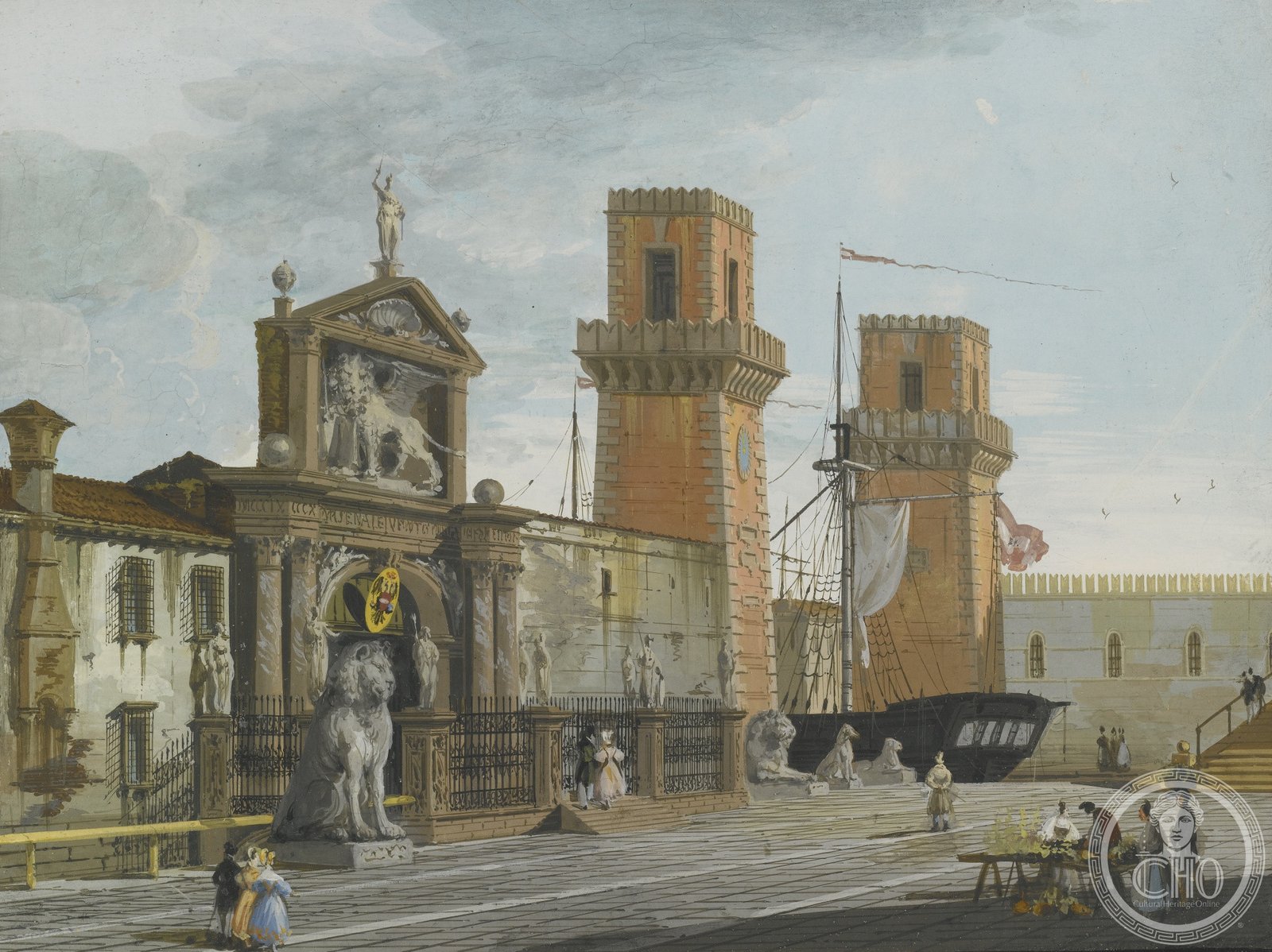
The Venice Arsenal — Arsenale di Venezia — is a vast walled complex of former shipyards and armories covering approximately 46 hectares in the Castello sestiere, representing the world’s first large-scale industrial production facility. Founded in 1104, the Arsenal at its peak employed some 16,000 workers and could reportedly assemble a fully equipped warship in a single day using proto-assembly-line methods, sustaining the maritime power of the Serenissima for nearly five centuries.
At a glance
- Type
- Historic naval shipyard and armory complex
- Period
- Founded 1104; major expansion 13th–16th centuries
- Style
- Gothic and Renaissance military-industrial architecture
- Location
- Castello, Venice, Veneto, Italy
- Coordinates
- 45.4348° N, 12.3477° E
Overview
The Arsenal was the industrial and military heart of the Venetian Republic for nearly five centuries, producing the warships and merchant galleys that sustained Venetian commercial and naval dominance across the Mediterranean. The complex is enclosed by crenellated brick walls and entered through a Renaissance gateway of 1460 — the first Renaissance structure in Venice — guarded by the famous pair of marble lions brought from Greece as war trophies. Today the Arsenal serves as the principal venue of the Venice Biennale.
History
Founded in 1104 on two small islands, the Arsenal grew through successive expansions in 1303–1325 (Arsenale Vecchio), 1473 (Arsenale Nuovo), and 1508–1573 (Arsenale Nuovissimo) to become the largest pre-modern industrial complex in the Western world. Dante Alighieri visited and immortalised it in the Inferno (Canto XXI), describing workers caulking ships in winter. At the height of Venetian power in the 16th century the yard employed up to 16,000 arsenalotti, who received guaranteed wages and benefits and formed an elite guild with honorary roles in state ceremonies. Napoleon’s conquest of Venice in 1797 ended the Republic and the Arsenal’s role as an active military yard; the French melted the bronze horses of the Bucintoro and stripped the complex of its treasures.
What you see
The main gateway of 1460, attributed to Antonio Gambello, frames a Renaissance arch flanked by two colossal archaic Greek lions, one of which (from the Piraeus) still bears runic inscriptions carved by Varangian mercenaries around 1040. Beyond the gate, the enormous dry docks and covered rope-works (Corderie) stretch for 316 metres — among the longest rooms in the world when built in 1579. During the Venice Biennale (Art and Architecture, alternate years) the docks and sheds are transformed into exhibition spaces accessible to the public. The Naval History Museum at the Arsenal’s western edge holds an extensive collection of Venetian maritime artefacts.
Cultural significance
The Venice Arsenal is widely considered the birthplace of industrial production, anticipating factory organisation by several centuries through its standardised parts, sequential assembly, and managed labour force. Its social model — guaranteed pay, sick leave, and retirement for arsenalotti — was equally revolutionary. The site’s literary immortalisation by Dante and its current life as the Biennale’s home ensure its relevance to both industrial history and contemporary culture.
Practical information
- Address
- Campo della Tana, Castello, 30122 Venezia VE
- Access
- Exterior and gateway viewable freely; interior open to the public primarily during Venice Biennale events; Naval History Museum at the western entrance is open year-round
- Admission
- Naval History Museum: charged. Biennale events: charged. Check official website for current prices.
Getting there
Take vaporetto line 1 or 4.1/4.2 to the Arsenale stop, which deposits visitors directly in front of the main gateway. Alternatively, the Giardini stop (line 1) is a short walk south. The Arsenal is approximately 20 minutes on foot from San Marco along the Riva degli Schiavoni waterfront promenade.
Sources & resources
See the place
Find it on the map
See this place and what’s around it →Historical events at this place (1)
📷 Become a Cultural Heritage Online photographer
Share your photos of places: they stay published under your name as the author. The more they're seen, the more you get noticed — and soon a contest will reward the most appreciated photos.
Log in or sign up free to add a photo