
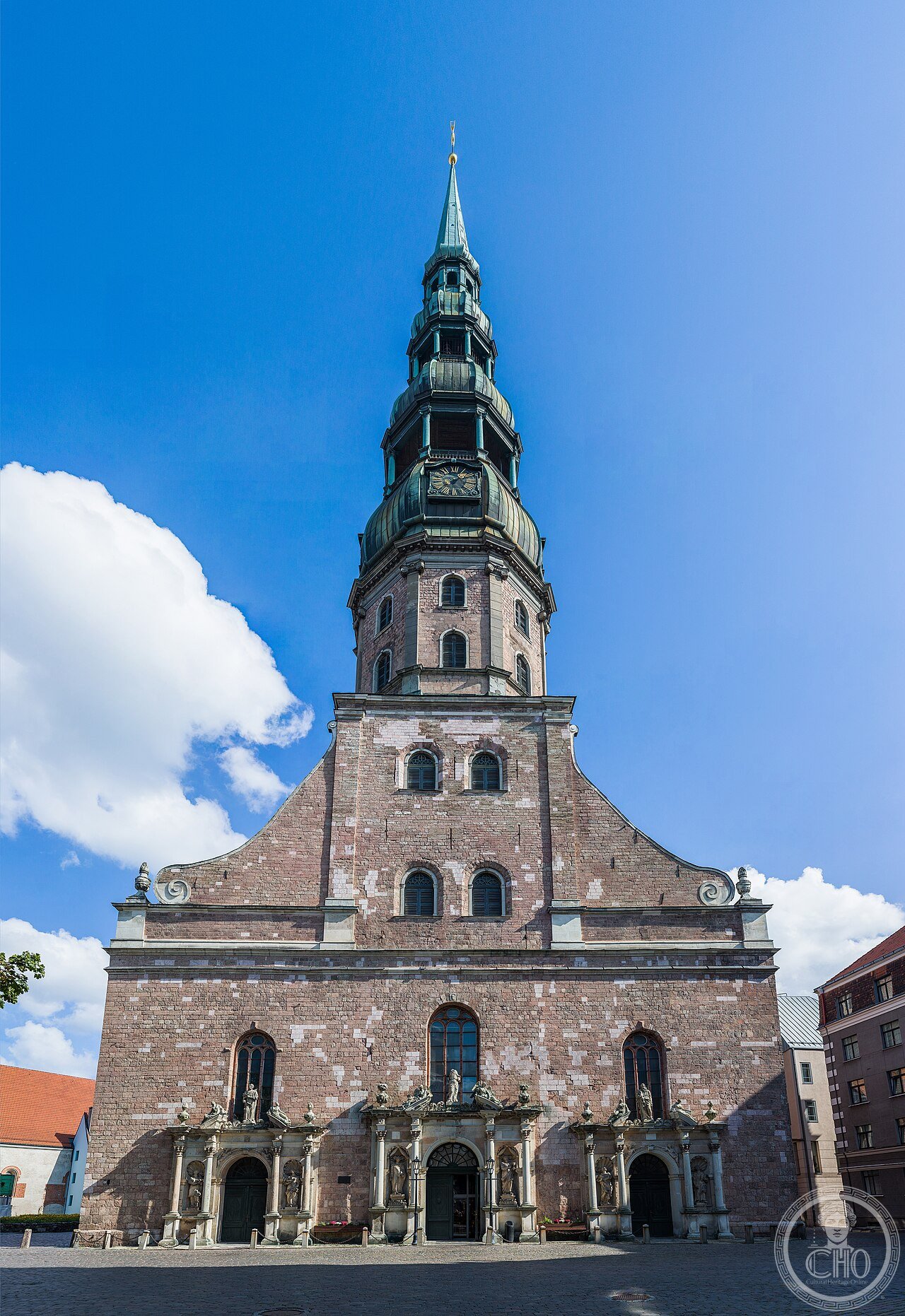
In Riga, Latvia, St. Peter’s Church is mentioned for the first time in a document from 1209, linked to the consecration of a nearby cemetery, and is considered one of the oldest medieval buildings in the Baltic states. It began as a Catholic parish church and became Lutheran during the Reformation, although sources do not report a precise date for the conversion. The original tower, built in 1491, collapsed on 11 March 1666 after being struck by lightning during a storm, destroying a nearby building and killing eight people buried under the rubble. The new cornerstone was laid on 29 June 1667, and the reconstruction, begun by master builder Jacob Josten starting in 1671, was completed after 1675 by Rupert Bindenschu, who finished around 1690 a new Baroque wooden spire about 148 metres tall, described by the most accurate sources as the tallest wooden structure in Europe of the time — not in the world, as less precise tourist sources sometimes report. That spire was destroyed on 29 June 1941 by a fire caused by artillery fire during the fighting for Riga in the Second World War, commonly attributed to a German shell, although sources note that both sides blamed each other for what happened. The fire also destroyed much of the interior and exterior decoration and the nave vaults. The post-war reconstruction, carried out mainly between 1967 and 1983, led to the placing of the weathercock on the new steel spire on 21 August 1970, the date generally cited for the completion of the structure, which today reaches an overall height of 123.25 metres, among the tallest ecclesiastical structures in the Baltic, with a viewing platform reachable by elevator up to 72 metres. The Lutheran congregation resumed regular services in 1991, but the building today functions mainly as a tourist attraction and cultural space, with the nave used for exhibitions and concerts and the tower open as a paid viewpoint.
About St. Peter’s Church
In Riga, Latvia, St. Peter’s Church is first documented in 1209, tied to the consecration of an adjoining cemetery, and is considered one of the oldest medieval buildings in the Baltic states; it began as a Catholic parish church and became Lutheran during the Reformation, though sources give no precise date for the conversion. The original tower, built in 1491, collapsed on 11 March 1666 after being struck by lightning during a storm, destroying a neighboring building and killing eight people buried in the rubble; a new cornerstone was laid on 29 June 1667, and reconstruction, begun by master builder Jacob Josten from 1671, was completed after 1675 by Rupert Bindenschu, who finished around 1690 a new Baroque wooden spire roughly 148 metres tall, described by the more careful sources as the tallest wooden construction in Europe at the time — not in the world, as some less precise tourism sources sometimes claim. That spire was destroyed on 29 June 1941 by a fire caused by artillery fire during the fighting for Riga in the Second World War, commonly attributed to a German shell, though sources note both sides blamed each other for the incident; the fire also destroyed much of the interior and exterior decoration and the nave vaults. Post-war reconstruction, carried out mainly between 1967 and 1983, culminated in placing the weathercock atop the new steel spire on 21 August 1970, the date generally cited for the structure’s completion, which today reaches an overall height of 123.25 metres, among the tallest church structures in the Baltics, with a viewing platform reachable by elevator up to 72 metres. The Lutheran congregation resumed regular services in 1991, but the building today functions primarily as a tourist attraction and cultural space, with the nave used for exhibitions and concerts and the tower open as a paid viewing point.
Key facts
- 1209: first documentary mention, among the oldest medieval buildings in the Baltic states.
- 11 March 1666: the original tower collapses after a lightning strike.
- c. 1690: a new 148-metre Baroque wooden spire completed, among the tallest wooden structures in Europe at the time.
- 29 June 1941: the spire destroyed by wartime artillery fire.
- 1970: a new 123.25-metre steel spire completed after decades of postwar reconstruction.
- 1991: regular Lutheran services resume, alongside the church’s role as a major tourist site.
History
St. Peter’s spire has effectively been rebuilt three times across its history — after an 18th-century lightning strike, a 20th-century wartime fire, and finally in modern steel — making the structure standing today a layered record of Riga’s repeated recoveries from disaster rather than a single unbroken original. Its current dual identity, an active Lutheran parish since 1991 that also functions as one of Riga’s principal visitor attractions, reflects how the church has adapted to serve both continuous worship and a city’s tourism economy.
What you see
A red-brick Gothic nave supports a steel spire rising 123.25 metres, the third major iteration of a tower first built in 1491, rebuilt in Baroque wood after 1666, and rebuilt again in steel after 1941 wartime destruction. Inside, exhibitions and concerts now occupy a nave whose original Gothic vaults were lost to fire, while an elevator carries visitors to a viewing platform 72 metres above the city.
Practical information
- Opening hours: generally open daily with seasonal variation; admission fee applies for the tower viewing platform; check current hours before visiting.
- Address: Skārņu iela 19, Riga, Latvia.
Getting there
St. Peter’s Church stands in Riga’s Old Town, a short walk from Riga Cathedral, easily reached on foot. GPS: 56°56′51″N, 24°06′34″E.
Nearby
- Riga Cathedral — the city’s main cathedral, a short walk away.
- Historic Centre of Riga — the surrounding UNESCO World Heritage old town.
Sources
- Wikipedia — “St. Peter’s Church, Riga” (en.wikipedia.org).
- LiveRiga — official Riga tourism site.
- Wondermondo — “Riga Saint Peter’s Church”
Find it on the map
See this place and what’s around it →📷 Become a Cultural Heritage Online photographer
Share your photos of places: they stay published under your name as the author. The more they're seen, the more you get noticed — and soon a contest will reward the most appreciated photos.
Log in or sign up free to add a photo