
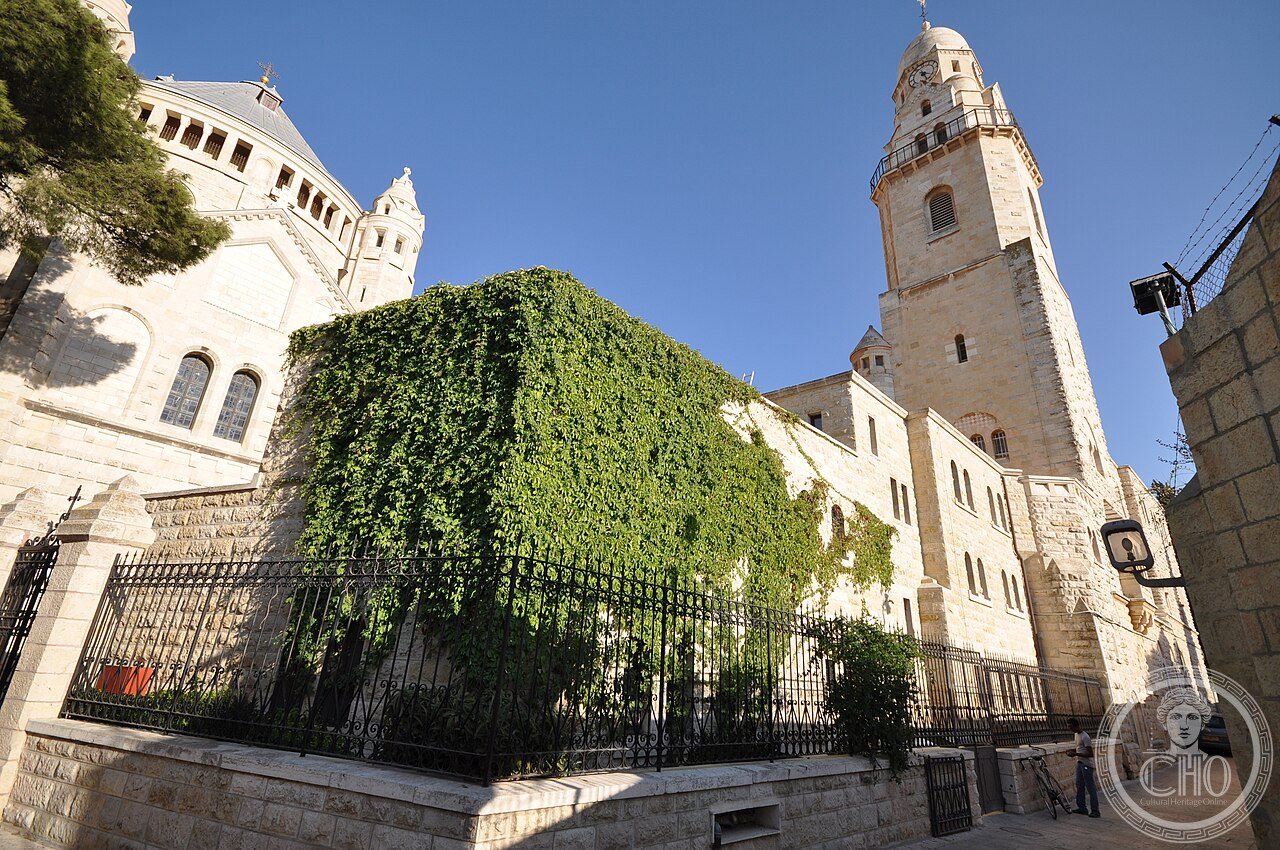
On Mount Zion, just outside the walls of the old city of Jerusalem, near Zion Gate, Dormition Abbey stands on the site traditionally linked to the «dormition», the death, of the Virgin Mary. It is a short way from the Cenacle, the traditional site of the Last Supper, and from the Tomb of King David. The land was bought in 1898 by Kaiser Wilhelm II, in Jerusalem for the dedication of the Lutheran Church of the Redeemer, from the Ottoman sultan Abdul Hamid II for 120,000 German goldmarks, and given to the German Association of the Holy Land. The foundation stone was laid on 7 October 1900, to a design by the architect Heinrich Renard, architect of the archdiocese of Cologne, and the basilica, built for the German Catholic Benedictines, was dedicated on 10 April 1910 by the Latin Patriarch of Jerusalem. Romanesque Revival in style, circular in plan and with four towers, the building holds in the crypt beneath the main church a life-size statue of the «sleeping» Virgin. It was originally of cherry wood and ivory, with a chased gown of silver plated in gold, of which only the wooden core survives today, the metal covering having been lost during the fighting on Mount Zion in the Arab-Israeli war of 1948. The dome above the statue carries mosaics of six women of the Old Testament, Eve, Miriam, Jael, Judith, Ruth and Esther, while the floor of the crypt bears zodiac symbols, the names of prophets and a verse from Proverbs. In the apse of the main church a golden mosaic shows Mary with the infant Jesus, the prophets of Israel below her. The bell tower was deliberately placed so that its shadow would never fall on the Tomb of David, out of respect for the Jewish holy site next door. Beyond the damage of 1948, the abbey was the target, between 2012 and 2016, of a series of acts of vandalism and attempted arson, among them anti-Christian graffiti in 2012 and in 2013, an attempted fire in May 2014 and damage to a crucifix and to statues in the cemetery in December of that year, generally attributed by press sources to extremist vandalism and reported here as documented facts without further judgement. The abbey remains an active Benedictine monastery, part of the Benedictine Congregation of the Annunciation since 2012, and one of the most visited destinations for pilgrimage and religious tourism in Jerusalem.
About Dormition Abbey
On Mount Zion, just outside the walls of Jerusalem’s Old City near Zion Gate, Dormition Abbey stands on the site traditionally associated with the “dormition,” or death, of the Virgin Mary, a short distance from both the Cenacle, the traditional site of the Last Supper, and King David’s Tomb. The land was purchased in 1898 by Kaiser Wilhelm II, visiting Jerusalem for the dedication of the Lutheran Church of the Redeemer, from Ottoman Sultan Abdul Hamid II for 120,000 German goldmarks, and donated to the German Association of the Holy Land; the foundation stone was laid on 7 October 1900 to a design by architect Heinrich Renard, architect of the Archdiocese of Cologne, and the basilica, built for German Catholic Benedictines, was dedicated on 10 April 1910 by the Latin Patriarch of Jerusalem. In Romanesque Revival style, with a circular plan and four towers, the building houses in the crypt beneath the main church a life-size statue of the “sleeping” Virgin, originally in cherry wood and ivory with a chased silver, gold-plated gown, of which only the wooden core survives today, having lost its metal covering during fighting on Mount Zion in the 1948 Arab-Israeli war; the dome above the statue bears mosaics of six Old Testament women — Eve, Miriam, Jael, Judith, Ruth and Esther — while the crypt floor carries zodiac symbols, prophets’ names and a verse from Proverbs. In the apse of the main church, a golden mosaic depicts Mary with the infant Jesus, with the prophets of Israel below; the bell tower was deliberately positioned so its shadow would never fall on King David’s Tomb, out of respect for the adjacent Jewish holy site. Beyond damage suffered in 1948, the abbey was the target, between 2012 and 2016, of a series of vandalism and arson-attempt incidents, including anti-Christian graffiti in 2012 and 2013, an attempted arson in May 2014, and damage to a crucifix and cemetery statues that December, generally attributed by news reports to extremist vandalism, reported here as documented events without further judgment. The abbey remains an active Benedictine monastery, part of the Benedictine Congregation of the Annunciation since 2012, and one of Jerusalem’s most visited pilgrimage and religious tourism sites.
Key facts
- 1898: land purchased by Kaiser Wilhelm II from Ottoman Sultan Abdul Hamid II.
- 1900-1910: the abbey built and dedicated, designed by architect Heinrich Renard.
- Crypt statue of the “sleeping” Virgin, its metal covering lost in the 1948 war.
- Bell tower positioned to avoid casting a shadow over King David’s Tomb.
- 2012-2016: a series of documented vandalism and arson-attempt incidents.
- Still an active German Benedictine monastery, part of the Congregation of the Annunciation since 2012.
History
The abbey’s founding, tied to a personal 1898 land purchase by a German emperor from an Ottoman sultan, places it among the more unusual diplomatic origin stories of any major Jerusalem church, built for German Benedictines on a site venerated for nearly two millennia before their arrival. Its documented vandalism incidents in the 2010s, alongside earlier damage from the 1948 war, reflect the layered and sometimes contested religious landscape of Mount Zion, where multiple faiths’ holy sites sit in close proximity.
What you see
A circular Romanesque Revival church with four towers rises over Mount Zion, its crypt centered on the statue of the “sleeping” Virgin beneath a dome mosaic of six Old Testament women. Upstairs, a golden apse mosaic of Mary and the infant Jesus surveys the nave, while outside, the bell tower’s carefully calculated angle avoids shadowing the neighboring Tomb of David.
Practical information
- Opening hours: generally open daily outside services; check current hours before visiting.
- Address: Mount Zion, Jerusalem.
Getting there
Dormition Abbey stands on Mount Zion just outside the Old City walls near Zion Gate, easily reached on foot from the Old City. GPS: 31°46′20″N, 35°13′44″E.
Nearby
- Cenacle (Room of the Last Supper) — the traditional Last Supper site adjoining the abbey.
- King David’s Tomb — the traditional tomb site on Mount Zion.
- Zion Gate — the nearby gate into Jerusalem’s Old City.
Sources
- Wikipedia — “Abbey of the Dormition” (en.wikipedia.org).
- SeeTheHolyLand.net — “Church of the Dormition”
- BibleWalks.com — “Dormition Abbey, Jerusalem”
Find it on the map
See this place and what’s around it →📷 Become a Cultural Heritage Online photographer
Share your photos of places: they stay published under your name as the author. The more they're seen, the more you get noticed — and soon a contest will reward the most appreciated photos.
Log in or sign up free to add a photo