
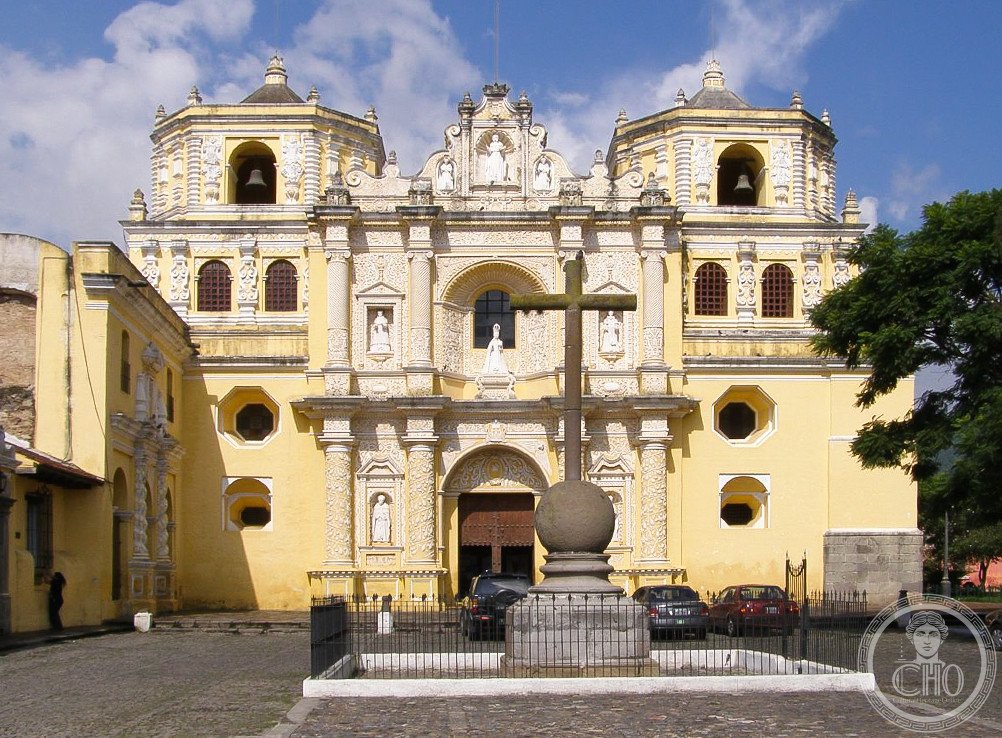
In Antigua Guatemala the Mercedarian friars settled in the Panchoy Valley, after the 1541 landslide forced them out of the Almolonga Valley. An earlier church and monastery on the site, with a library and an infirmary, were badly damaged by the 1717 earthquake and again by the 1751 earthquake. The present building was raised between 1749 and 1767, the year of its dedication, to a design by the architect Juan de Dios Estrada. He deliberately lowered the usual height of Baroque vaulting by roughly two-thirds, and used walls up to a metre thick with reinforced buttresses, precisely in order to resist earthquakes. The choice proved decisive. When the devastating 1773 earthquake struck Antigua — the event that led to the city’s abandonment as colonial capital — the church was only six years old. It was damaged but stayed standing, kept its images and its altarpieces and went on hosting worship, while many older churches were badly hurt. The facade, in colonial Baroque stucco in tones of ochre yellow and white, is today held to be one of the best preserved in Antigua, precisely because of that earthquake-resistant construction. In the ruined cloister behind the church stands the Fountain of the Fish, an 18th-century fountain 27 metres across and shaped like a water lily, described as one of the largest colonial-era fountains in Latin America. Antigua Guatemala’s historic centre, of which La Merced is part, was inscribed on the UNESCO World Heritage List in 1979, and the church is named explicitly among the monuments in the official listing. The church is still active for worship and has housed the parish of San Sebastián since the late 19th century, while the ruined convent alongside is open to visitors as a courtyard and garden around the fountain.
About the Church of La Merced
In Antigua Guatemala, Mercedarian friars settled in the Panchoy Valley after being forced from the Almolonga Valley by the 1541 landslide; an earlier church and monastery on the site, with a library and infirmary, suffered serious damage from the 1717 earthquake and again from the 1751 earthquake. The present building was constructed between 1749 and 1767, the year of its dedication, to a design by architect Juan de Dios Estrada, who deliberately lowered the typical height of Baroque vaulting by roughly two-thirds and used walls up to a metre thick with reinforced buttresses specifically to resist earthquakes. The choice proved decisive: when the devastating 1773 earthquake struck Antigua, the event that led to the city’s abandonment as colonial capital, the church, only six years old, suffered damage but remained standing and continued to host worship, retaining its images and altarpieces, while many older churches were badly damaged. The facade, in colonial Baroque stucco in tones of ochre yellow and white, is today considered one of the best preserved in Antigua precisely because of this earthquake-resistant construction. In the ruined cloister behind the church stands the Fountain of the Fish, an 18th-century fountain 27 metres in diameter, shaped like a water lily, described as one of the largest colonial-era fountains in Latin America. Antigua Guatemala’s historic centre, of which La Merced forms part, was inscribed on the UNESCO World Heritage List in 1979, and the church is explicitly named among the site’s monuments in its official listing. Today the church remains active for worship, having hosted the parish of San Sebastián since the late 19th century, while the adjoining convent, in ruins, is open to visitors as a courtyard and garden around the fountain.
Key facts
- 1749-1767: the present church built and dedicated, by architect Juan de Dios Estrada.
- Built low and thick-walled deliberately to survive earthquakes, walls up to a metre thick.
- 1773: survives the earthquake that ended Antigua’s time as colonial capital, largely intact.
- Fountain of the Fish: an 18th-century water-lily-shaped fountain, 27 metres in diameter, in the ruined cloister.
- 1979: becomes part of the UNESCO World Heritage Site of Antigua Guatemala’s historic centre.
- Still an active parish church, while the adjoining convent remains in ruins, open to visitors.
History
La Merced’s earthquake-resistant design, adopted after two prior structures on the site were damaged by tremors in 1717 and 1751, was vindicated within six years of its 1767 dedication, when the catastrophic 1773 earthquake devastated Antigua and forced the relocation of Guatemala’s capital to what is now Guatemala City. That the church survived largely intact while older, taller colonial buildings collapsed made its low, heavy-walled architecture a lasting lesson in how Antigua’s builders adapted Baroque form to a genuinely dangerous seismic landscape.
What you see
An intricately worked yellow-and-white Baroque stucco facade, deliberately lowered and thickened for earthquake resistance, fronts a church that has remained in continuous use since the 1760s. Behind it, the ruined cloister opens onto the vast water-lily-shaped Fountain of the Fish, its scale among the largest surviving from colonial Latin America, now a quiet garden space framed by roofless arches.
Practical information
- Opening hours: the church is generally open daily; the ruined cloister and fountain have separate visiting hours and a small admission fee; check current hours before visiting.
- Address: 1a Calle Poniente, Antigua Guatemala, Guatemala.
Getting there
The Church of La Merced stands a few blocks north of Antigua Guatemala’s central plaza, easily reached on foot within the historic centre. GPS: 14°33′42″N, 90°44′04″W.
Nearby
- Antigua Guatemala — the UNESCO-listed colonial historic centre.
- Santa Catalina Arch — the iconic yellow arch spanning 5a Avenida Norte.
- Volcán de Agua — the volcano overlooking the city.
Sources
- Wikipedia — “Iglesia de La Merced, Antigua Guatemala” (es.wikipedia.org).
- UNESCO World Heritage Centre — “Antigua Guatemala” (whc.unesco.org).
- La Antigua Guatemala — “Convent and church of La Merced” (laantiguaguatemala.com).
Find it on the map
See this place and what’s around it →📷 Become a Cultural Heritage Online photographer
Share your photos of places: they stay published under your name as the author. The more they're seen, the more you get noticed — and soon a contest will reward the most appreciated photos.
Log in or sign up free to add a photo