
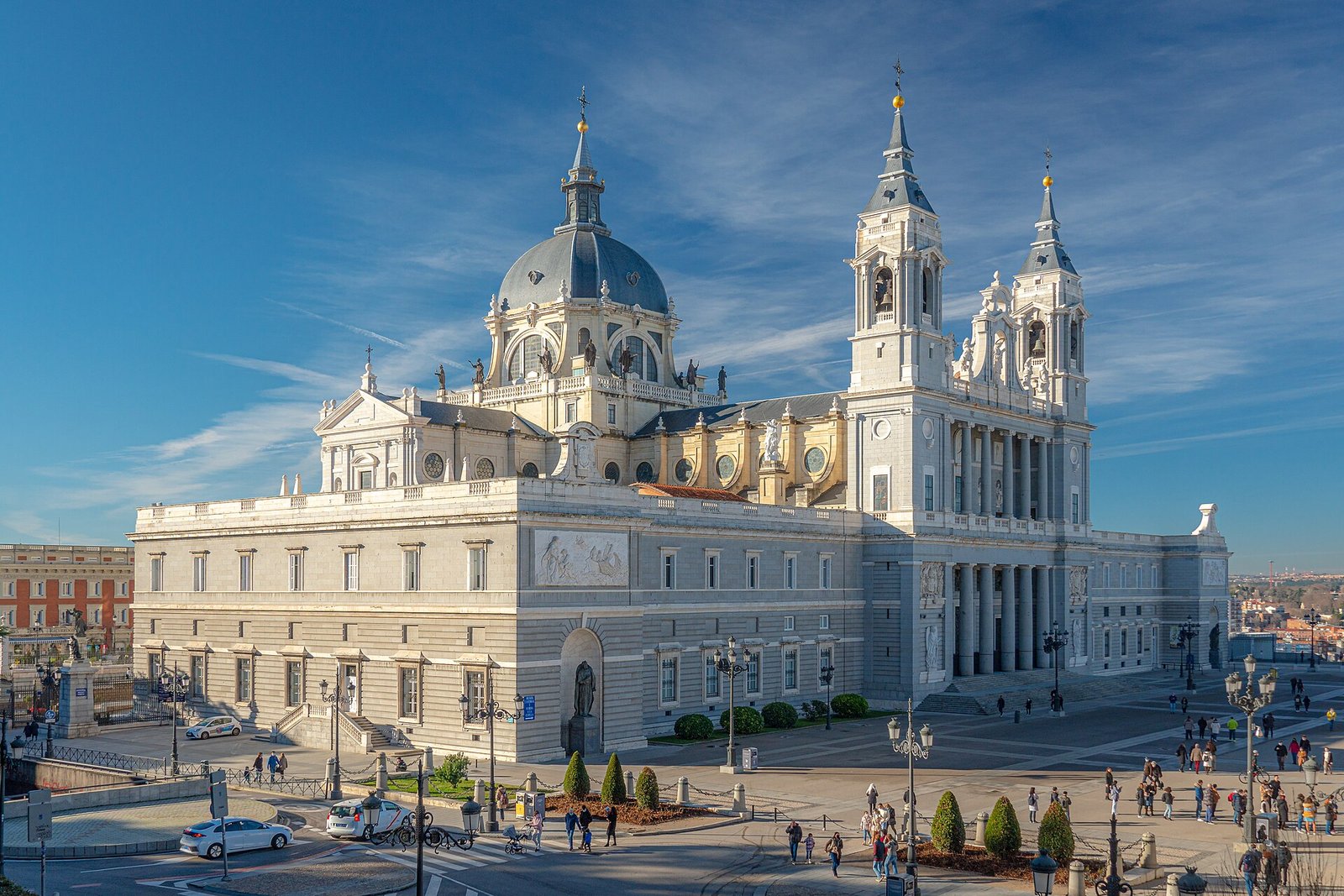
The Almudena Cathedral (Catedral de la Almudena) is the Roman Catholic cathedral of the Archdiocese of Madrid, consecrated in 1993 by Pope John Paul II after more than a century of construction. Standing opposite the Royal Palace on a commanding promontory above the Manzanares valley, the building uniquely combines a Neoclassical exterior with a Neo-Gothic interior, making it one of the most architecturally distinctive and historically complex religious buildings in the Spanish capital.
At a glance
- Type
- Roman Catholic cathedral; seat of the Archbishop of Madrid
- Period
- Construction begun 1883; consecrated 1993
- Style
- Neoclassical exterior; Neo-Gothic interior with later polychrome decoration
- Location
- Calle de Bailén, central Madrid, Spain
- Coordinates
- 40.4157° N, 3.7167° W
Overview
Almudena Cathedral occupies the site of Madrid’s medieval mosque and a later parish church, both swept away as the city expanded into a major capital after Philip II moved the Spanish court here in 1561. The building is dedicated to Our Lady of the Almudena, the patron saint of Madrid, whose image has been venerated in the city since the medieval period. The cathedral’s position beside the Royal Palace makes the pair one of the defining architectural ensembles of the Spanish capital.
History
Plans for a dedicated cathedral for Madrid were discussed for centuries; a formal project began only in 1879 under the patronage of King Alfonso XII. Architect Francisco de Cubas designed the original Neo-Gothic scheme; construction started in 1883. Work was repeatedly interrupted by political upheaval, the Spanish Civil War, and funding shortfalls, stretching the build phase across 110 years. The exterior was eventually redesigned in a Neoclassical style to harmonise with the adjacent Royal Palace, and the cathedral was finally consecrated on 15 June 1993 by Pope John Paul II during his visit to Spain.
What you see
The cathedral’s granite and limestone facade presents a sober Neoclassical profile, with a large dome visible from across the city. Inside, the Neo-Gothic nave surprises visitors with a vaulted ceiling decorated in vivid polychrome geometric patterns, completed in the 1990s and 2000s. The crypt beneath the main church, begun in the 1880s and completed in 1911, is in a pure Neo-Romanesque style and contains the tomb of Queen Mercedes, first wife of Alfonso XII. The image of Our Lady of the Almudena, a medieval wooden figure, is enshrined in a prominent side chapel.
Cultural significance
Almudena Cathedral is the primary place of worship for the Archdiocese of Madrid and the venue for major state religious ceremonies, including the wedding of King Felipe VI and Queen Letizia in 2004 and the funeral of Prince Felipe of Asturias in 1938. Its long construction history — spanning monarchy, republic, civil war, dictatorship, and democracy — makes the building a layered document of modern Spanish history as much as a work of architecture.
Practical information
- Address
- Calle de Bailén, s/n, 28013 Madrid, Spain
- Opening hours
- Monday–Saturday 10:00–21:00; Sunday 14:00–21:00 (check official website for current hours)
- Admission
- Cathedral free; museum admission charged — check official website for current prices
- Website
- catedraldelaalmudena.es
Getting there
The closest metro station is Ópera (lines 2 and 5), approximately five minutes’ walk from the cathedral entrance on Calle de Bailén. Bus lines 3, 148, and others serve the nearby Plaza de la Armería. The Royal Palace is directly adjacent, making a combined visit straightforward.
Sources & resources
See the place
Find it on the map
See this place and what’s around it →📷 Become a Cultural Heritage Online photographer
Share your photos of places: they stay published under your name as the author. The more they're seen, the more you get noticed — and soon a contest will reward the most appreciated photos.
Log in or sign up free to add a photo