
On the hill of Tepeyac, in Mexico City, Catholic tradition tells that the Virgin Mary appeared four times to the indigenous peasant Juan Diego, in December 1531, between the 9th and the 12th of the month. She appeared once to his uncle Juan Bernardino. In the fourth apparition, tradition says, Mary asked Juan Diego to gather Castilian roses, out of season, in his tilma, the cloak, to show as proof to the sceptical Bishop Juan de Zumárraga. When Juan Diego opened the cloak before the bishop, the roses fell out and the image of the Virgin appeared printed on the cloth. The tilma is woven from maguey (agave) fibre, a material that normally decays in twenty or thirty years, and it is displayed in the basilica today, nearly five hundred years on. Devotional sources cite that longevity as a sign of the miracle, while other analyses raise scientific doubts about the origin of the image; no settled agreement exists between the two positions. The old colonial basilica, built from 1695 by the architect Pedro de Arrieta and opened in 1709, sank steadily into the lakebed soil of Mexico City and was stabilised with underground piles between 1976 and 1982. It still stands beside the new basilica, built between 1974 and 1976 to a design by the architect Pedro Ramírez Vázquez with others. Its circular plan has no columns, so that thousands of worshippers can see the tilma at once; a moving walkway runs beneath the image. Juan Diego was canonised by Pope John Paul II on 31 July 2002, in the basilica itself, becoming the first indigenous saint of the Americas. The shrine is held to be the most visited Catholic place of pilgrimage in the world, with about twenty million visitors a year, several million of them concentrated around 12 December, the feast of Our Lady of Guadalupe.
About the Basilica of Our Lady of Guadalupe
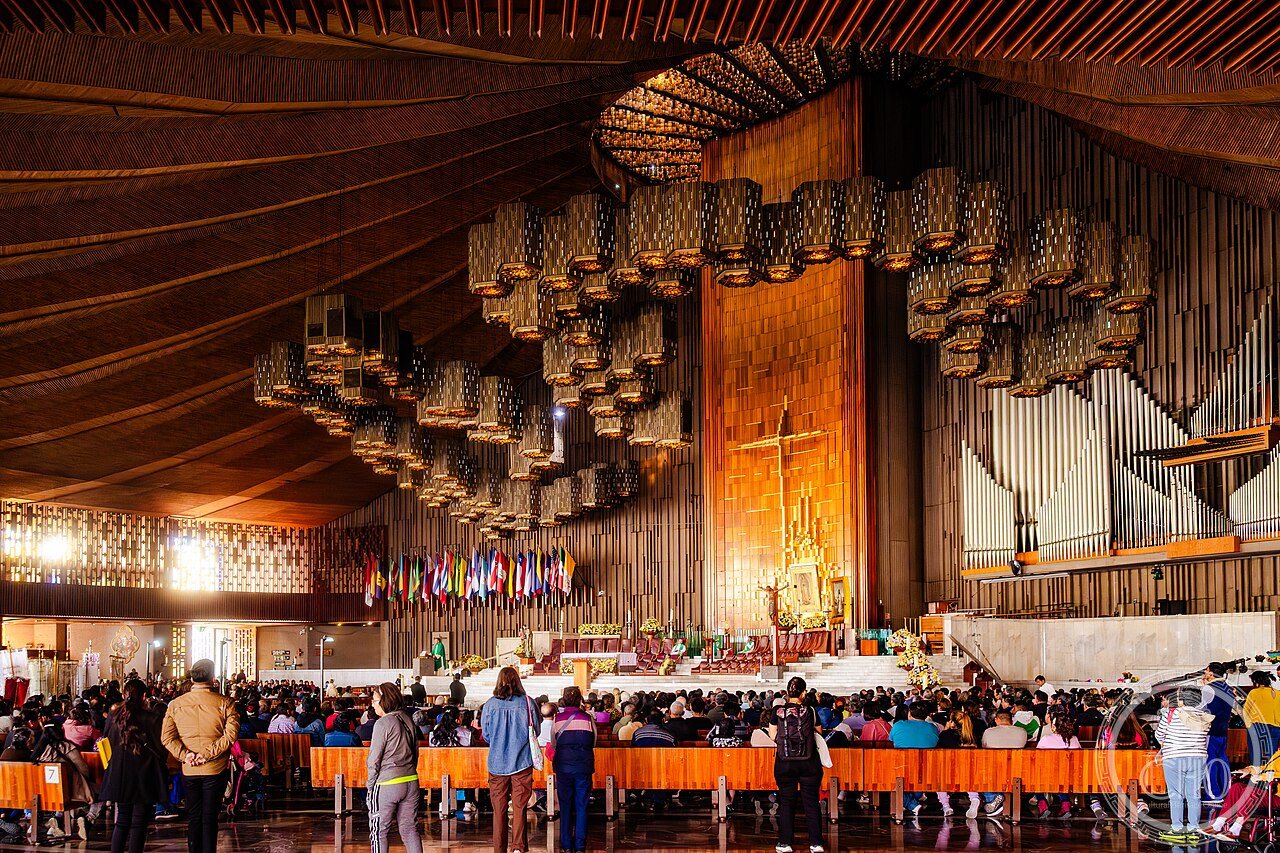
On Tepeyac Hill in Mexico City, Catholic tradition holds that the Virgin Mary appeared four times to the Indigenous peasant Juan Diego in December 1531, between the 9th and 12th of the month, and once to his uncle Juan Bernardino. In the fourth apparition, tradition recounts, Mary instructed Juan Diego to gather Castilian roses, out of season, in his tilma, or cloak, to present as proof to the sceptical Bishop Juan de Zumárraga; when Juan Diego unfolded the cloak before the bishop, the roses fell out and the image of the Virgin was said to have appeared imprinted on the fabric. The tilma, woven from maguey cactus fibre — a material that typically degrades within twenty to thirty years — remains on display in the basilica nearly five hundred years later; devotional sources cite this longevity as evidence of the miracle, while other analyses raise scientific questions about the image’s origin, and no definitive consensus exists between the two positions. The original colonial-era basilica, built from 1695 by architect Pedro de Arrieta and opened in 1709, gradually sank into Mexico City’s soft lakebed soil and was stabilised with underground piles between 1976 and 1982; it still stands today beside the new basilica, built between 1974 and 1976 under architect Pedro Ramírez Vázquez and collaborators, its pillar-free circular design allowing thousands of worshippers to view the tilma simultaneously, with a moving walkway carrying pilgrims beneath the image for closer viewing. Juan Diego was canonised by Pope John Paul II on 31 July 2002, at the basilica itself, becoming the first Indigenous saint of the Americas. The shrine is widely regarded as the most visited Catholic pilgrimage site in the world, drawing roughly twenty million visitors annually, with several million concentrated around 12 December, the feast of Our Lady of Guadalupe.
Key facts
- December 1531: tradition holds the Virgin Mary appeared to Juan Diego on Tepeyac Hill.
- The tilma: a maguey-fibre cloak bearing the image, displayed nearly 500 years later.
- 1695-1709: construction of the original colonial-era basilica, still standing.
- 1974-1976: construction of the new circular basilica by Pedro Ramírez Vázquez.
- 2002: Juan Diego canonised, the first Indigenous saint of the Americas.
- ~20 million visitors annually, the most visited Catholic pilgrimage site in the world.
History
The Basilica of Our Lady of Guadalupe’s central place in Mexican religious and national identity reflects the depth of devotion surrounding the 1531 apparition tradition, a narrative that fused Indigenous and Spanish Catholic religious experience at a formative moment in colonial Mexican history. The construction of an entirely new, structurally ambitious basilica in the 1970s, designed to accommodate pilgrim numbers the aging colonial-era church could no longer safely sustain, reflects the continued and growing scale of devotion to Our Lady of Guadalupe across five centuries.
What you see
The new basilica’s circular, pillar-free design, its copper-clad roof supported entirely by the ring structure, allows an unobstructed view of the tilma from virtually any seat in the building, with capacity for around 10,000 people inside and vastly larger crowds in the surrounding atrium during major feasts. The older colonial basilica, its sandstone facade showing the visible tilt of its long struggle against Mexico City’s soft soil, stands preserved nearby as a direct architectural link to the shrine’s earlier centuries.
Practical information
- Opening hours: generally open daily with seasonal variation; free admission; expect very large crowds around 12 December; check current hours before visiting.
- Address: Tepeyac, Gustavo A. Madero, Mexico City, Mexico.
Getting there
The Basilica of Our Lady of Guadalupe stands on Tepeyac Hill in northern Mexico City, easily reached via La Villa-Basílica metro station. GPS: 19.4838° N, 99.1170° W.
Nearby
- Antigua Basílica — the original colonial-era basilica, adjacent to the new one.
- Capilla del Cerrito — hilltop chapel marking the traditional site of the apparitions.
- Mexico City historic centre — reachable by metro from the shrine.
Sources
- Wikipedia — “Basilica of Our Lady of Guadalupe” and “Our Lady of Guadalupe” (en.wikipedia.org).
- Encyclopaedia Britannica — “Basilica of Guadalupe” (britannica.com).
- Vatican.va — Pope John Paul II’s canonization homily, 31 July 2002.
Find it on the map
See this place and what’s around it →📷 Become a Cultural Heritage Online photographer
Share your photos of places: they stay published under your name as the author. The more they're seen, the more you get noticed — and soon a contest will reward the most appreciated photos.
Log in or sign up free to add a photo