
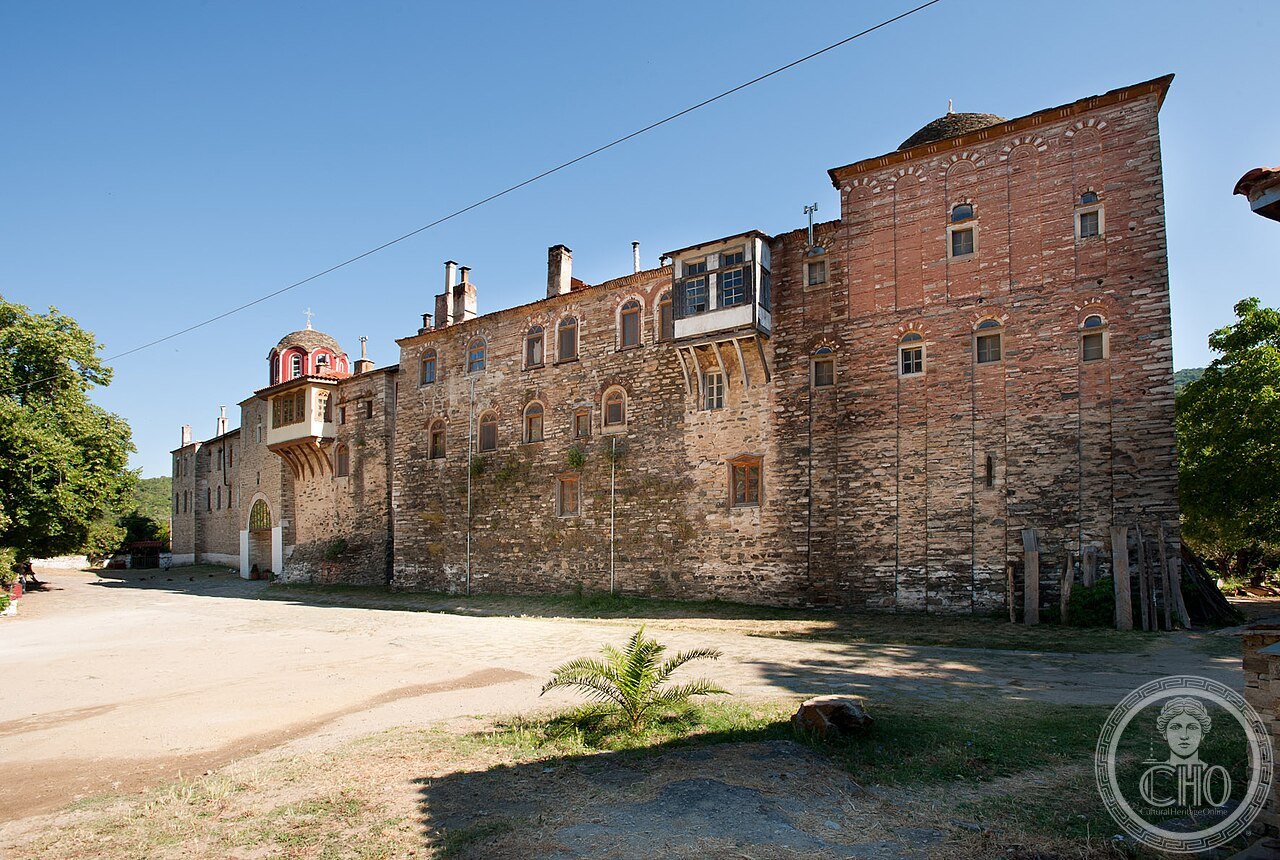
On the southeastern side of the Mount Athos peninsula, in Greece, Konstamonitou Monastery is documented between the tenth and 11th centuries. Historical sources disagree on the exact date: some attribute it to an unidentified member of the aristocratic Byzantine Kastamonites family, others to a monk simply called Konstamonites, from the Kastamon region of Paphlagonia. The monastery holds the last place, the twentieth, in the hierarchy of Mount Athos’s twenty sovereign monasteries. Destroyed by fire in the 1420s, it was rebuilt with the support of the Serbian magnate Radič, drawing numerous monks from the South Slavic lands and enjoying a century of prosperity. The buildings visible today date mostly from the eighteenth and 19th centuries, with the katholikon, dedicated to Saint Stephen the Protomartyr, rebuilt around 1867. According to the official source of the Ephorate of Antiquities of Chalkidiki and Mount Athos, the main church has no extensive fresco cycle, apart from a portion of the central dome, and its decoration relies mostly on portable icons, among them one depicting Saint Stephen, 120 centimetres tall, dated to the 8th century, with damage from the iconoclast period. Today the monastery has around forty monks and novices, one of the higher numbers among Athonite communities. Since 1988 it has formed part of the UNESCO World Heritage Site of Mount Athos.
About Konstamonitou Monastery
Konstamonitou Monastery, on the southeastern side of the Mount Athos peninsula in Greece, is documented between the 10th and 11th centuries. Historical sources disagree on the precise date: some attribute its founding to an unidentified member of the aristocratic Byzantine Kastamonites family, others to a monk simply called Konstamonites, originating from the Kastamon region of Paphlagonia. The monastery holds the twentieth and last position in the hierarchy of Mount Athos’s twenty ruling monasteries.
Destroyed by fire in the 1420s, it was rebuilt with the support of the Serbian magnate Radič, drawing numerous monks from the South Slavic lands and experiencing a century of prosperity. The buildings visible today date largely to the 18th and 19th centuries, with the katholikon, dedicated to Saint Stephen the Protomartyr, rebuilt around 1867.
According to the official source of the Ephorate of Antiquities of Chalkidiki and Mount Athos, the main church does not feature an extensive fresco cycle, apart from a portion of the central dome. Its decoration instead relies largely on portable icons, including one depicting Saint Stephen, 120 centimetres tall, dated to the 8th century and bearing damage attributed to the era of Byzantine iconoclasm. Today the monastery houses around forty monks and novices, one of the higher populations among Athonite communities. Since 1988, Konstamonitou has formed part of the UNESCO World Heritage Site “Mount Athos.”
Key facts
- 10th-11th century: documented founding, precise date and founder disputed across sources.
- 20th and last in the hierarchy of Mount Athos’s twenty ruling monasteries.
- 1420s: destroyed by fire, rebuilt with support from the Serbian magnate Radič.
- Katholikon dedicated to Saint Stephen the Protomartyr, rebuilt around 1867.
- 8th-century icon of Saint Stephen, bearing damage attributed to Byzantine iconoclasm.
- ~40 monks and novices, among the more populated Athonite communities.
- 1988: becomes part of the UNESCO World Heritage Site “Mount Athos”
History
Konstamonitou’s position as the lowest-ranked of Mount Athos’s twenty ruling monasteries belies a resilient institutional history, marked by destruction and recovery through the support of Serbian patronage in the 15th century, which drew South Slavic monks and sustained a period of relative prosperity despite the monastery’s modest standing. Its comparatively high current monastic population, around forty monks and novices, suggests a living community whose vitality is not reflected in its place at the foot of the Athonite hierarchy.
What you see
The monastery’s present buildings, largely dating to the 18th and 19th centuries, surround the katholikon dedicated to Saint Stephen, rebuilt around 1867 with a sanctuary screen of Athenian marble. Rather than extensive wall frescoes, the church’s decorative programme centres on portable icons, most notably the 8th-century icon of Saint Stephen bearing traces of iconoclast-era damage.
Practical information
- Access: Mount Athos requires a special entry permit (diamonitirion); open only to men, following traditional Athonite restrictions; the Julian calendar is observed.
- Address: Mount Athos peninsula, Chalkidiki, Greece.
Getting there
Konstamonitou Monastery lies inland on the southeastern side of the Mount Athos peninsula, on a wooded slope, reachable by mountain track from Daphni, the peninsula’s port. GPS: 40.2882° N, 24.1739° E.
Nearby
- Zografou Monastery — the Bulgarian monastery of Mount Athos, nearby.
- Docheiariou Monastery — coastal Athonite monastery, a distance away.
- Daphni — the port serving Mount Athos, reachable by track.
Sources
- Wikipedia — “Konstamonitou Monastery” (en.wikipedia.org).
- Ephorate of Antiquities of Chalkidiki and Mount Athos, Greek Ministry of Culture (efachagor.gr).
- UNESCO World Heritage Centre — “Mount Athos” (whc.unesco.org).
Find it on the map
See this place and what’s around it →📷 Become a Cultural Heritage Online photographer
Share your photos of places: they stay published under your name as the author. The more they're seen, the more you get noticed — and soon a contest will reward the most appreciated photos.
Log in or sign up free to add a photo