
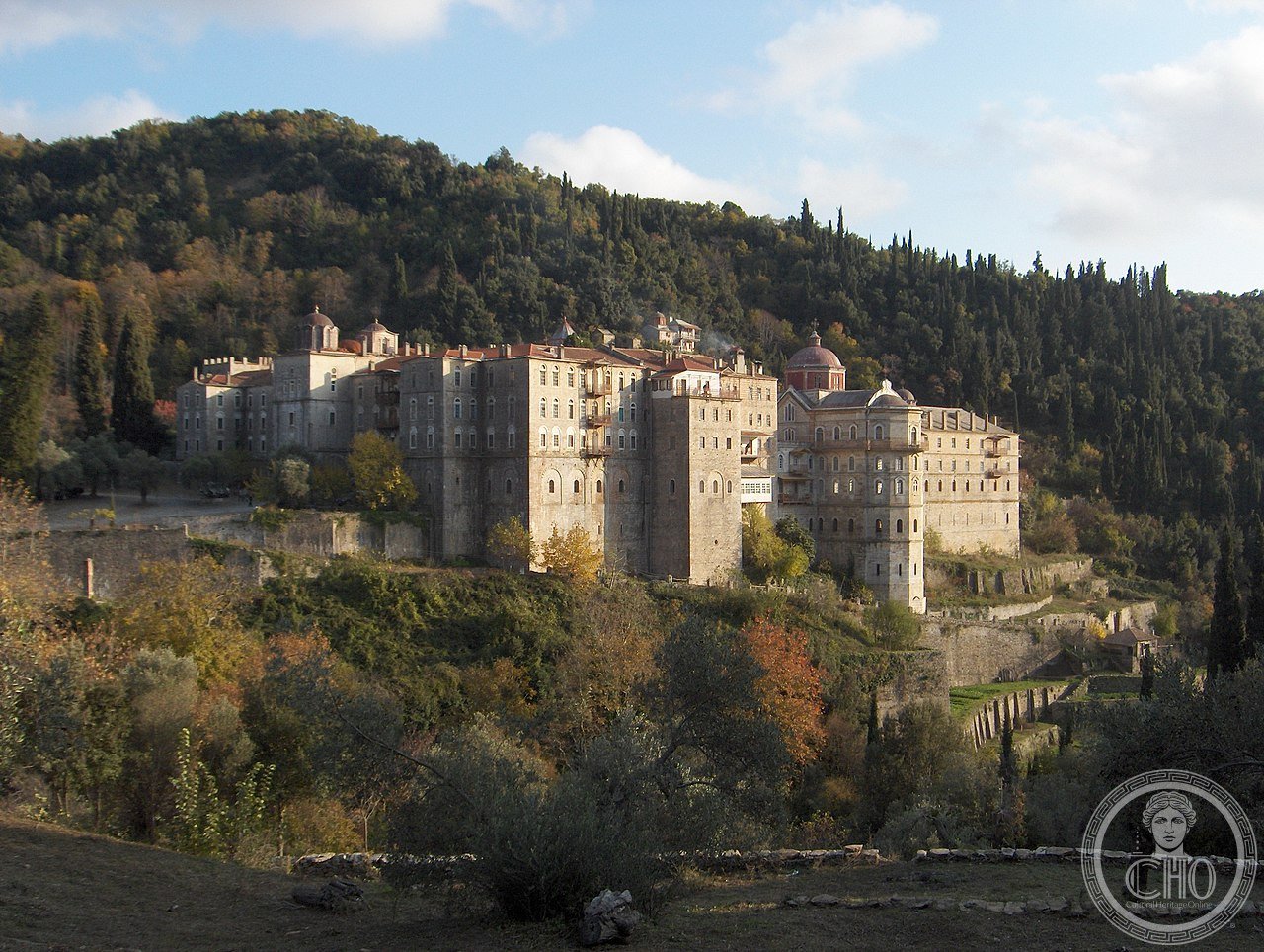
On Mount Athos, in Greece, the monastery of Zografou was founded between the late IX and early X century, according to some sources in the year 919, by three monk-brothers from Ohrid: Mosè, Aronne and Giovanni. The first written mention of the monastery dates to the year 980. The name “Zograf,” which in Greek means “the Painter,” comes from the founding legend. Unable to agree on which saint to dedicate the church to, the three brothers prepared a blank wooden panel and spent the night in prayer. In the morning they found on it, miraculously and “not made by human hands,” the image of Saint George, so resolving the dispute. Zografou is regarded as the historic Bulgarian monastery of Mount Athos, one of the Holy Mountain’s three “Slavic” monasteries alongside Hilandar (Serbian) and Saint Panteleimon (Russian). It received generous support from medieval Bulgarian rulers such as Ivan Asen II and Ivan Alessandro. The monastery holds ninth place in the hierarchy of the twenty ruling monasteries of Mount Athos. In 1275 it was plundered and burned by mercenaries acting, according to sources, under the indirect influence of the Byzantine Emperor Michael VIII Paleologo, killing twenty-six monks, today commemorated by a cenotaph erected in the monastery courtyard in 1873. A further raid followed between 1307 and 1309 at the hands of the Catalan Grand Company. A fire in 1847 destroyed the north and west wings of the complex, later rebuilt. The monastery’s library, of great importance for Bulgarian culture, preserves 388 manuscripts in Church Slavonic and 126 in Greek, as well as around 10,000 printed books. Since 1988 Zografou has been part of the UNESCO World Heritage Site of Mount Athos.
About Zografou Monastery
Zografou Monastery, on Mount Athos in Greece, was founded in the late 9th or early 10th century, some sources citing the year 919, by three monk-brothers from Ohrid: Moses, Aaron and John. The monastery’s first written mention dates to 980. Its name, “Zograf,” meaning “the Painter” in Greek, derives from its founding legend: unable to agree on which saint to dedicate their church to, the three brothers prepared a blank wooden panel and spent the night in prayer; by morning, the image of Saint George had miraculously appeared on the panel, “not made by human hands,” resolving the dispute. Zografou is regarded as the historic Bulgarian monastery of Mount Athos, one of the Holy Mountain’s three “Slavic” monasteries alongside Hilandar (Serbian) and Saint Panteleimon (Russian), and received generous patronage from medieval Bulgarian rulers including Ivan Asen II and Ivan Alexander. The monastery ranks ninth in the hierarchy of Mount Athos’s twenty ruling monasteries. In 1275, it was plundered and burned by mercenaries acting, according to sources, under the indirect influence of the Byzantine Emperor Michael VIII Palaiologos, killing twenty-six monks, commemorated today by a cenotaph erected in the monastery courtyard in 1873; a further raid followed between 1307 and 1309 at the hands of the Catalan Grand Company. A fire in 1847 destroyed the complex’s north and west wings, later rebuilt. The monastery’s library, of major significance to Bulgarian culture, preserves 388 manuscripts in Church Slavonic and 126 in Greek, alongside roughly 10,000 printed books. Since 1988, Zografou has formed part of the UNESCO World Heritage Site “Mount Athos.”
Key facts
- Late 9th-early 10th century: founding by three monk-brothers from Ohrid.
- Legend: an icon of Saint George miraculously “painted itself” on a blank panel, giving the monastery its name.
- 9th in the hierarchy of Mount Athos’s twenty ruling monasteries.
- 1275: the monastery is sacked and burned, twenty-six monks killed.
- 388 Church Slavonic and 126 Greek manuscripts in the monastery’s Bulgarian-significant library.
- 1988: becomes part of the UNESCO World Heritage Site “Mount Athos”
History
Zografou’s status as one of Mount Athos’s three Slavic monasteries, alongside Serbian Hilandar and Russian Saint Panteleimon, situates it at the intersection of Bulgarian national and religious identity, its centuries of royal Bulgarian patronage reflecting the deep ties between medieval Bulgaria and Orthodox monasticism on the Holy Mountain. The monastery’s repeated destruction by raiders in the 13th and 14th centuries, culminating in the killing of twenty-six monks in 1275, places it among the Athonite communities that suffered most severely during the turbulent decades following the Fourth Crusade.
What you see
The monastery’s fortified complex, rebuilt after the 1847 fire that destroyed its north and west wings, encloses the katholikon housing the venerated icon of Saint George, alongside a courtyard cenotaph commemorating the twenty-six monks killed in 1275. The extensive library, one of the most significant repositories of Bulgarian manuscript culture anywhere, preserves centuries of Church Slavonic and Greek texts.
Practical information
- Access: Mount Athos requires a special entry permit (diamonitirion); open only to men, following traditional Athonite restrictions; the Julian calendar is observed.
- Address: Mount Athos peninsula, Chalkidiki, Greece.
Getting there
Zografou Monastery lies inland on the western side of the Mount Athos peninsula, reachable by mountain path or vehicle track from Daphni, the peninsula’s port. GPS: 40.3058° N, 24.1603° E.
Nearby
- Docheiariou Monastery — coastal Athonite monastery, a distance away.
- Konstamonitou Monastery — another Athonite monastery nearby.
- Daphni — the port serving Mount Athos, reachable by track.
Sources
- Wikipedia — “Zograf Monastery” (en.wikipedia.org).
- OrthodoxWiki — “Zographou Monastery (Athos)” (orthodoxwiki.org).
- UNESCO World Heritage Centre — “Mount Athos” (whc.unesco.org).
Find it on the map
See this place and what’s around it →📷 Become a Cultural Heritage Online photographer
Share your photos of places: they stay published under your name as the author. The more they're seen, the more you get noticed — and soon a contest will reward the most appreciated photos.
Log in or sign up free to add a photo