
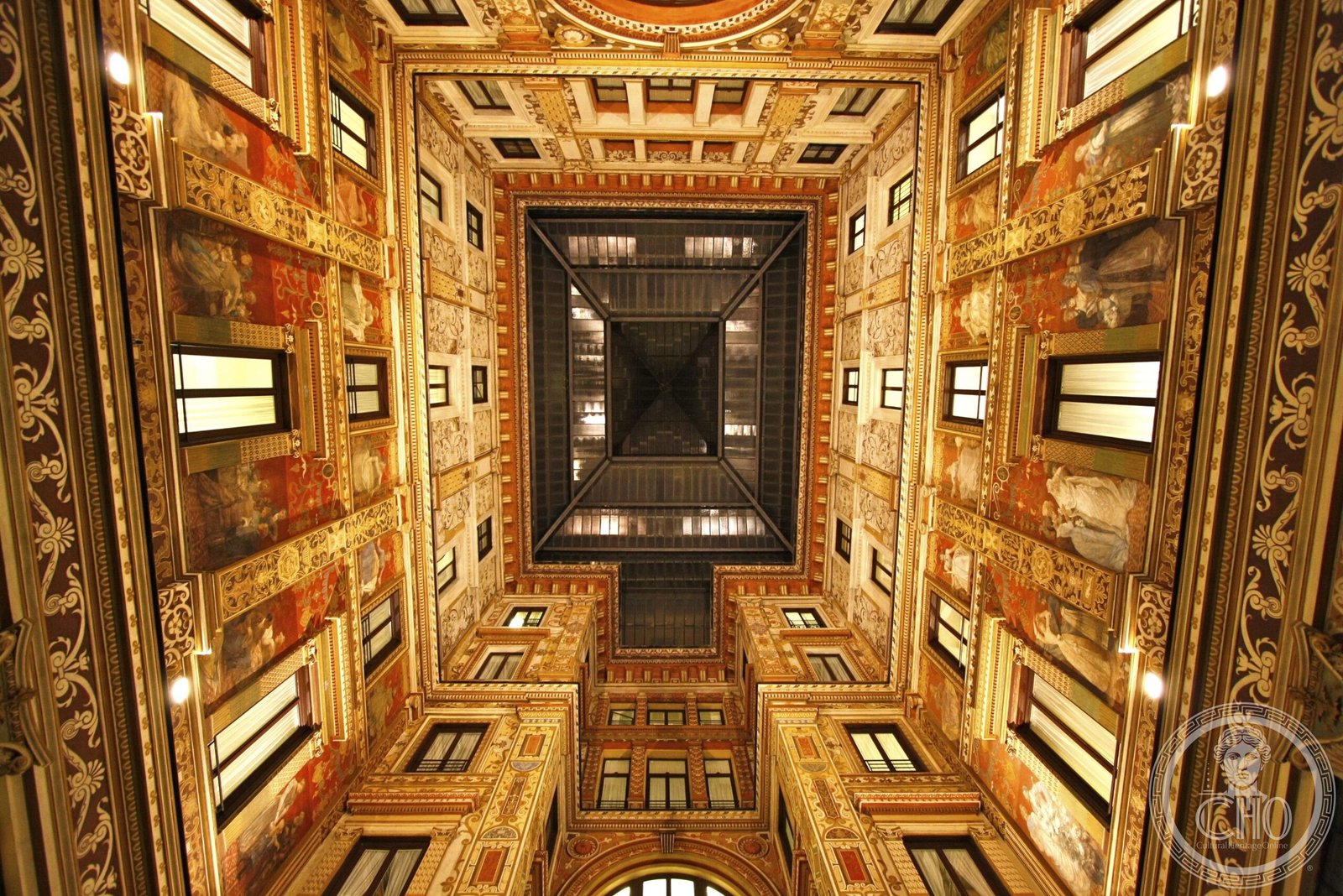
Galleria Sciarra is an intimate glass-roofed courtyard passageway inserted into the Palazzo Sciarra complex in central Rome, commissioned by Prince Maffeo Sciarra Colonna and completed between 1882 and 1898. Designed by architect Giulio de Angelis, the gallery is celebrated for its richly frescoed interior walls and wrought-iron and glass roof structure, which together represent one of the finest examples of Italian Liberty-style decorative architecture in Rome. Frescoes by Giuseppe Cellini on the upper floors depict allegorical scenes of feminine virtue in an exuberant late-19th-century style.
At a glance
- Type
- Covered urban passageway (galleria) within a noble palace complex
- Period
- 1882–1898
- Style
- Italian Liberty (Art Nouveau) with eclectic historicist ornament
- Location
- Via Marco Minghetti 10 / Vicolo Sciarra, 00187 Rome, Italy
- Coordinates
- 41.8998° N, 12.4795° E
Overview
Galleria Sciarra is a semi-public covered passageway threading through the interior courtyard of Palazzo Sciarra, linking Via Marco Minghetti and Vicolo Sciarra in the heart of Rome’s historic centre, steps from the Trevi Fountain and the Corso. The gallery was created as part of a broader redevelopment of the Sciarra family’s Roman palace in the late 19th century, reflecting the fashion for covered iron-and-glass commercial galleries that swept European cities after the Galleria Vittorio Emanuele II in Milan. Though modest in scale compared to its Milanese counterpart, the Galleria Sciarra compensates with exceptional decorative density.
History
Prince Maffeo Sciarra Colonna commissioned architect Giulio de Angelis to redesign the interior courtyard of the family palace in the early 1880s. Work proceeded through the decade with the iron-and-glass roof structure and the surrounding frescoed loggia completed by the 1890s. The fresco cycle on the upper floors was executed by Giuseppe Cellini, depicting female allegorical figures representing virtues such as prudence, faith, humility, and generosity in a lush decorative idiom informed by both Renaissance precedent and Liberty-era ornamentalism. The Sciarra family’s fortune declined in the early 20th century and the palace passed to other owners; the gallery fell into relative obscurity before being rediscovered by architectural historians.
What you see
The passageway opens through a portal on Via Marco Minghetti into a narrow rectangular courtyard roofed with an elegant wrought-iron and glass structure admitting diffuse natural light. The walls of the upper stories are covered with Cellini’s frescoes in vivid colours, framed by ornate pilasters and cornices. The ground floor loggia features decorative ironwork balconies and archways. The overall effect is of a jewel-box interior, intimate in scale but extravagant in surface decoration — a sharp contrast to the plain street facade of the palazzo outside.
Cultural significance
The Galleria Sciarra is one of Rome’s best-kept architectural secrets: largely unknown to mass tourism, it offers a concentrated example of the decorative ambition of Italian Liberty-style patrons in the capital. As one of the few surviving 19th-century covered passages in Rome — a city that otherwise lacks the grand commercial galleries common in Milan or Naples — it holds a unique place in the documentation of Roman urban history.
Practical information
- Address
- Via Marco Minghetti 10, 00187 Rome, Italy
- Access
- The passageway is typically open during business hours as it serves working offices in the palazzo; check locally for current access
- Admission
- Free to pass through
Getting there
Metro: Barberini (Line A) or Spagna (Line A), both a ten-to-fifteen-minute walk. Bus: stop Tritone on Via del Tritone, one block away. The gallery is best approached on foot from Via del Corso heading east toward Via Marco Minghetti, or from the direction of the Trevi Fountain heading west. The entrance portal on Via Marco Minghetti is easily missed — look for the number 10.
Sources & resources
See the place
Find it on the map
See this place and what’s around it →Historical events at this place (1)
- 2022 Liberty a Roma
📷 Become a Cultural Heritage Online photographer
Share your photos of places: they stay published under your name as the author. The more they're seen, the more you get noticed — and soon a contest will reward the most appreciated photos.
Log in or sign up free to add a photoIs this page about you?
This page is read by travellers and heritage enthusiasts who find it on Google. Tell us how you are connected to this place and we will take it from there.