
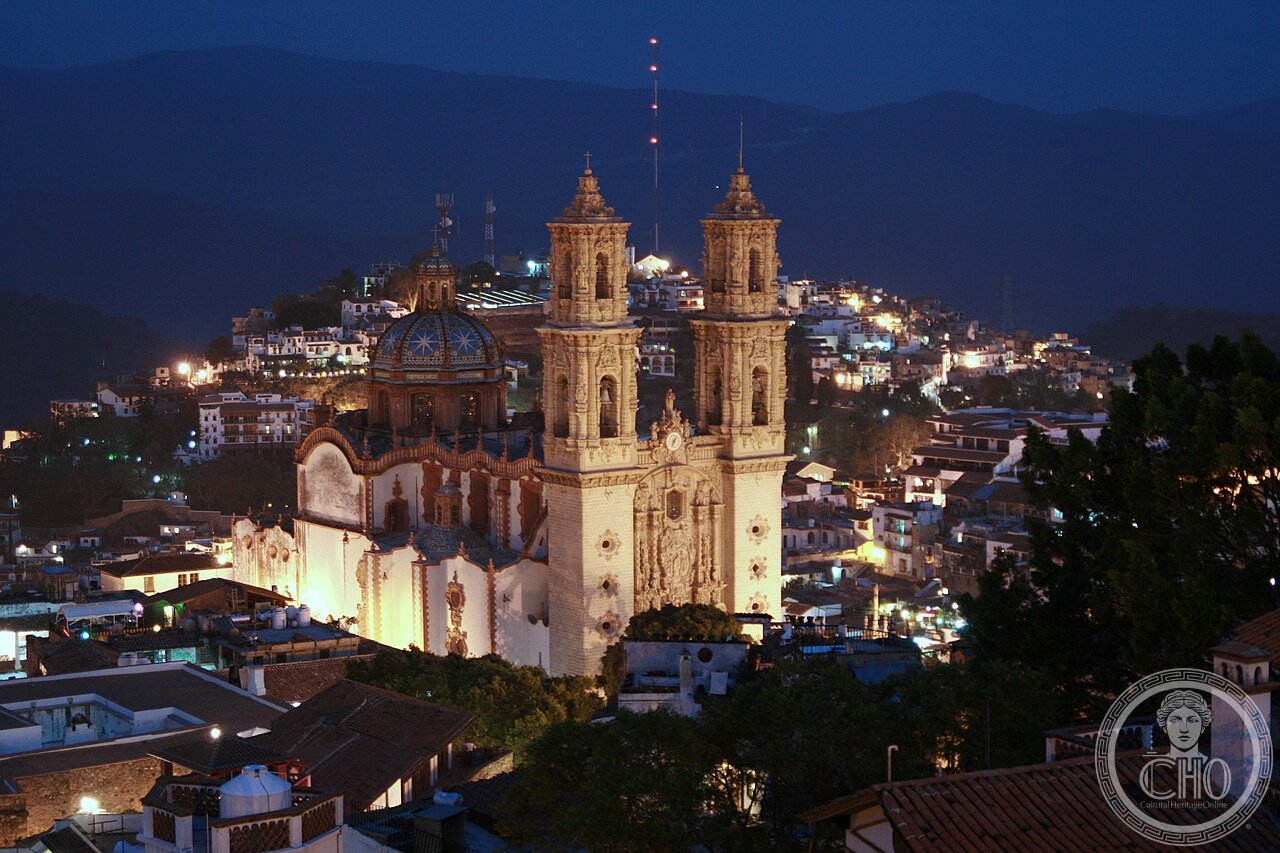
Nel centro storico di Taxco, nello stato messicano di Guerrero, la chiesa di Santa Prisca fu costruita e finanziata interamente da José de la Borda, magnate delle miniere d’argento che fece fortuna proprio a Taxco e divenne uno degli uomini più ricchi della Nuova Spagna. Secondo la tradizione, Borda avrebbe pronunciato al completamento della chiesa la celebre frase “Dios da a Borda, Borda da a Dios” (“Dio dà a Borda, Borda dà a Dio”), riassumendo il progetto come un atto di gratitudine; l’opera, secondo alcune fonti, portò quasi alla rovina finanziaria lo stesso Borda nonostante la sua enorme ricchezza. I lavori iniziarono nel 1751 e si conclusero, secondo le fonti, tra il 1758 e il 1759: appena sette o otto anni per un edificio di simile ricchezza decorativa, un ritmo eccezionale per l’epoca. Il risultato è considerato una delle massime espressioni dello stile churrigueresco messicano, il barocco portato all’estremo ornamentale: la facciata in pietra cantera dai toni rosati è ricoperta da una fittissima decorazione scultorea, tra colonne tortili e nicchie con statue di santi, fiancheggiata da due torri campanarie gemelle. All’interno, nove altari lignei dorati (retablos) e dipinti del pittore barocco messicano Miguel Cabrera completano un insieme che dal 2001 figura nella lista propositiva del Patrimonio Mondiale UNESCO.
About the Church of Santa Prisca
The Church of Santa Prisca, formally the Parroquia de Santa Prisca y San Sebastián, in the historic centre of Taxco, Guerrero, Mexico, was built and financed entirely by José de la Borda, a silver-mining magnate who made his fortune in Taxco’s mines and became one of the wealthiest men in New Spain. Tradition attributes to Borda the famous saying “Dios da a Borda, Borda da a Dios” — “God gives to Borda, Borda gives to God” — reportedly spoken upon the church’s completion as an expression of the project’s purpose as an act of thanksgiving; some accounts suggest the church’s lavish cost nearly bankrupted Borda despite his considerable fortune. Construction began in 1751 and concluded, according to most sources, in 1758 or 1759 — a remarkably fast seven-to-eight-year timeline for a building of such decorative richness. The result is widely regarded as one of the finest expressions of Mexican Churrigueresque architecture, a style that pushed Baroque ornamentation to an extreme of sculptural density: the church’s pink-toned cantera stone facade is covered with elaborately carved decoration, including Solomonic columns and niches filled with sculpted saints, flanked by twin bell towers. Inside, nine gilded wooden altarpieces and paintings by the Mexican Baroque artist Miguel Cabrera, commissioned by Borda himself, complete an ensemble that has stood since 2001 on UNESCO’s Tentative List of future World Heritage candidates. The church remains an active parish and the defining architectural symbol of Taxco, protected as a federal historic monument.
Key facts
- Patron: José de la Borda, a silver-mining magnate who funded the entire construction
- 1751-1758/59: construction, remarkably rapid for such an ornate building
- Style: a leading example of Mexican Churrigueresque architecture
- Nine gilded altarpieces (retablos) and paintings by Miguel Cabrera inside
- 2001: added to UNESCO’s Tentative List as a future World Heritage candidate
- Status: federally protected historic monument, active parish church
History
The Church of Santa Prisca stands as one of the clearest architectural expressions of New Spain’s colonial silver wealth, its extraordinary decoration made possible entirely by the fortune José de la Borda extracted from Taxco’s mines and channelled into a single, extravagant act of religious patronage. Its rapid construction, achieving a building of exceptional decorative complexity in under a decade, distinguishes it even among the many richly ornamented churches funded by New Spain’s mining elite during the 18th century.
What you see
The church’s pink cantera stone facade, dense with sculpted saints, Solomonic columns and scrollwork, rises between twin bell towers in a compressed Latin-cross plan dictated by Taxco’s steep hillside site. Inside, nine floor-to-ceiling gilded wooden altarpieces frame the nave, alongside paintings by Miguel Cabrera depicting the martyrdoms of Saints Sebastian and Prisca and other religious scenes commissioned by Borda for the church.
Practical information
- Opening hours: generally open daily with seasonal variation; free admission; check current hours before visiting
- Address: Plaza Borda, Taxco de Alarcón, Guerrero, Mexico
Getting there
The Church of Santa Prisca stands on the main plaza of Taxco de Alarcón, easily reached on foot from anywhere in the town’s historic centre. GPS: 18.5564° N, 99.6047° W.
Nearby
- Plaza Borda — Taxco’s main square, directly in front of the church
- Museo Guillermo Spratling — museum of pre-Columbian art and Taxco’s silver-crafting history, nearby
- Taxco silver market — the town’s famous silversmithing shops, throughout the historic centre
Sources
- Wikipedia — “Church of Santa Prisca de Taxco” (en.wikipedia.org)
- Smarthistory — “Church of Santa Prisca and San Sebastian, Taxco, Mexico” (smarthistory.org)
- UNESCO World Heritage Centre — Tentative List, “Church of Santa Prisca and its Surroundings” (whc.unesco.org)
Find it on the map
See this place and what’s around it →📷 Become a Cultural Heritage Online photographer
Share your photos of places: they stay published under your name as the author. The more they're seen, the more you get noticed — and soon a contest will reward the most appreciated photos.
Log in or sign up free to add a photo