
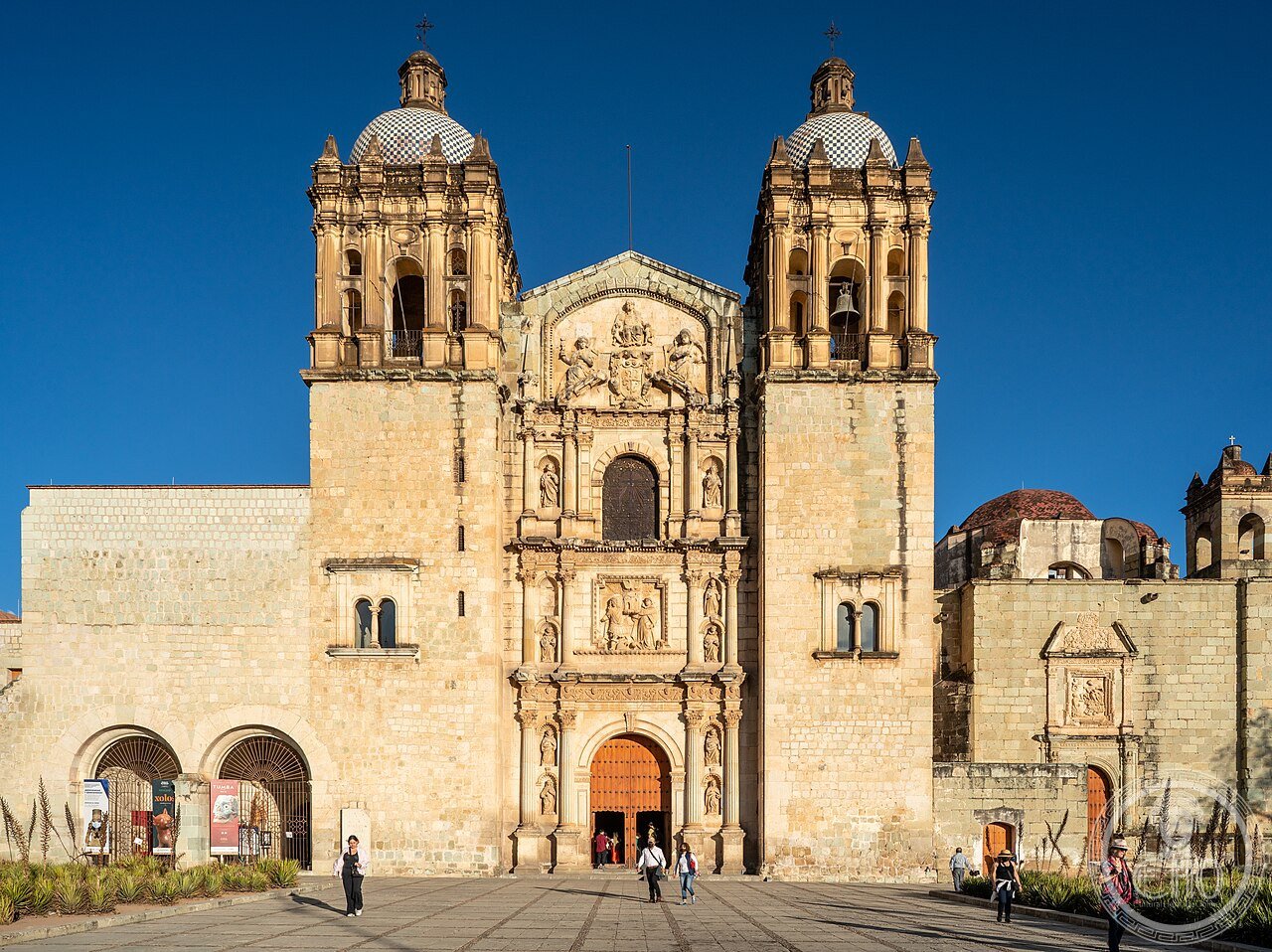
In the centre of Oaxaca, in Mexico, building of the Dominican church of Santo Domingo de Guzmán began in the 1570s, after the city gave the land to the Dominican order in 1551; the friars occupied the complex, still unfinished, in 1608, replacing the earlier convent of San Pablo destroyed by an earthquake. Repeated interruptions caused by earthquakes slowed the work for more than a century, and the Capilla del Rosario, the complex’s most famous chapel, was completed only between 1724 and 1731. The austere, fortified exterior, typical of Mexican colonial churches built to withstand earthquakes, hides one of the most sumptuous Baroque interiors in the Americas, entirely covered in polychrome gilded stucco. Just inside the entrance, above the choir, a famous gilded stucco family tree shows Felix de Guzmán, father of Saint Dominic, reclining in a shell niche, from which gilded branches rise to the Virgin of the Rosary with the Child, surrounded by 36 painted panels with biblical and Marian scenes. The adjoining former convent today houses the Museum of the Cultures of Oaxaca, which holds the Mixtec treasure of Tomb 7 at Monte Albán, discovered by the archaeologist Alfonso Caso in 1932: around 600 objects in gold, silver, turquoise and jade, including the famous turquoise mosaic skull.
About Templo de Santo Domingo de Guzmán
The Templo de Santo Domingo de Guzmán, in the historic centre of Oaxaca City, Mexico, began construction in the 1570s, following the city’s 1551 grant of land to the Dominican order, with friars occupying the still-unfinished complex in 1608 after their previous convent, San Pablo, was destroyed by an earthquake. Repeated earthquake damage halted work over the following decades, and the complex — including its celebrated Rosary Chapel, built between 1724 and 1731 — was not fully finished until well into the 18th century. The church’s plain, fortress-like exterior, thick-walled and built in the earthquake-resistant style typical of colonial Mexican churches, conceals one of the most extravagantly decorated Baroque interiors anywhere in the Americas, its walls and vaults covered almost entirely in gilded polychrome stucco. Just inside the entrance, above the choir loft, a famous gilded stucco genealogical tree begins with a reclining figure of Félix de Guzmán, father of Saint Dominic, set within a shell-shaped niche, its golden branches rising through the Guzmán lineage toward a culminating image of the Virgin of the Rosary holding the Christ child, surrounded by thirty-six painted panels depicting biblical and Marian scenes. The adjoining former convent now houses the Museo de las Culturas de Oaxaca, home to the extraordinary Mixtec treasure recovered from Tomb 7 at the archaeological site of Monte Albán, discovered by archaeologist Alfonso Caso in 1932: roughly 600 objects in gold, silver, turquoise, jade and other precious materials, including the celebrated turquoise mosaic skull, one of the richest archaeological finds ever made in the Americas.
Key facts
- 1551: the city cedes land to the Dominican order
- 1570s-18th century: construction, repeatedly halted by earthquakes
- 1724-1731: construction of the Rosary Chapel
- Gilded stucco genealogical tree depicting the lineage of Félix de Guzmán, father of Saint Dominic
- 1932: Alfonso Caso discovers the Mixtec Tomb 7 treasure at Monte Albán, now housed in the adjoining museum
- Jardín Etnobotánico de Oaxaca occupies the former monastery garden adjacent to the complex
History
The century-and-a-half construction history of Templo de Santo Domingo, punctuated by repeated earthquake damage typical of the seismically active Oaxaca valley, reflects the broader pattern of colonial Mexican church-building, in which structural resilience took precedence over speed, producing buildings whose austere exteriors belied the wealth invested in their interiors. The 1932 discovery of the Tomb 7 treasure at nearby Monte Albán, now displayed in the church’s former convent, added an entirely new layer of significance to the site, connecting the colonial-era Dominican complex directly to one of the most important pre-Columbian archaeological finds in Mesoamerican history.
What you see
The church’s thick cantera-stone walls and plain facade give little hint of the interior’s extravagance, where gilded polychrome Baroque stucco covers nearly every surface, culminating in the famous genealogical tree above the choir and the richly decorated Rosary Chapel. The adjoining former convent, now the Museo de las Culturas de Oaxaca, displays the Mixtec Tomb 7 treasure alongside other regional archaeological and ethnographic collections, while the surrounding Jardín Etnobotánico showcases native Oaxacan plant species within the monastery’s former grounds.
Practical information
- Opening hours: church generally open daily with seasonal variation, free admission; adjoining museum requires a separate ticket; check current hours before visiting
- Address: Macedonio Alcalá, Historic Centre, Oaxaca de Juárez, Mexico
Getting there
Templo de Santo Domingo de Guzmán stands in the historic centre of Oaxaca City, easily reached on foot from the main Zócalo. GPS: 17.0593° N, 96.7205° W.
Nearby
- Museo de las Culturas de Oaxaca — housed in the church’s former convent, adjacent
- Jardín Etnobotánico de Oaxaca — botanical garden in the former monastery grounds
- Zócalo de Oaxaca — the city’s main square, a short walk away
Sources
- Wikipedia — “Church of Santo Domingo de Guzmán” (en.wikipedia.org)
- Oaxaca Auténtico — church and museum history (oaxacaautentico.com)
- Programa Destinos México / Travel by Mexico — colonial architecture and árbol genealógico detail (travelbymexico.com)
Find it on the map
See this place and what’s around it →📷 Become a Cultural Heritage Online photographer
Share your photos of places: they stay published under your name as the author. The more they're seen, the more you get noticed — and soon a contest will reward the most appreciated photos.
Log in or sign up free to add a photo