
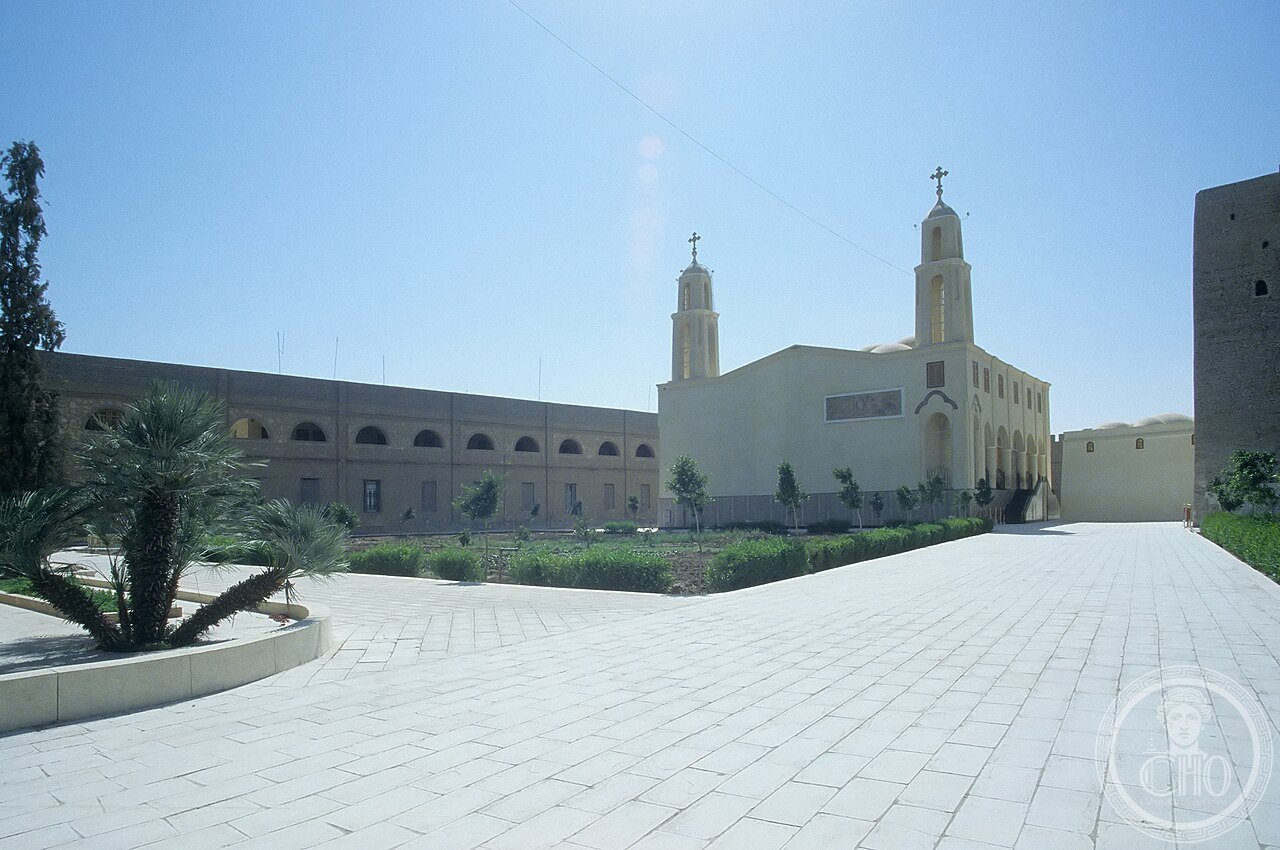
Nell’Alto Egitto, vicino ad Al-Qusiya, sorge Deir el-Muharraq, uno dei siti di pellegrinaggio copti più venerati del paese. Secondo la tradizione copta, questo fu il punto più meridionale raggiunto dalla Sacra Famiglia durante la fuga in Egitto, dove Maria, Giuseppe e il piccolo Gesù avrebbero soggiornato più a lungo che in ogni altra tappa del viaggio — secondo la tradizione, circa sei mesi. La Chiesa della Vergine (Al-Adra), costruita sopra il luogo dove la Sacra Famiglia avrebbe dimorato, è considerata una delle chiese più antiche d’Egitto, con un altare la cui pietra attuale risale, secondo alcune fonti, al 747 d.C. Un sermone attribuito al patriarca Teofilo di Alessandria racconta di una visione in cui la Vergine Maria rivelò che la chiesa fu consacrata da Gesù stesso, assistito dai suoi discepoli; la data esatta di fondazione e il fondatore restano tuttavia incerti nelle fonti storiche. Ogni anno, tra il 18 e il 28 giugno, la festa che celebra la consacrazione della chiesa richiama a Deir el-Muharraq migliaia di pellegrini, tanto che il monastero è soprannominato “la seconda Betlemme”.
About Deir el-Muharraq
Deir el-Muharraq, near Al-Qusiya in Upper Egypt’s Assiut Governorate, ranks among the most venerated Coptic Orthodox pilgrimage sites in the country. According to Coptic tradition, this was the southernmost point reached by the Holy Family — Mary, Joseph and the infant Jesus — during their flight into Egypt, and their stay here is traditionally said to have lasted longer than at any other stop along the route, commonly cited as roughly six months. This tradition, while devotional rather than archaeologically verified, has shaped the site’s identity for centuries and earned the monastery its popular nickname, “the second Bethlehem.” At the heart of the complex stands the Church of Al-Adra, the Church of the Virgin Mary, built over the site traditionally identified as the Holy Family’s dwelling and regarded as one of the oldest churches in Egypt; the altar’s current stone is dated by some sources to 747 CE, a renovation rather than an original founding date. A sermon attributed to Patriarch Theophilus of Alexandria recounts a vision in which the Virgin Mary revealed that the church had been consecrated by Jesus himself, assisted by his disciples — the closest documented version of a founding legend associated with the site, concerning consecration rather than construction. The precise founding date and founder of the monastery remain genuinely uncertain in the historical record, and some traditions linking it to Saint Pachomius are not confirmed in the earliest Lives of Pachomius. The monastery also encloses a fortified stone keep on Mount Koskam, dated to the 6th or 7th century, alongside further churches including those of Saint George and the Archangel Michael.
Key facts
- Tradition: the southernmost point reached by the Holy Family during the flight into Egypt
- Church of Al-Adra: one of the oldest churches in Egypt, its altar stone dated by some sources to 747 CE
- 6th-7th century: the monastery’s fortified keep on Mount Koskam
- June 1 (24 Bashans): Coptic-wide Feast of the Entry of the Holy Family into Egypt
- June 18-28 (centred on June 21-22): the monastery’s own feast marking the church’s consecration, drawing large pilgrim crowds
- Nickname: “the second Bethlehem”
History
Deir el-Muharraq’s association with the Holy Family’s flight into Egypt has made it one of the most significant destinations in the wider geography of Coptic Marian devotion, its status reinforced over centuries by the annual pilgrimage feasts that continue to draw large numbers of the faithful to the site each June. Despite the monastery’s deep devotional importance, the exact circumstances and date of its founding remain undocumented with certainty in the surviving historical sources, a gap that coexists with, rather than diminishes, the strength of the surrounding pilgrimage tradition.
What you see
The monastery complex is enclosed by fortified walls centred on the ancient keep on Mount Koskam, dated to the 6th or 7th century, historically used as a place of refuge. The Church of Al-Adra, at the heart of the complex, preserves its ancient altar together with further churches dedicated to Saint George and the Archangel Michael, the whole complex reflecting building phases spanning from the 7th to the 20th centuries.
Practical information
- Opening hours: generally open with seasonal and religious-calendar variation; expect large crowds during the June pilgrimage feasts; check current hours before visiting
- Address: near Al-Qusiya, Assiut Governorate, Upper Egypt
Getting there
Deir el-Muharraq lies near Al-Qusiya, on the west bank of the Nile north of Assiut, reachable by car or taxi from Assiut. GPS: 27.3845° N, 30.7789° E.
Nearby
- Al-Qusiya — the nearest town
- Assiut — the regional capital, a drive south along the Nile
- Ancient Cusae — nearby archaeological site associated with the region’s pharaonic history
Sources
- Wikipedia — “Deir el-Muharraq” (en.wikipedia.org)
- Coptic Orthodox Church — official monastery page (copticorthodox.church)
- Watani / Middle East Council of Churches — coverage of the Feast of the Entry of the Holy Family into Egypt (mecc.org)
Find it on the map
See this place and what’s around it →📷 Become a Cultural Heritage Online photographer
Share your photos of places: they stay published under your name as the author. The more they're seen, the more you get noticed — and soon a contest will reward the most appreciated photos.
Log in or sign up free to add a photo