
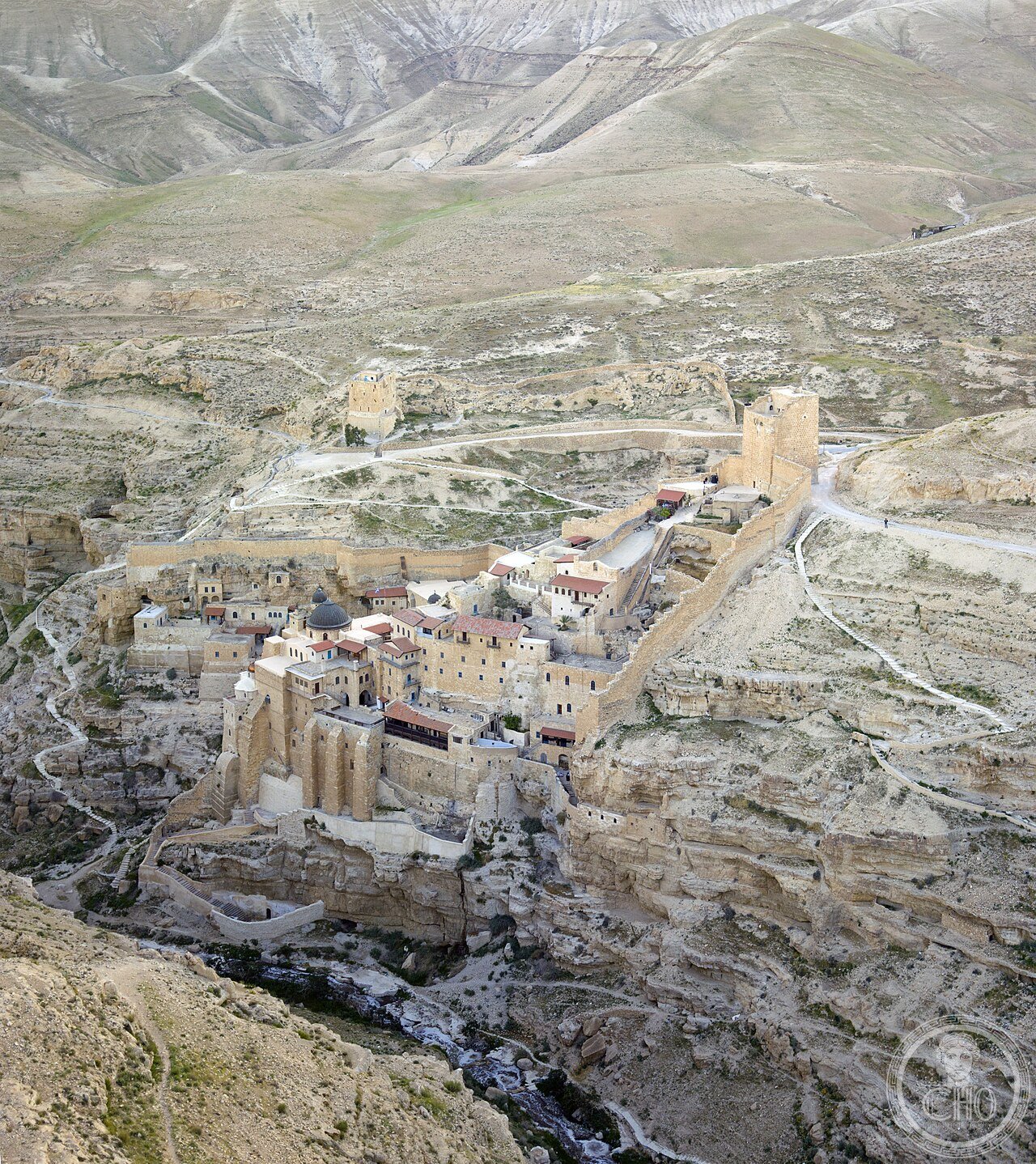
Aggrappato alle pareti rocciose della Valle del Cedron, nel deserto della Giudea, il monastero greco-ortodosso di Mar Saba fu fondato nel 483 d.C. da san Saba il Santificato, monaco originario della Cappadocia, attorno al quale si radunò una comunità di circa settanta eremiti. Per quasi cinquant’anni Saba guidò la Grande Laura, e la sua regola monastica (il Typikon) divenne lo standard liturgico per tutta la Chiesa ortodossa orientale e per le Chiese cattoliche di rito bizantino. Qui visse e fu ordinato monaco san Giovanni Damasceno, la cui tomba si trova in una grotta sotto il monastero. Il 16 maggio 614, durante la conquista persiana di Gerusalemme, le truppe persiane e i loro alleati arabi massacrarono 44 monaci; un secondo attacco, nel 797, ne uccise altri venti. Le reliquie di san Saba, portate a Venezia dai crociati, furono restituite al monastero da Papa Paolo VI nel 1965. Ancora oggi alle donne è permesso avvicinarsi solo a una torre esterna, senza mai varcare le mura del complesso monastico.
About Mar Saba Monastery
Mar Saba Monastery is a Greek Orthodox monastic community built directly into the cliffs of the Kidron Valley (Nahal Kidron) in the Judean Desert, founded in 483 CE by Sabbas the Sanctified, a monk originally from Cappadocia in what is now Turkey. Sabbas first gathered a community of roughly seventy hermits around his own hermitage on the eastern side of the gorge before the community relocated to the opposite, western side, where the Church of Theoktistos was built in 486 and consecrated in 491, followed by the Church of the Theotokos in 502, which became the monastery’s main church. Sabbas led what became known as the Great Laura for nearly fifty years, and the monastic rule he established, his Typikon, went on to become the standard liturgical framework followed across the Eastern Orthodox Church and the Byzantine-rite Eastern Catholic churches, giving Mar Saba an influence on Christian monasticism far beyond its own remote desert walls. The monastery is also closely associated with Saint John of Damascus, the 8th-century theologian and hymnographer, who was tonsured and ordained a monk at Mar Saba and whose tomb lies in a cave beneath the complex. Mar Saba ranks among the oldest continuously inhabited monasteries in the world, its community persisting for roughly 1,500 years, although historical sources note periods of reduced habitation and hardship during the later medieval era. The monastery survives today as an active, walled male monastic community where women are permitted to approach only a designated tower near the entrance but may never enter the monastic enclosure itself, a restriction unbroken since the monastery’s founding.
Key facts
- 483 CE: founded by Sabbas the Sanctified, a monk from Cappadocia
- 502 CE: the Church of the Theotokos, the monastery’s main church, completed
- May 16, 614 CE: Persian and allied forces kill 44 monks during the Persian conquest of Jerusalem; a further 20 monks are killed in a 797 attack
- 1965: the relics of Saint Sabbas, long held in Venice, are returned to the monastery by Pope Paul VI
- Saint John of Damascus was tonsured here and is buried in a cave beneath the complex
- Access: women may not enter the monastic enclosure, only a tower near the entrance; the monastery is closed to visitors on Wednesdays and Fridays
History
Mar Saba’s foundation by Sabbas the Sanctified in 483 CE places it among the formative institutions of Eastern Christian monasticism, its Typikon shaping liturgical practice across the Byzantine world for centuries after the founder’s own lifetime. The monastery’s location in the remote Judean Desert did not spare it from violence: the Persian conquest of Jerusalem in 614 brought a massacre of 44 monks, recorded by the eyewitness monk Antiochus Strategos, and a further attack in 797 killed twenty more, underscoring the vulnerability of even the most isolated desert communities during the region’s recurring conflicts.
The 1965 return of Saint Sabbas’s relics from Venice, where they had been held since the Crusader era, by Pope Paul VI, stands as a notable gesture of Catholic-Orthodox reconciliation in the 20th century, restoring to the monastery the physical remains of its founding saint after many centuries of separation.
What you see
The monastery presents a striking sight, its walls, domes and cells built directly into and against the cliff face above the Kidron gorge, accumulated over centuries as the community grew. A defensive tower near the entrance, traditionally the only structure women visitors may approach, rises above the fortified compound, while multiple chapels carved into and built against the rock house the monastery’s relics, manuscripts and the tomb of Saint John of Damascus.
Practical information
- Opening hours: closed to visitors on Wednesdays and Fridays; men may enter the compound, women may approach the entrance tower only; check current access before visiting
- Address: Kidron Valley, Judean Desert, West Bank, Palestinian Territories
Getting there
Mar Saba Monastery is commonly visited as a day trip from Bethlehem, reached by road through the Judean Desert. GPS: 31.7048° N, 35.3312° E (approximate).
Nearby
- Bethlehem — historic city and common starting point for visits, a drive away
- Kidron Valley — the desert gorge in which the monastery is built
- Jerusalem — reachable by road through the Judean Desert
Sources
- Wikipedia — “Mar Saba” (en.wikipedia.org)
- Wikipedia — “Sabbas the Sanctified” (en.wikipedia.org)
- Antiochus Strategos — “The Capture of Jerusalem by the Persians in 614 AD” (primary eyewitness text)
Find it on the map
See this place and what’s around it →📷 Become a Cultural Heritage Online photographer
Share your photos of places: they stay published under your name as the author. The more they're seen, the more you get noticed — and soon a contest will reward the most appreciated photos.
Log in or sign up free to add a photo