
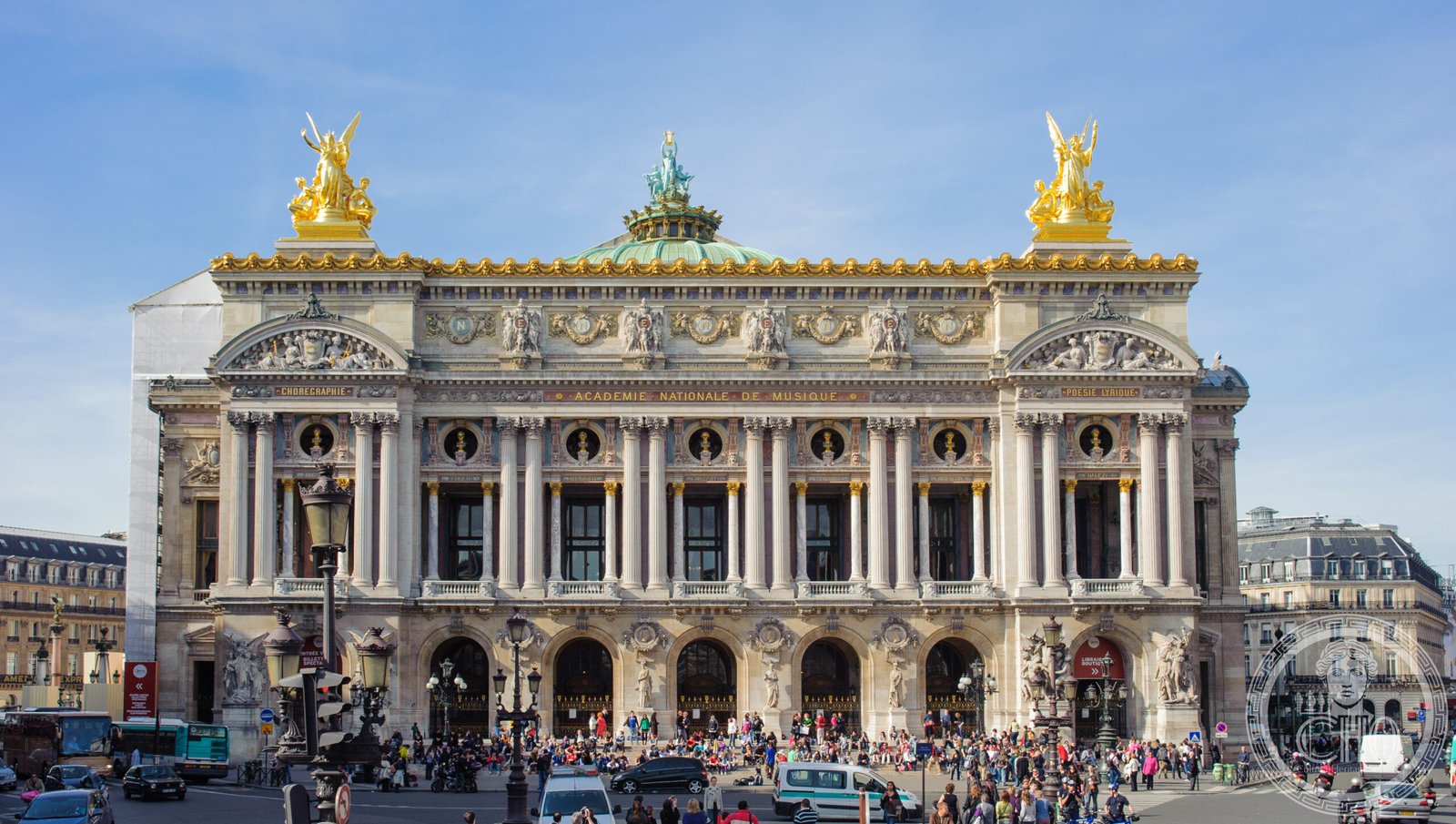
The Palais Garnier, also known as the Opera Garnier, is a 1,979-seat opera house and one of the world’s most celebrated examples of Beaux-Arts architecture, built for the Paris Opera between 1861 and 1875 at the Place de l’Opera in the 9th arrondissement. Designed by architect Charles Garnier at the behest of Emperor Napoleon III, the building is renowned for its extraordinary opulence: a grand marble staircase, a ceiling painted by Marc Chagall (1964), and the famed central chandelier that inspired Gaston Leroux’s 1910 novel The Phantom of the Opera. A monument historique since 1923, it remains the home of the Paris Opera Ballet.
At a glance
- Type
- Opera house; theatre
- Period
- Built 1861-1875; inaugurated 5 January 1875
- Style
- Napoleon III / Beaux-Arts
- Location
- Place de l’Opera, 75009 Paris, France
- Architect
- Charles Garnier
- Capacity
- 1,979 seats
- Current use
- Opera and ballet house (Paris Opera Ballet); open to visitors daily
- Designation
- Monument historique (listed 1923)
Overview
The Palais Garnier was built for the Paris Opera from 1861 to 1875 at the behest of Emperor Napoleon III and was initially referred to simply as the nouvel Opera de Paris. It soon became known as the Palais Garnier, an acknowledgment of its extraordinary opulence, named after architect Charles Garnier, whose plans represent the apogee of the Napoleon III style. It served as the primary theatre of the Paris Opera and its associated ballet company until 1989, when the Opera Bastille opened; today the company uses the Palais Garnier mainly for ballet performances, while the building itself draws over a million visitors a year.
History
Following an assassination attempt on Napoleon III near the old opera house in 1858, a competition was launched for a new, more secure venue. Charles Garnier, a little-known Prix de Rome laureate, won the 1861 competition with a design that synthesised Baroque, Renaissance, and Classical elements. Foundations required five months of pumping to drain a subterranean lake (which became the basis of Leroux’s legend). Work was interrupted by the Franco-Prussian War and the Paris Commune but resumed under the Third Republic; the theatre opened on 5 January 1875. The Chagall ceiling for the main auditorium was added in 1964 at the initiative of Culture Minister Andre Malraux.
What you see
The exterior is a symphony of coloured marble, gilded bronze sculpture, and allegorical figures, most famously Jean-Baptiste Carpeaux’s group La Danse. Inside, the Grand Staircase of white Algerian marble divides into twin branches beneath a painted vault. The five-tiered horseshoe auditorium is draped in red velvet and gold leaf, crowned by a 6-tonne crystal chandelier and Chagall’s dreamlike ceiling medallion of 1964. Beneath the stage, a labyrinth of service spaces surrounds the artificial lake that feeds the building’s hydraulic systems.
Cultural significance
The Palais Garnier crystallised the Beaux-Arts aesthetic that dominated public architecture from Paris to Buenos Aires for the next half century, influencing opera houses, railway stations, and government buildings worldwide. Gaston Leroux’s novel The Phantom of the Opera (1910) transformed the building into a global myth, generating adaptations in every medium. The Chagall ceiling controversy of 1964 remains a touchstone in debates about contemporary art in historic monuments.
Practical information
Open for self-guided visits daily from 10:00 to 17:00 (last entry 16:30), except on certain performance days and public holidays. Guided tours in French and English are available; audio guides can be hired at the entrance. Access to the auditorium depends on rehearsal schedules. Tickets can be booked online on the Opera National de Paris website. Photography is permitted in most public areas but not during performances.
Getting there
The Palais Garnier faces the Place de l’Opera, served directly by Metro line 3 and RER A at Opera station. Metro lines 7 and 8 also stop at Opera. Bus lines 20, 21, 22, 27, 29, 42, 52, 66, 68, 81, and 95 pass through the square. The building is also a short walk from the grands magasins Galeries Lafayette and Printemps on boulevard Haussmann.
Sources & resources
See the place
Find it on the map
See this place and what’s around it →📷 Become a Cultural Heritage Online photographer
Share your photos of places: they stay published under your name as the author. The more they're seen, the more you get noticed — and soon a contest will reward the most appreciated photos.
Log in or sign up free to add a photoIs this page about you?
This page is read by travellers and heritage enthusiasts who find it on Google. Tell us how you are connected to this place and we will take it from there.