
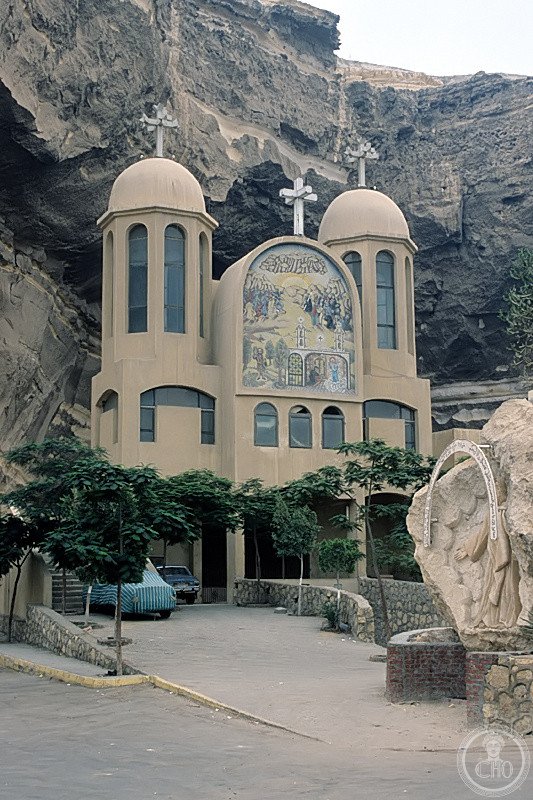
Sulla montagna di Mokattam, sopra il quartiere del Cairo dove vivono gli zabbalín (i raccoglitori di rifiuti copti), sorge un complesso di chiese scavate nella roccia dedicato a san Simone il Conciatore, santo copto vissuto nel tardo X secolo. La leggenda narra che, sotto il califfo fatimide al-Mu’izz (953-975), un dibattito religioso oppose il patriarca copto Abramo il Siro a uno studioso ebreo convertito all’islam, Yaqub ibn Killis, il quale citò il versetto evangelico secondo cui una fede autentica può spostare le montagne, sfidando i cristiani a dimostrarlo pena la persecuzione. Simone il Conciatore, un umile artigiano, indicò al patriarca il modo: pregare tre volte “Signore, abbi pietà” tracciando il segno della croce verso la montagna. Secondo la tradizione, il Mokattam si sollevò davanti alla corte del califfo. Oggi la moderna Cattedrale della Grotta, capace di ospitare oltre 20.000 fedeli, domina dall’alto la Città della Spazzatura.
About the Monastery of Saint Simon the Tanner
The Monastery of Saint Simon the Tanner, widely known as the Cave Church, is a complex of Coptic Orthodox churches carved directly into the limestone of Mokattam Mountain, overlooking the Manshiyat Naser district of Cairo, more commonly called Zabbaleen or “Garbage City” after the Coptic Christian garbage collectors who have lived and worked there since the late 1960s. The monastery takes its name from Saint Simon the Tanner, a humble Coptic craftsman who lived in Cairo in the late 10th century, during the reign of the Fatimid Caliph al-Mu’izz li-Din Allah (953-975), a period when the Coptic Patriarch Abraham the Syrian led the Christian community of Egypt. According to tradition, a public religious debate arranged at the caliph’s court pitted Patriarch Abraham against a Jewish scholar named Yaqub ibn Killis, who had converted to Islam and risen to prominence in the Fatimid administration. Ibn Killis invoked a verse from the Gospel of Matthew stating that faith the size of a mustard seed could move a mountain, and challenged the Christians to prove their faith genuine by performing the feat, on pain of persecution should they fail. It was Simon the Tanner, an unassuming and humble artisan rather than a cleric, who instructed Patriarch Abraham on how to proceed: to fast and pray, then stand before the Mokattam Mountain and cry out “Lord, have mercy” three times while making the sign of the cross toward it. Tradition holds that the mountain visibly shifted before the assembled court, astonishing the caliph and securing the safety of Cairo’s Christian community. Simon himself, humble to the last, is said to have vanished before he could be honoured, his identity confirmed only afterward.
Key facts
- Late 10th century: lifetime of Saint Simon the Tanner, under Caliph al-Mu’izz and Patriarch Abraham the Syrian
- Legend: the miraculous moving of Mokattam Mountain before the Fatimid court
- Modern complex: a series of amphitheatre-style churches carved into the rock face
- Capacity: the largest church in the complex seats more than 20,000 worshippers, among the biggest in the Middle East
- Location: above Manshiyat Naser, Cairo’s Zabbaleen (“garbage people”) district
- Community: Coptic Christian garbage collectors, settled in the area from 1969 onward
History
The Zabbaleen community that today surrounds the Cave Church traces its roots to Coptic Christian farmers who migrated to Cairo from Upper Egypt in the 1940s in search of work, gradually taking up informal waste collection and recycling as a livelihood; by 1969, city authorities relocated the community to the Mokattam district, and by the late 1980s roughly 15,000 people lived in what became known as Garbage City, sustained largely by manually sorting and recycling Cairo’s household waste. It was within this community, in the 1970s and 1980s, that the modern monastery complex began to take shape, as local Coptic priests encouraged the carving of churches directly into the mountain’s limestone cliffs, drawing on the site’s association with Saint Simon the Tanner’s mountain-moving legend to root the new community’s faith in a much older Cairene Christian tradition. The complex grew over subsequent decades into one of the largest Christian gathering places in the Middle East, hosting large congregations for weekly services and becoming a significant pilgrimage and tourist destination, its dramatic amphitheatre-style seating carved directly from the rock drawing visitors from well beyond the neighbourhood’s own Coptic community.
What you see
The main church, dedicated to Saint Simon, is carved as an open-air amphitheatre directly into the Mokattam cliff face, its tiered stone seating rising toward a rock overhang that shelters the altar area, while the surrounding cliffs are covered with large relief carvings depicting biblical scenes, cut into the rock by Polish sculptor Mario Iskander over more than a decade. Several smaller cave churches within the same complex serve the daily needs of the surrounding Zabbaleen community, and the site’s entrance areas display further rock-cut facades and inscriptions referencing the mountain-moving legend that gives the monastery its founding narrative.
Practical information
- Opening hours: generally open daily with seasonal variation; free admission; check current hours before visiting
- Address: Mokattam Mountain, Manshiyat Naser, Cairo, Egypt
Getting there
The Monastery of Saint Simon the Tanner stands on Mokattam Mountain above the Manshiyat Naser district of Cairo, reachable by taxi or ride-hailing app from central Cairo; visitors are advised to arrange transport in advance given the district’s informal road network. GPS: 30.0333° N, 31.2833° E (Mokattam Mountain).
Nearby
- Manshiyat Naser (Zabbaleen district) — the surrounding Coptic Christian garbage-collector community
- Mokattam Mountain viewpoints — panoramic views over greater Cairo
- Old Cairo / Coptic Cairo — historic Coptic Christian quarter, a drive away
Sources
- Wikipedia — “Monastery of Saint Simon the Tanner” (en.wikipedia.org)
- Coptic Orthodox Diocese of the Southern United States — “Saint Simon the Tanner” (suscopts.org)
- Atlas Obscura — “Cave Church of St. Simon” (atlasobscura.com)
Find it on the map
See this place and what’s around it →📷 Become a Cultural Heritage Online photographer
Share your photos of places: they stay published under your name as the author. The more they're seen, the more you get noticed — and soon a contest will reward the most appreciated photos.
Log in or sign up free to add a photo