
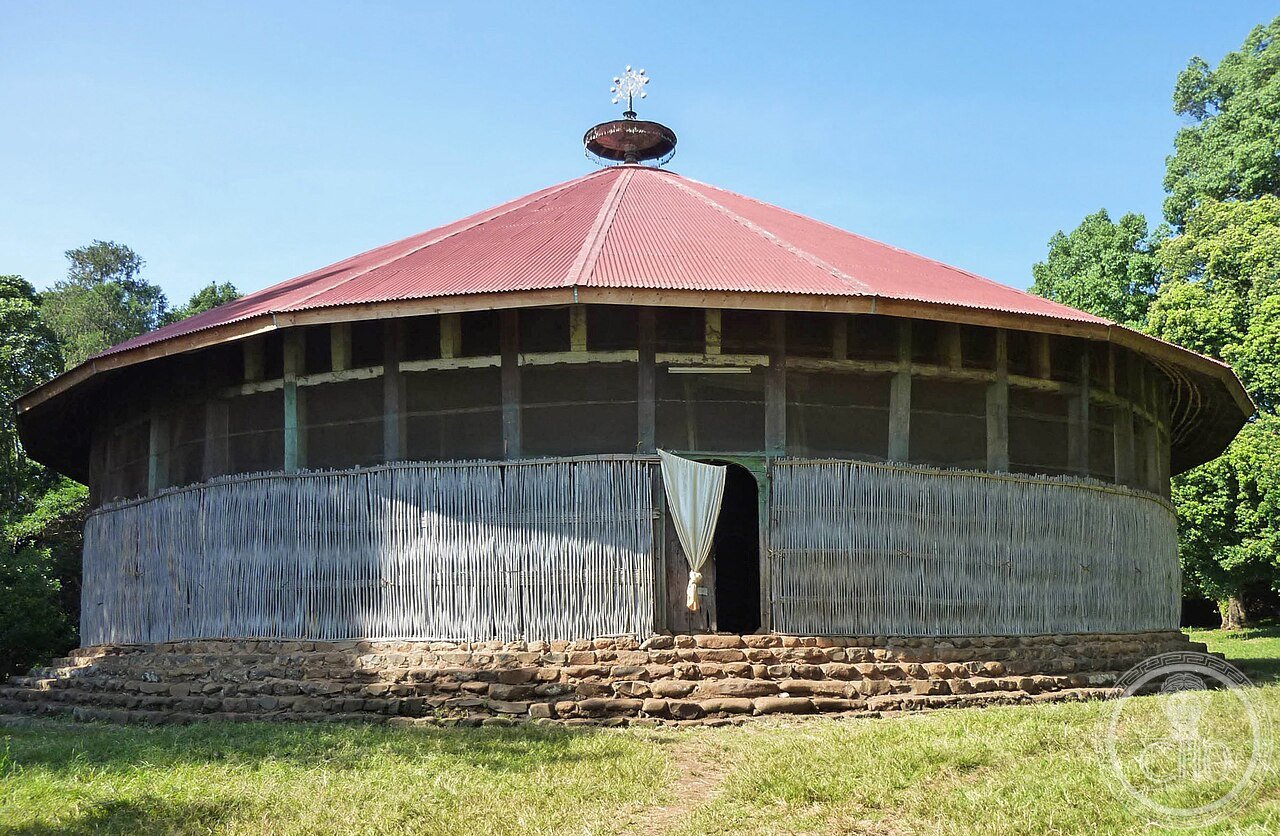
Il convento di Ura Kidane Mehret, sulla penisola di Zege nel Lago Tana, fu fondato nel XIV secolo dal santo Betre Mariyam (“Bastone di Maria” in amarico), anche se l’attuale chiesa circolare risale al XVI secolo. L’interno del monastero è interamente decorato con affreschi colorati e vividi, dipinti tra i 100 e i 250 anni fa, che raffigurano santi etiopi e la storia della Chiesa ortodossa etiope, incluse scene con il Negus Tekle Haymanot di Gojjam e i suoi seguaci. A differenza di alcuni altri monasteri sparsi sulle isole e penisole del Lago Tana, dove alle donne è tradizionalmente vietato l’ingresso, Ura Kidane Mehret consente l’accesso sia agli uomini sia alle donne, rendendolo uno dei siti monastici più visitati e accessibili dell’intera regione. Accanto al monastero si trova anche il piccolo Museo Zege Satekela, dedicato agli oggetti artigianali e agli strumenti musicali ancora oggi utilizzati dalle comunità locali.
About Ura Kidane Mehret Monastery
Ura Kidane Mehret is a round church of the Ethiopian Orthodox Church, standing on the Zege Peninsula that extends into Lake Tana, Ethiopia’s largest lake and the source of the Blue Nile. The monastery was founded in the 14th century by the saint Betre Mariyam, whose name translates from Amharic as “Rod of Mary,” although the circular church structure standing today dates to a later rebuilding in the 16th century. The monastery’s interior is renowned for its exceptionally vivid and richly coloured mural paintings, executed between roughly 100 and 250 years ago, covering the walls with depictions of Ethiopian saints and scenes drawn from the broader history of the Ethiopian Orthodox Church, including images of Negus Tekle Haymanot of Gojjam and his followers. Ura Kidane Mehret holds a distinctive position among the numerous monasteries scattered across Lake Tana’s islands and peninsulas in that it permits entry to both men and women; several other monasteries in the same lake region maintain traditional restrictions barring women from entering their grounds, making Ura Kidane Mehret one of the more accessible and consequently more frequently visited sites in the wider Lake Tana monastic network. Adjacent to the monastery stands the small Zege Satekela Museum, where visitors can view hand-crafted objects and traditional musical instruments still actively used by the surrounding local communities today, offering a living complement to the monastery’s historic religious art.
Key facts
- 14th century: monastery founded by Saint Betre Mariyam
- 16th century: present circular church built
- Frescoes: painted approximately 100-250 years ago, depicting Ethiopian saints and church history
- Access: open to both men and women, unlike several other Lake Tana monasteries
- Zege Satekela Museum: adjacent museum of local crafts and musical instruments
- Location: Zege Peninsula, Lake Tana, source of the Blue Nile
History
As one of the oldest and most artistically significant monasteries within the dense network of religious communities scattered across Lake Tana’s islands and peninsulas, Ura Kidane Mehret preserves a continuous tradition of Ethiopian Orthodox monastic life and mural painting stretching back some seven centuries. The monastery’s location on the Zege Peninsula places it within a broader landscape of Lake Tana monasticism that has historically served as one of the principal centres of Ethiopian Orthodox religious and artistic life, closely tied to the lake’s role as the source of the Blue Nile.
Ura Kidane Mehret’s distinctive openness to female visitors, in contrast to the gender restrictions maintained by several neighbouring Lake Tana monasteries, reflects the varied and locally determined nature of access rules across Ethiopian Orthodox monastic institutions, rather than a single uniform practice across the tradition as a whole.
What you see
The monastery’s circular church, rebuilt in the 16th century, follows the distinctive round plan characteristic of many Ethiopian Orthodox churches, its thatched conical roof rising above a colonnaded outer ambulatory. Inside, walls covered floor to ceiling with vividly coloured murals depicting Ethiopian saints and church history form the monastery’s principal artistic treasure, complemented by the adjacent Zege Satekela Museum’s collection of local crafts and instruments.
Practical information
- Opening hours: generally open daily with seasonal variation; admission fee applies; check current hours before visiting
- Address: Zege Peninsula, West Gojjam Zone, Amhara Region, Ethiopia
Getting there
Ura Kidane Mehret Monastery stands on the Zege Peninsula on Lake Tana, reachable by boat from the city of Bahir Dar. GPS: 11.6950° N, 37.3412° E.
Nearby
- Zege Peninsula — the forested peninsula surrounding the monastery, home to further smaller churches
- Bahir Dar — the regional city on Lake Tana’s southern shore, reachable by boat
- Blue Nile Falls — waterfall on the Blue Nile downstream from Lake Tana, a drive from Bahir Dar
Sources
- Wikipedia — “Ura Kidane Mehret” (en.wikipedia.org)
- Lake Tana Biosphere Reserve — “Monasteries” (laketana-biosphere.com)
- Daily Trust — “A walk in Ura Kidane Mehret, Lake Tana’s Monastery” (dailytrust.com)
Find it on the map
See this place and what’s around it →📷 Become a Cultural Heritage Online photographer
Share your photos of places: they stay published under your name as the author. The more they're seen, the more you get noticed — and soon a contest will reward the most appreciated photos.
Log in or sign up free to add a photo