
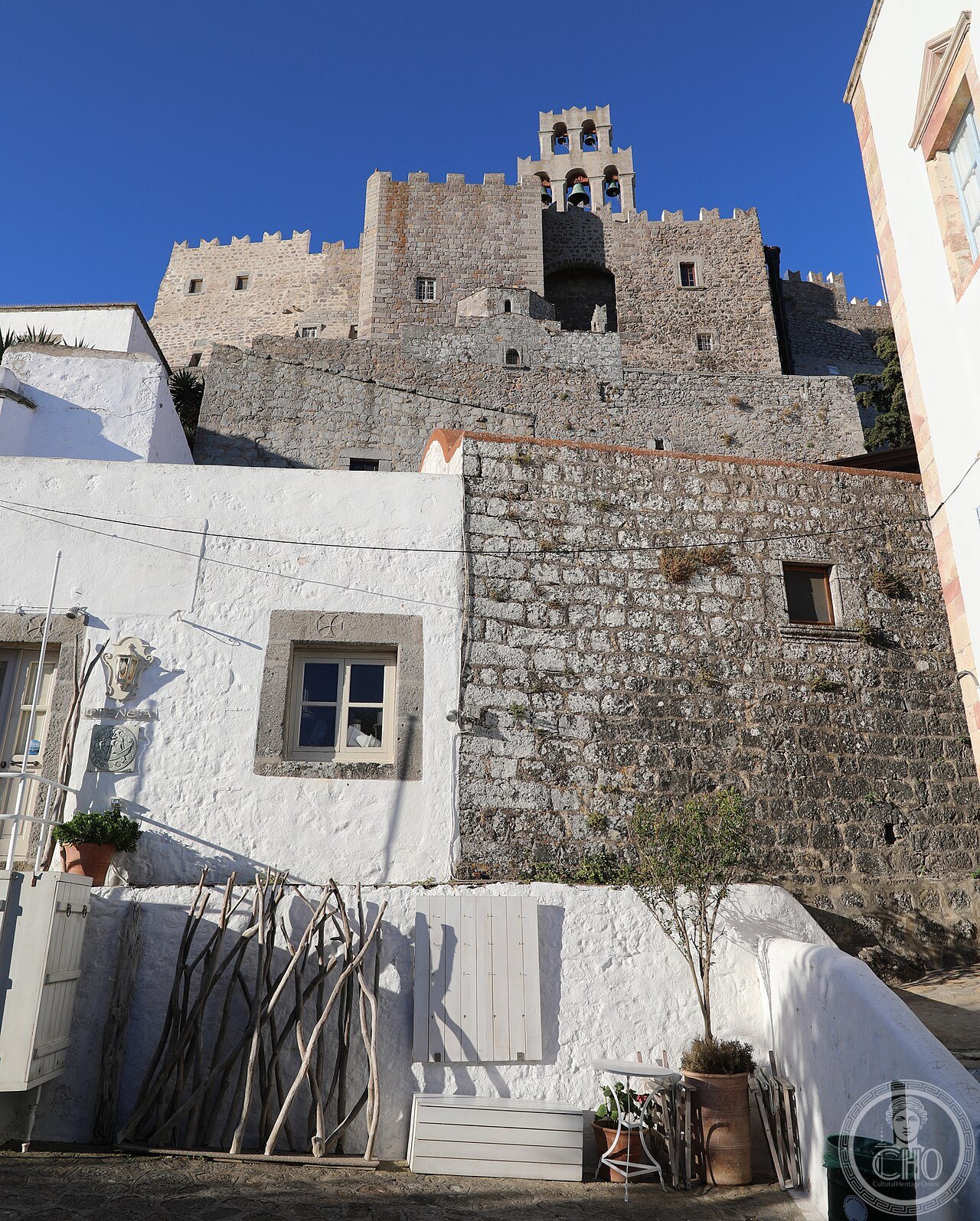
La piccola isola di Patmos, nel Dodecaneso, è ritenuta il luogo dove l’apostolo Giovanni scrisse, intorno al 95 d.C., sia il suo Vangelo sia l’Apocalisse. Nel 1088, il monaco Cristodulo Latrino vi fondò un monastero dedicato al “discepolo amato”, parte della strategia dell’imperatore bizantino Alessio I Comneno di colonizzare le isole dell’Egeo e crearvi basi strategiche. Il monastero sorge sopra la Grotta dell’Apocalisse, dove secondo la tradizione Giovanni ricevette le sue visioni: nella grotta, oggi trasformata in luogo di culto, sono ancora visibili l’incavo nella roccia dove l’evangelista avrebbe appoggiato il capo per dormire e la fessura dalla quale, si narra, usciva la voce di Dio. Nel 1092, incursioni dell’emiro di Smirne costrinsero i monaci ad abbandonare temporaneamente Patmos per l’Eubea, prima di farvi ritorno nel 1095 e riprendere la costruzione.
About the Monastery of St John the Theologian
The small island of Patmos in the Dodecanese is traditionally held to be the place where Saint John the Theologian composed both his Gospel and the Book of Revelation (the Apocalypse), around 95 CE, during a period of exile on the island. A monastery dedicated to this “beloved disciple” was founded there in 1088 by the monk Hosios Christodoulos Latrinos, and it has remained a centre of pilgrimage and Greek Orthodox learning continuously ever since. The monastery’s foundation formed part of a deliberate policy by Byzantine Emperor Alexios I Komnenos to colonise the Aegean islands and establish fortified religious and strategic outposts across the region. The Monastery of Hagios Ioannis Theologos, together with the nearby Cave of the Apocalypse, commemorates the specific site where John is said to have received the visionary revelations recorded in his Apocalypse. The Cave itself, located roughly halfway along the road connecting the island’s port to Chora, the main town perched atop Patmos’s central mountain, has been transformed into an active place of worship; visitors today can still see a natural indentation in the cave wall traditionally identified as the place where the Evangelist rested his head, alongside a cleft in the rock from which, according to tradition, the Voice of God was heard speaking to him. The monastery’s own early history was far from untroubled: raids by the emir of Smyrna forced the resident monks to abandon Patmos entirely in 1092, relocating temporarily to the island of Euboea, before they were able to return to Patmos in 1095 and resume construction of the monastery complex. Heavily fortified against the ongoing threat of piracy and Seljuk Turkish raids, the monastery’s grey defensive walls dominate the mountaintop of Chora to this day, and the site — encompassing both the monastery and the Cave of the Apocalypse — was collectively inscribed as a UNESCO World Heritage Site.
Key facts
- c. 95 CE: traditional date of John’s composition of Revelation on Patmos
- 1088: monastery founded by Christodoulos of Patmos
- Part of Alexios I Komnenos’s policy to colonise and fortify the Aegean islands
- 1092: monks forced to abandon Patmos after raids by the emir of Smyrna
- 1095: monks return and resume construction
- Cave of the Apocalypse: preserves the traditional site of John’s visions, with a rock indentation and a cleft associated with the “Voice of God”
- UNESCO World Heritage Site, jointly with Chora and the Cave of the Apocalypse
History
As the traditional site of the composition of the Book of Revelation, one of the most consequential and widely interpreted texts in the entire Christian canon, Patmos occupies a place of singular significance within Christian sacred geography, its monastery serving for nearly a millennium as both a physical guardian of this tradition and a major centre of Byzantine and later Greek Orthodox religious learning and manuscript preservation. The monastery’s foundation as part of Emperor Alexios I Komnenos’s broader strategic colonisation of the Aegean islands situates its establishment within the wider context of Byzantine imperial policy toward the eastern Mediterranean during a period of significant external pressure from Seljuk Turkish expansion.
The monastery’s early forced abandonment in 1092, followed by its return and continued construction from 1095, together with its subsequent heavy fortification against piracy and further raids, reflects the genuinely precarious security conditions facing Byzantine religious institutions in the Aegean throughout the late 11th and 12th centuries, conditions that directly shaped the monastery’s enduring fortress-like architectural character.
What you see
The monastery’s grey fortified walls, built to withstand piracy and raids, crown the summit of Chora, dominating the surrounding landscape of Patmos and visible from much of the island. Within, courtyards, chapels, and a significant treasury and library preserve centuries of Byzantine and post-Byzantine religious art and manuscripts, while the separate Cave of the Apocalypse, partway down the mountain toward the port, remains an active shrine centred on the rock features traditionally associated with John’s visions.
Practical information
- Opening hours: generally open daily with seasonal variation; modest dress required; check current hours before visiting
- Address: Plateia Alexios Komninos, Chora, 855 00 Patmos, Greece
Getting there
The Monastery of St John the Theologian stands atop the hill of Chora, the main town of the Greek island of Patmos in the Dodecanese, reachable by ferry from Piraeus or nearby islands, followed by a short uphill walk or drive. GPS: 37.3089° N, 26.5478° E.
Nearby
- Cave of the Apocalypse — the traditional site of John’s visions, partway down the mountain
- Chora — the island’s historic hilltop main town, surrounding the monastery
- Skala — the island’s port town, at the foot of the mountain
Sources
- UNESCO World Heritage Centre — “The Historic Centre (Chorá) with the Monastery of Saint-John the Theologian and the Cave of the Apocalypse” (whc.unesco.org)
- Wikipedia — “Monastery of Saint John the Theologian” (en.wikipedia.org)
- Greek News Agenda — “The Monastery of Saint John the Theologian and the Cave of the Apocalypse on Patmos” (greeknewsagenda.gr)
Find it on the map
See this place and what’s around it →
📷 Become a Cultural Heritage Online photographer
Share your photos of places: they stay published under your name as the author. The more they're seen, the more you get noticed — and soon a contest will reward the most appreciated photos.
Log in or sign up free to add a photo