
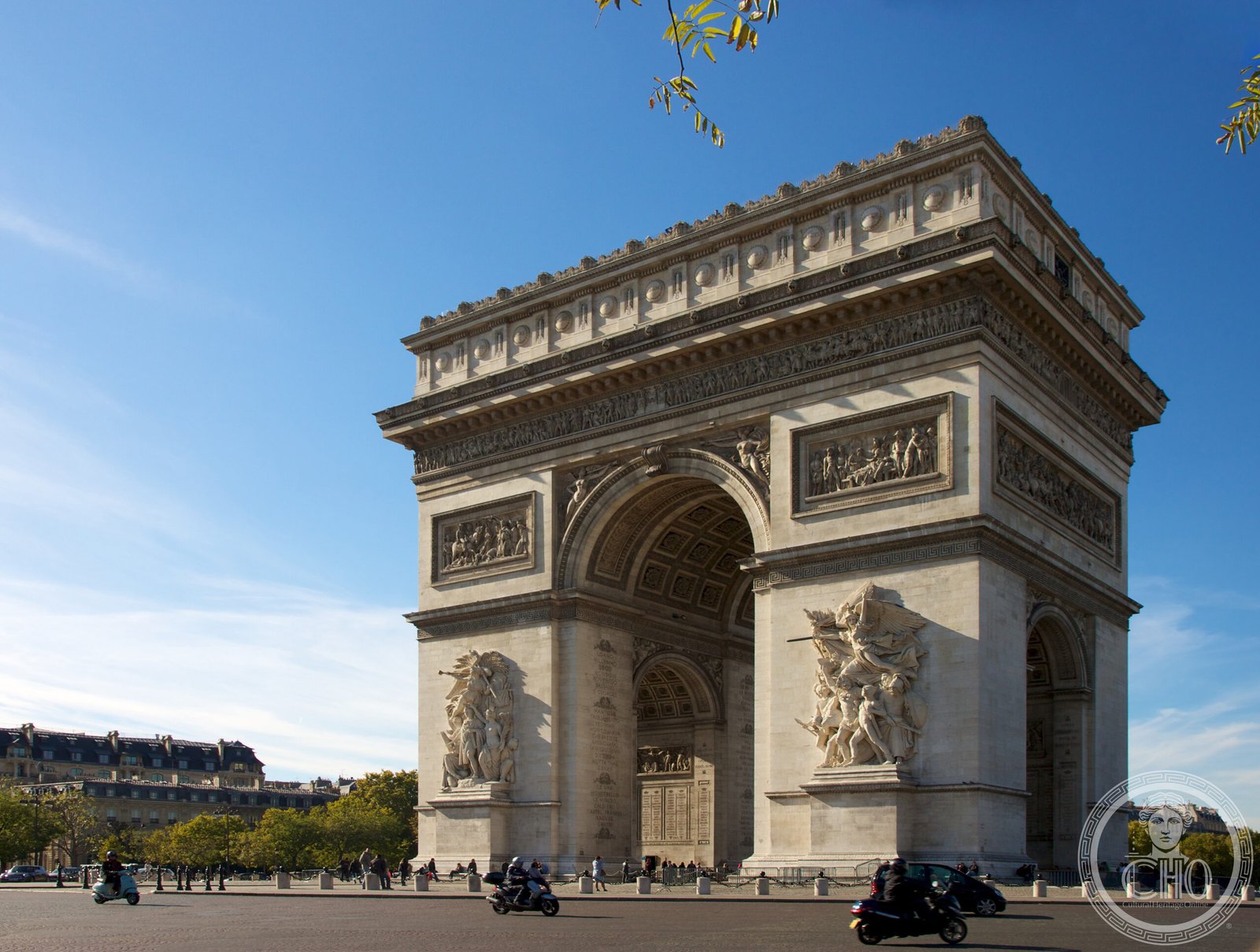
The Arc de Triomphe de l’Étoile is one of the most celebrated monuments in France, standing at the western end of the Champs-Élysées at the centre of Place Charles de Gaulle — formerly Place de l’Étoile — from which twelve grand avenues radiate outward like the points of a star. Commissioned by Napoleon Bonaparte in 1806 to honour the French armies, it was designed by Jean Chalgrin in the Roman triumphal arch tradition and completed in 1836 under King Louis-Philippe. Beneath its vault lies the Tomb of the Unknown Soldier of World War I, with an eternal flame rekindled each evening since 1923.
At a glance
- Type
- Triumphal arch and national monument
- Period
- Commissioned 1806; construction 1806–1836
- Style
- Neoclassical (Roman triumphal arch tradition)
- Architect
- Jean Chalgrin (original design); continued by Jean-Nicolas Huyot after Chalgrin’s death in 1811
- Location
- Place Charles de Gaulle, 75008 Paris, France
- Coordinates
- 48.8737° N, 2.2928° E
Overview
Rising 50 metres high and 45 metres wide, the Arc de Triomphe is the largest triumphal arch in the world by height. It stands at the meeting point of the 16th, 17th, and 8th arrondissements of Paris, at the hub of the twelve avenues of the Place Charles de Gaulle. The arch honours those who fought and died for France in the French Revolutionary and Napoleonic Wars: the names of 128 battles and 660 French generals are engraved on its inner and outer surfaces. The Tomb of the Unknown Soldier has been located beneath the arch since November 1920, and the eternal flame is rekindled each evening by French veterans’ associations.
History
Napoleon ordered the construction of the arch on 18 February 1806, after his victory at the Battle of Austerlitz, instructing architect Jean Chalgrin to design a monument “worthy of the grandeur of the French people.” Work was interrupted repeatedly by political upheaval and funding shortfalls, and Chalgrin died in 1811 before seeing significant progress. Construction resumed under the Restoration and was completed by Louis-Philippe in 1836 — thirty years after the original commission and fifteen years after Napoleon’s own death. The arch’s most iconic sculptural group, François Rude’s La Marseillaise (The Departure of the Volunteers of 1792), was added to the northeast pillar in 1833–36 and is regarded as one of the masterworks of French Romantic sculpture.
What you see
Each of the four piers of the arch carries a large sculptural group: François Rude’s La Marseillaise on the northeast pier, Jean-Pierre Cortot’s Triumph of Napoleon on the southeast, Antoine Étex’s Resistance and Peace on the west piers. The attic storey carries 30 shields engraved with the names of major Napoleonic victories, while the inner faces of the arch list the names of battles. The flat roof terrace, accessible by a 284-step spiral staircase, offers one of Paris’s finest panoramic views: the Champs-Élysées to the east, La Défense to the west, and the entire radial street plan of Haussmann’s Paris spread around the arch. Beneath the vault, the Tomb of the Unknown Soldier is marked by a stone slab and the bronze eternal flame bowl.
Cultural significance
The Arc de Triomphe is the focal point of France’s most solemn state ceremonies: it is here that the President of the Republic lays a wreath on Armistice Day (11 November), and that the Liberation of Paris parade of 1944 passed beneath. The monument is inscribed on France’s national inventory of historic monuments and is one of the country’s most visited landmarks, receiving nearly two million visitors per year. Its image — framed by the perspective of the Champs-Élysées — is among the most recognised architectural views in the world.
Practical information
- Address
- Place Charles de Gaulle, 75008 Paris (access via underground passage from the Champs-Élysées side)
- Opening hours
- Daily 10:00–23:00 (April–September); 10:00–22:30 (October–March). Roof access may have separate hours. Check official website for current information.
- Admission
- Paid entry to the roof terrace and museum; free for visitors under 26 from EU countries. Check official website for current rates.
- Website
- paris-arc-de-triomphe.fr
Getting there
The arch is directly above Charles de Gaulle–Étoile metro station (lines 1, 2, and 6), making it one of the most accessible major monuments in Paris. RER Line A also stops at Charles de Gaulle–Étoile. Do not attempt to cross the Place Charles de Gaulle roundabout on foot — the only safe access is via the underground pedestrian tunnel on the north side of the Champs-Élysées. Bus lines 22, 30, 31, 52, 73, 92, and others serve the Étoile area.
Sources & resources
See the place
Find it on the map
See this place and what’s around it →📷 Become a Cultural Heritage Online photographer
Share your photos of places: they stay published under your name as the author. The more they're seen, the more you get noticed — and soon a contest will reward the most appreciated photos.
Log in or sign up free to add a photoIs this page about you?
This page is read by travellers and heritage enthusiasts who find it on Google. Tell us how you are connected to this place and we will take it from there.